A rope rescue technician may remember how to assemble a familiar system but struggle to predict how it will behave when the load, geometry, or operating conditions change. This is an important consequence of skill fade because procedural knowledge and technical reasoning do not necessarily deteriorate at the same rate. Understanding rope rescue system behavior requires more than recognizing equipment configurations; it requires knowing how forces move through a system and how those relationships change during an operation.
In Why Rope Skill Fades Between Certifications, we examined the deterioration of technical capabilities between periods of formal instruction. One consequence deserves particular attention: a technician may retain procedural familiarity while becoming less practiced at evaluating the mechanical relationships that determine whether a system remains appropriate for its intended purpose. Comparing a two-rope offset with a highline provides a practical way to examine this problem.
One Rescue Problem, Two Different Systems
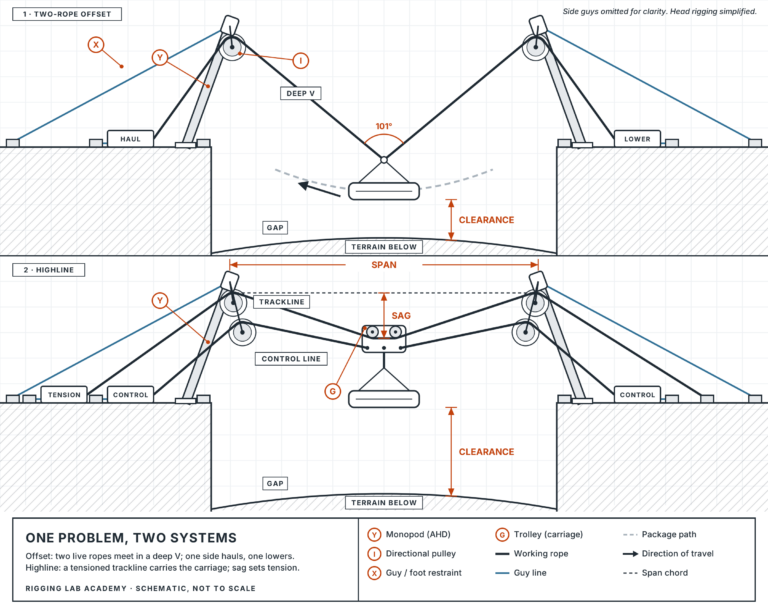
Consider a rescue package that must cross an obstacle between two elevated positions. The available clearance beneath the crossing is limited, requiring the crew to evaluate how the load will travel and what forces the supporting system must accommodate. A two-rope offset and a highline may both provide a solution, but their mechanical arrangements differ considerably.
In The Two-Rope Offset, two independently controlled rope systems support the rescue package from opposite sides of the span. Coordinated hauling and lowering move the load along a path determined by the changing relationship between the supporting ropes. A deeper V-shaped arrangement generally reduces rope tension but requires greater clearance beneath the load, while a flatter arrangement increases tension as the supporting angles become more horizontal.
A highline uses a tensioned trackline supporting a traveling carriage, creating different requirements for anchor loading, sag, clearance, and movement control. As explained in Tensioning a Highline, reducing sag requires increasing trackline tension, making the available clearance and the resulting forces inseparable considerations. Selecting either system requires understanding how its geometry will behave throughout the operation rather than relying solely on familiarity with its construction.
Predicting the Consequences of Changing Geometry
Consider a two-rope offset supporting a rescue package near the center of a span. The package hangs beneath the two elevated directionals, forming a relatively deep V. The crew determines that additional clearance is necessary and considers raising the package while maintaining its position across the span.
As the package rises, the supporting ropes become flatter and their included angle increases. Although the weight of the rescue package remains unchanged, greater tension is required in each supporting rope to maintain the load in its elevated position. The change also affects the forces transmitted through the directionals and into their supporting anchors.
The technician should be able to anticipate this increase before the system is adjusted. If the crew continues raising the package, the tension can increase substantially as the supporting geometry approaches a nearly horizontal arrangement. What initially appeared to be a clearance adjustment has introduced a different mechanical demand on the entire system.
This creates an important distinction in system selection. A two-rope offset relies on sufficient vertical clearance to maintain favorable supporting geometry, while a properly engineered highline addresses the crossing through a different arrangement designed around its anticipated trackline forces. Attempting to eliminate the offset’s characteristic sag through excessive tension does not transform it into a properly designed highline.
The technician’s responsibility is to recognize when the geometry of a proposed solution is becoming unsuitable rather than continuing to make adjustments based only on the desired position of the load.
Testing the Prediction Against Actual Behavior
The relationship between geometry and tension can be examined through a supervised educational exercise using a properly engineered system, a controlled test load, and suitable force-measurement equipment. The exercise begins with the package suspended in a relatively deep V, with the supporting-rope geometry and measured tensions recorded at known locations.
Before changing the load position, the technician predicts what should happen when the package is raised and the supporting ropes become flatter. For a symmetrical arrangement under otherwise equivalent static conditions, the expected result is an increase in tension in both supporting ropes. The direction and relative magnitude of the change can then be compared with measurements taken under the new geometry.
If the readings show the anticipated increase, the observations support the technician’s understanding of the relationship between angle and tension. If the results differ from the prediction, the discrepancy requires further examination. Unequal supporting angles, friction through directionals, movement during measurement, or differences in measurement location may explain why the observed values do not match the simplified expectation.
This distinction is developed further in Rope Rescue Rigging Physics From Force to Measurement, where the relationship between geometry, equipment, friction, local rope tension, and resultant forces is examined. A load cell measures force at its installed location, so understanding the complete system requires interpreting that measurement within the actual load path.
The exercise demonstrates a specific technical principle and provides a means of evaluating whether the technician understands it. Recognizing that flatter rope angles produce greater tension is useful knowledge, but predicting the consequence, interpreting the measurement, and explaining unexpected results establish a deeper level of technical understanding.
When Familiarity Exceeds Technical Understanding
Repeated experience with familiar configurations improves procedural efficiency and equipment recognition. However, successful repetition does not independently establish that a technician can evaluate the consequences of changing system geometry. The difference becomes important when a familiar arrangement must accommodate different anchor positions, altered spans, additional loads, or restricted clearance.
This concern is explored in The Illusion of Competence, where confidence developed through familiarity is distinguished from demonstrated technical capability. A technician may recognize every component of a system and remember the correct operating sequence while remaining uncertain about how the forces will change once the load begins moving.
The ability to apply existing knowledge under changing conditions is examined in this RLA article on technical skill transfer. The article considers why successful performance under familiar conditions does not automatically establish the ability to apply the same principles in a different operating environment. For rope rescue technicians, that distinction matters because terrain, anchor locations, equipment arrangements, and operational demands rarely remain identical between exercises or actual rescues.
Technical understanding must therefore extend beyond reproducing a previously successful arrangement. It requires examining the conditions that made the original system appropriate and determining whether those conditions continue to exist.
Continued Technical Education and Sustained Understanding
The value of continued technical education lies partly in preserving the connection between technical principles and their practical application. Equipment familiarity, procedural memory, and system construction remain essential capabilities, but they must be supported by an understanding of force, geometry, movement, and measurement.
System comparisons and controlled practical exercises provide opportunities to reinforce those relationships. When technicians predict how a system will behave, compare their expectations with observable results, and explain discrepancies, they revisit the reasoning required to make informed technical judgments. Repeated application under varied conditions also helps reveal gaps in understanding that may not appear during familiar procedural exercises.
This brings the discussion back to skill fade. Technical capability is not maintained simply because a technician remembers the equipment or has previously completed a particular configuration. The ability to evaluate changing conditions must also remain active, particularly when small adjustments to geometry can create substantial changes in system forces.
Continued technical education should help technicians maintain the ability to construct systems correctly, predict their behavior, interpret observable results, and recognize when operating conditions require a different approach. Sustaining those capabilities between certifications strengthens the connection between what technicians have learned and what they must understand when applying that knowledge in the field.
Peace on your Days
Lance