When Familiar Training Meets Unfamiliar Conditions
How rope rescue technicians develop the ability to retain, recognize, and apply what they have learned when circumstances change.
The Difference Between Training Success and Operational Application
A well-designed rope rescue course establishes the conditions under which technicians develop and demonstrate specific skills. Equipment is selected, training objectives are identified, and instructors guide personnel through progressively demanding exercises. Through repetition and feedback, unfamiliar procedures become recognizable, movements become more efficient, and technicians develop the confidence necessary to operate within their qualifications.
Yet successful performance during training raises an important question. How effectively will that same knowledge serve the technician when the circumstances surrounding the task are different?
A rescue technician may become highly proficient with an established system during repeated exercises. The equipment, operating sequence, and environment are familiar, allowing the technician to concentrate on executing the task correctly. This represents meaningful learning, but it does not independently establish how effectively the technician will apply that knowledge in a different operating environment.
In our earlier article, Why Rope Skill Fades Between Certifications, we examined how previously acquired capabilities can deteriorate during periods of limited use. There is another consideration that deserves equal attention. Even when knowledge has been retained, applying it successfully under different conditions may require an understanding that extends beyond the circumstances in which it was originally learned.
For technical rescue personnel, this distinction is particularly relevant because the operational environment rarely reproduces every feature of a training exercise. Terrain, access, equipment placement, and the intended rescue movement can introduce circumstances that require technicians to recognize which established principles remain applicable.
What Learning Research Tells Us
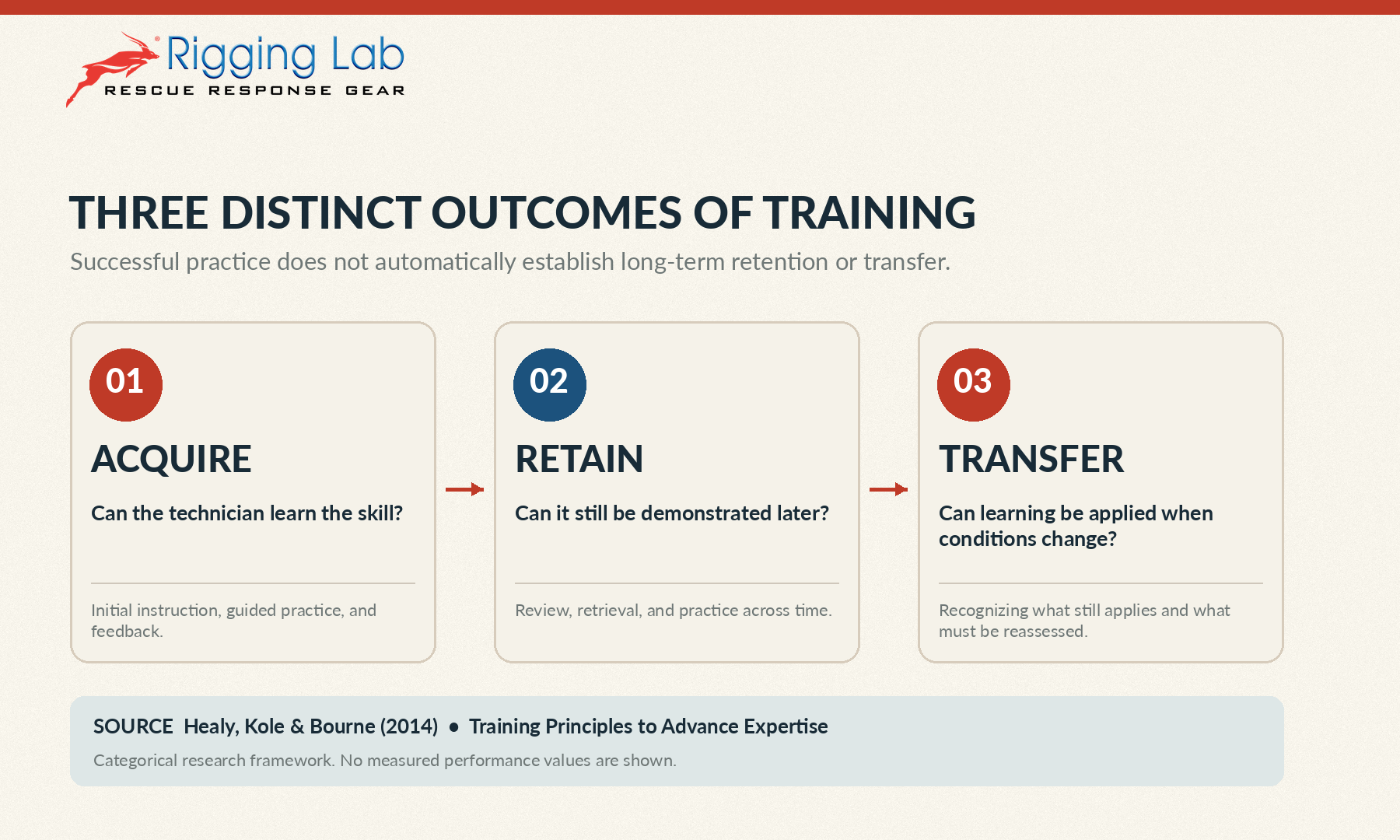
Research into human learning distinguishes three related but separate outcomes of training: acquisition, retention, and transfer.
Acquisition concerns the development of a new capability. Retention concerns the ability to maintain that capability over time. Transfer concerns the ability to apply previously acquired knowledge or skills in circumstances different from those encountered during the original learning process.
In their 2014 research review, Training Principles to Advance Expertise, psychologists Alice Healy, James Kole, and Lyle Bourne examined how instructional conditions influence these outcomes. Their work demonstrates an important distinction between training that produces efficient initial performance and training designed to promote durable, transferable learning.
The researchers identify several practices that can support longer-term learning, including retrieval, refresher training, and variability in practice conditions. They also explain that training methods beneficial for one outcome may not produce equal benefits for another.
For rope rescue instruction, the implications are significant without requiring us to assume that every laboratory finding transfers directly to field performance.
Repeated practice with a familiar arrangement helps technicians develop necessary procedural skills. However, appropriately varied exercises can encourage learners to recognize the underlying principles rather than become dependent upon the specific circumstances of one familiar task.
The distinction is not between repetition and variation as competing methods. Effective instruction uses each for a purpose. Repetition establishes dependable performance, while carefully managed variation provides opportunities to examine how learned principles apply when relevant conditions change.
The desired result is not simply a technician who remembers the equipment and procedures, but one who understands the requirements governing their appropriate application.
When the Training Environment Changes
Consider an illustrative training progression involving an approved rope rescue system used for movement over an edge.
During the initial exercise, the anchor locations are established, the terrain is familiar, and the rope paths have been selected to support the intended operation. Technicians practice the assigned procedures until they can operate the arrangement proficiently under instructor supervision.
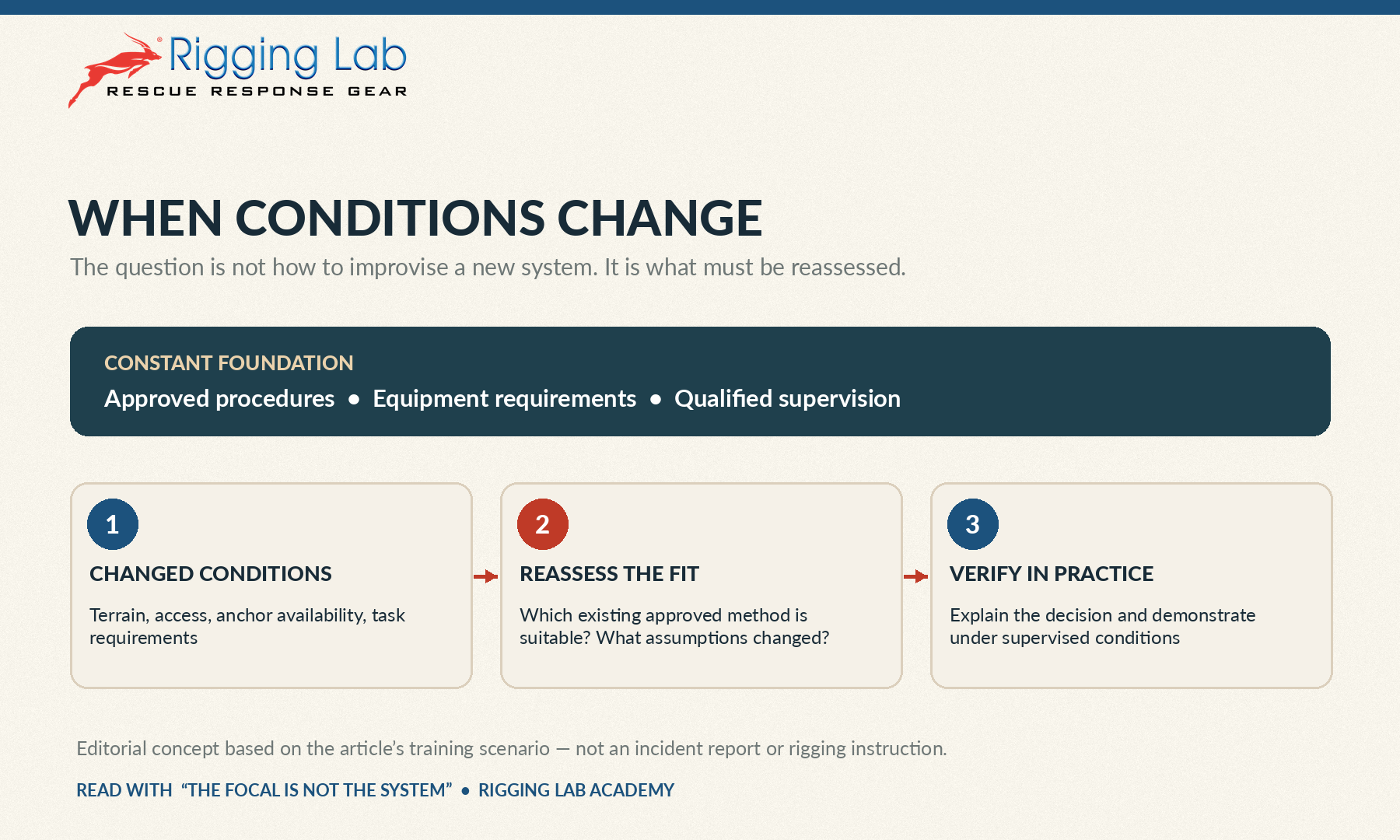
For a subsequent exercise, the instructor introduces a different environment while maintaining the organization’s established equipment requirements, approved procedures, and operational limits.
The available anchor locations may differ, the approach to the edge may be less convenient, or the terrain may require a different assessment of the intended rope path. The technicians are not being asked to invent new procedures. They are being challenged to determine which of their existing methods remain appropriate and what additional evaluation the changed conditions require.
This is where learning transfer becomes visible.
A technician who understands only the familiar training arrangement may find it difficult to explain why a particular option remains suitable. Another technician may recognize the controlling principles and identify which details must be reassessed before proceeding.
The exercise provides an opportunity to examine understanding without placing personnel outside their qualifications or approved operational practices.
RLA’s article The Focal Is Not the System demonstrates an important aspect of this reasoning. Correctly identifying equipment at a focal point does not establish that the entire rescue system has been evaluated. Anchor suitability, load paths, system architecture, operating responsibilities, and intended movement must also be understood.
These questions remain relevant when the environment changes, even though the answers may differ.
The educational value lies in recognizing the difference between a principle that remains applicable and a condition that requires renewed assessment. This is a capability that develops through technical understanding, deliberate questioning, and supervised experience.
Building Knowledge That Remains Useful
The practical challenge for instructors and training officers is to develop transferable understanding without sacrificing the consistency required for dependable operations.
A department’s established procedures remain the operational foundation. Continued learning should reinforce those procedures while providing opportunities to examine their purpose, limitations, and application under the conditions personnel may reasonably encounter.
This can be accomplished through a combination of technical review, appropriately varied practical exercises, and evaluation of individual performance. Technicians might revisit an established system during academic instruction, explain the relationships governing its operation, and subsequently demonstrate its approved application during a supervised field exercise.
When gaps are identified, the training program can address them through targeted instruction and additional practice.
Our article Building Rope Rescue Team Competency examines this relationship between qualified instruction, standardized procedures, realistic training, and performance evaluation. The underlying objective is to develop personnel who can reliably perform their assigned responsibilities within the environments their organization is expected to manage.
Continuing technical education contributes to this process by maintaining access to the knowledge supporting practical skills. Concepts involving system behavior, equipment limitations, load paths, and operational requirements can be revisited and examined between formal training events.
Rigging Lab Academy’s CORE membership supports this academic foundation through structured Classic Courses, technical Playlists, and an extensive library of rescue and rigging resources. These materials provide individuals and teams with opportunities to reinforce their understanding while preparing for practical training under their organization’s approved procedures and qualified instructors.
The benefit is not simply retaining a collection of technical facts. It is maintaining an understanding of how those facts relate to the systems technicians are expected to evaluate and operate.
No training program can reproduce every circumstance a rescuer may encounter. Nevertheless, instruction that combines dependable procedures with an understanding of the principles behind them can better prepare technicians to recognize when familiar knowledge applies and when changing conditions require additional assessment.
The lasting value of rope rescue education is found not only in what a technician can demonstrate at the conclusion of a course, but in how that knowledge is retained, examined, and appropriately applied throughout a career.
Research foundation
Healy, A. F., Kole, J. A., & Bourne, L. E. Jr. (2014). Training Principles to Advance Expertise. Frontiers in Psychology, 5, Article 131.
Continue Developing Your Technical Foundation
Explore RLA CORE’s Classic Courses, technical Playlists, and continuing education resources through Technician and Crew Memberships.
Peace on your Days
Lance