The line every rope program refuses to say out loud
Most rope rescue programs assume the technician who passed the course last year is still current today. Usually they aren’t.
That is not a criticism of the technician, the instructor, or the program. It is a statement about how human skill actually behaves between the day a course ends and the day the team is expected to perform. A certification proves competence at a moment in time. What happens in the months after that moment is a separate problem — and it is a problem every high-stakes field has already studied.
If you understand what those fields have learned, the shape of the fix becomes obvious. That fix is the reason Rigging Lab Academy exists.
What “skill fade” actually is
Skill fade, sometimes called skill decay, is the measurable loss of a trained capability during a period of non-use. It is not a gentle drift. It is a fast, front-loaded collapse that flattens out at a much lower maintenance level than the level the course ended on.
The most cited quantification is a meta-analysis of 189 data points across 53 studies, which found that after roughly a year of non-use the average person was performing about 1.4 standard deviations below their post-training level — a drop large enough to place them below almost everyone who was in the room with them on graduation day (Arthur et al., 1998). Two facts inside that finding matter more than the number itself:
-
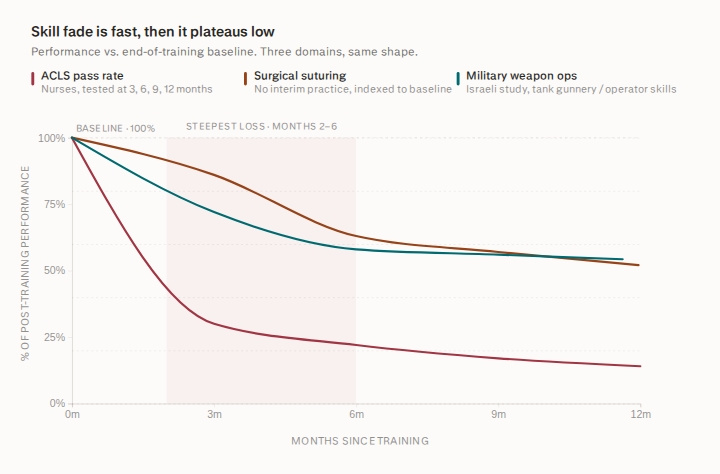
The curve is front-loaded. Most of the loss happens in the first few months, then flattens. The dangerous interval is not month 12. It is months 2 through 6, where the CPR, surgical, and military studies below all show the steepest fall.
-
What fades is not what tests measure. Fine motor control, integrated decision-making, and time-pressured execution fade fastest. Declarative knowledge — vocabulary, diagrams, definitions — outlasts hands. A team can pass an interview and fail a build.
Both facts describe rope work exactly.
The same curve, four different industries
The evidence for skill fade is not a rope-rescue guess. It is a well-replicated finding across every field where people are certified once and then expected to perform later.
Resuscitation and life support
CPR is the most studied skill on the decay curve, and the numbers are brutal. A systematic review found strong skill acquisition immediately after training — 74% to 90% correct performance across components — followed by a marked decline in chest compression quality within 6 to 8 months, concentrated in the hands-on elements rather than the knowledge elements (PMC, 2024).
The UK General Medical Council’s skills-fade literature review collects dozens of studies with the same shape. In one, nurses were tested at 3, 6, 9 and 12 months. Their theoretical knowledge stayed intact. Their execution did not: BLS pass rates went from 63% at 3 months to 58% at 12 months, and ACLS pass rates collapsed from 30% at 3 months to 14% at 12 months. Most trained clinicians could not pass the advanced skill inside a year. That is the real shape of decay — not a small annual drift, but the majority of trained performers falling below the pass line.
Surgery
Surgical skill decay shows up in months, not years. In a randomized study on minimally invasive surgical skills, a group told not to practice between tests degraded significantly within three to six months: suturing time rose from 196 seconds at baseline to 309 seconds at six months (+58%), errors tripled, and instrument-tip travel distance more than doubled. A matched group practicing 30 minutes every two weeks held their post-training level and on some measures improved on it (Fransen et al., 2022, Surgical Endoscopy).
Two details in that study translate directly to rope teams. First, warming up right before the test was not enough — only structured, spaced practice between tests preserved the skill. Second, the GMC review’s summary of surgical retention names the specific failure mode: “finer motor skills declined fastest.” That is the exact difference between remembering how a system is supposed to work and being able to build one cleanly on an edge, on the clock, with a real load hanging off it.
Aviation
The FAA’s Cognitive Skill Degradation study compared type-rated B737 and A320 pilots who were current, 6–12 months out, and 12–24 months out of the cockpit. The skills that degraded fastest were the ones used to build an accurate picture of the aircraft’s state under load — collection, integration, estimation. Understanding of automation modes (“what is the system doing right now?”) was among the most susceptible to loss. Pilots away for 12–24 months executed those skills more slowly.
A separate finding for F-16 pilots is even blunter: after more than a few months out, no returning pilot was estimated to exceed 80% proficiency at any point on return; after a long hiatus, proficiency on return was estimated at 30–40% (GMC review). Type-rated professionals, previously current, returning to work at less than half of their trained level.
Replace “aircraft state” with “rigging system state” and this paragraph describes every hesitation you have seen on a scene.
Military and tactical medicine
The military literature captured in the GMC review shows the same front-loaded curve. Across military tasks, one year of non-use dropped average performance by nearly a full standard deviation. An Israeli study of 330 service members on tank gunnery and weapon-operator skills found most of the decline happened between 0 and 6 months, then flattened — the loss is fast, then the team lives at the lower maintenance level until the next event. Skill refreshers improved knowledge but did not, on their own, restore practical ability; the hands need the practice, not just the review.
In tactical medicine, a review of Stop-the-Bleed and TCCC programs names decay as the central operational problem and periodic retraining as the standard mitigation. It also reports that a simple point-of-care flashcard prompt more than doubled correct tourniquet application in untrained lay responders (20% → 44%) — a reminder that structured scaffolding at the moment of use is itself a measurable intervention, not a crutch (Chambers et al., 2019, Military Medicine).
The mechanism — why this happens to competent people
The same handful of mechanisms keep showing up across every field. None of them are unique to rope rescue.
-
Non-use is the primary driver. Time between reps is the single strongest predictor of decay. Every replication since 1998 has confirmed it.
-
The curve is front-loaded, not linear. The team does not lose a little each month. They lose most of what they will lose inside the first few months, and then settle at a much lower maintenance level. This is why “we recert every two years” produces teams that are, on average, operating from the maintenance level — not from the level the course actually ended on.
-
Motor and integrated skills fade fastest. Procedural hands and time-pressured decision-making decay faster than declarative facts. Vocabulary outlasts execution. This is the CPR, surgical, and aviation finding, all pointing the same way.
-
Complexity multiplies decay. Skills that require chaining several sub-skills under load — pick the anchor, evaluate the vector, choose the MA, manage the belay, brief the team — fade faster than any single sub-skill in isolation, because each dependency has its own decay curve, and they compound.
-
Cognitive load under stress finishes the job. Skills that felt automatic at the end of a course become effortful again after months away. That extra effort displaces situational awareness at exactly the moment it is needed most.
-
Knowledge hides the loss. Teams read as “current” on paper and in conversation long after their hands are no longer current. The CPR studies found exactly this: theoretical knowledge intact, execution failing. Certifications and interviews measure the intact half.
-
The overlearning margin erodes first. The proficiency buffer the course built — the margin that made the team fast and sharp — is the first thing to go. What remains is bare-minimum competence. That is not the standard rope work is done to.
Every one of these mechanisms describes rope rescue exactly.
What the same industries do about it
The interventions that work are consistent across fields, and none of them are “another certification.”
-
Spaced practice beats massed practice. Multiple meta-analyses and the interventions in the studies above show distributed, repeated exposure produces better long-term retention than a single intense course, even when total training time is held constant (GMC review).
-
Short refreshers attenuate decay. Brief, structured refreshers between full events consistently reduce measured decay in CPR, AED, surgical and military studies (GMC review).
-
Interim practice of similar skills protects the parent skill. Practitioners who used related skills during the retention interval retained the trained skill better than those who did not.
-
Overlearning past minimum proficiency raises the floor. Training beyond the pass line raises the level performance settles at after decay begins.
-
Scaffolding at the moment of use. Job aids, checklists and point-of-care prompts measurably improve execution — most usefully as recall aids for previously trained responders, not as substitutes for training.
-
Feedback during practice, not just at the test. Booster sessions with feedback outperform booster sessions without it in CPR retention studies.
Add those up and you get the same operational picture in every industry: a full course establishes the skill; a maintained system between courses is what keeps it. The between-courses layer is not a study aid. It is the intervention.
Why rope teams feel this more, not less
Rope work has every risk factor the decay literature flags:
-
Skills are integrated, not isolated — building a system is a chain of dependent sub-skills.
-
Fine motor control matters (the sub-skill that fades fastest in surgical studies).
-
Execution happens under stress with real load and real consequences (the condition under which residual competence collapses fastest).
-
Certification cadences are long (typically annual or biannual), and the studies above show the first six months are where the steepest decline happens.
-
Field practice between courses is often uneven — some crews rig weekly, others go months without touching a system that isn’t for training.
That last one is the quiet driver. The team’s real retention curve is not set by their certification schedule. It is set by how much rigging they actually do, in what pattern, with what feedback, between certifications. Certifications only measure the outcome — and, as the CPR and aviation data show, they measure the intact half of it.
What Rigging Lab Academy actually is, in this light
Rigging Lab Academy is the layer that lives between certifications — the maintained, structured, come-back-to-it environment that every other high-stakes field has already concluded is required to keep trained skill from fading.
Concretely, it is designed around the interventions the evidence actually supports:
-
A single place a team returns to on a spaced cadence, so practice is distributed rather than crammed the week before recert — the pattern surgical, CPR and aviation research all identify as producing better retention than massed practice.
-
Review and retrain material organized by skill area — anchors, mechanical advantage, edge safety, belay, litter, high directionals, TTRS — so a specific fading sub-skill can be refreshed on its own instead of waiting for the next full course.
-
The RLA Accelerator, which walks a described rigging problem in the same structured pattern every time: what’s holding, what’s loading, where the problem actually is. That gives the team a shared reasoning surface at the moment of use — the “scaffolding” role the tactical medicine literature identifies as measurably improving performance for people who were trained but are out of practice.
-
A consistent baseline across the team, so everyone builds and checks systems the same way. The dominant testimonial in the field is not about new gear or new techniques; it is about having a shared, trusted baseline. The GMC review names the same effect: retention is stronger when peers stay in contact and practice the same way.
-
Instructor and team-leader tools to identify where the crew’s understanding has drifted, so the refresher is aimed at the sub-skill that has actually faded — not the whole course again.
None of that replaces certification. It maintains what certification proved.
The honest summary
Certifications prove a team was current on a specific day. The literature is unambiguous about what happens on the other days: most of what fades, fades fast — inside the first few months — and then the team lives at a lower maintenance level until the next event. The hands go first, the decisions go with them, and the vocabulary stays intact just long enough to hide the loss.
This is true in CPR wards, in operating rooms, in cockpits, on the battlefield, and on rope. The mechanism is the same, and the fix is the same: spaced practice, targeted refreshers, interim use of related skills, feedback, and a shared baseline the team returns to.
That is what Rigging Lab Academy is for. It is what keeps the technician who passed the course last year still actually current today.
Peace on your Days
Lance
Sources
-
Arthur, W., Bennett, W., Stanush, P. L., & McNelly, T. L. (1998). Factors that influence skill decay and retention: A quantitative review and analysis. Human Performance. Full text (PDF).
-
General Medical Council. Skills fade literature review, full report. PDF.
-
Fransen, S. et al. (2022). The effect of continuous at-home training of minimally invasive surgical skills on skill retention. Surgical Endoscopy. Article.
-
Federal Aviation Administration. Cognitive Skill Degradation: Phase III. Report.
-
Chambers, J. A. et al. (2019). “Stop the Bleed”: A U.S. Military Installation’s Model. Military Medicine. Article.
-
Systematic review of skill retention after school-based CPR training. PMC, 2024.
-
Rigging Lab Academy — Home and Training System.