Anchors and Anchor Systems in Rope Rescue
Every rope rescue system begins with one decision: what will hold the load? Before the haul systems, before the litter movement, before the edge transition, there is the anchor. It is the structural foundation that determines whether the entire operation functions smoothly or fails under pressure. In technical rescue, anchor systems are not simply attachment points. They are engineered control systems responsible for force distribution, redundancy, directional management, and operational efficiency.
This is where strong rescue teams separate themselves from reactive ones. Experienced rescuers do not just “find something solid.” They evaluate load paths, force direction, focal point positioning, vector angles, edge hazards, redundancy, and operational movement before the system is ever loaded. A tree, vehicle, boulder, structural beam, artificial high directional, or bolt may all become part of the solution—but only when properly understood inside the larger system architecture. The goal is not simply to build an anchor. The goal is to build an anchor system that remains stable, predictable, and controllable throughout the entire rescue evolution.
Why Anchors Matter More Than Most Rescuers Realize
Anchors are often treated like a starting point, but in reality they are the governing force behind the entire rigging operation. Every vector, every rope angle, every tension shift, and every directional load eventually resolves back into the anchor system. Poor anchors create inefficiency long before they create failure. Rope drag increases. Focal points shift. Edge transitions become unstable. Load distribution changes unexpectedly. Communication breaks down because systems are scattered or poorly aligned.
The practical reality is that most rescue environments are imperfect. The ideal anchor rarely exists exactly where rescuers need it. That is why anchor construction becomes less about memorizing knots and more about understanding system behavior.
Understanding the Foundation of Anchor Systems
Anchor systems generally fall into several major categories:
- Single Point Anchors
- Multipoint Anchors
- Load Sharing Anchors (LSA)
- Load Distributing Anchors (LDA)
- Slack Anchors
- Tensioned Anchors
- V Anchors
- Artificial Anchors and Bolt Systems
Each serves a different operational purpose.
Single Point Anchors
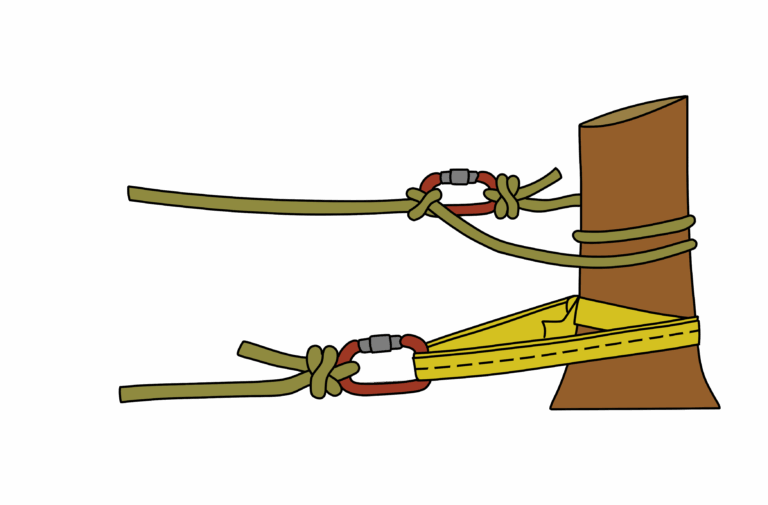
Single point anchors are often the fastest systems to deploy when a truly bombproof anchor exists. Large trees, structural steel, massive boulders, or engineered anchor points can support direct or indirect attachments using:
- Tensionless hitches
- Basket hitches
- Girth hitches
- Wrap 3 Pull 2 systems
- Anchor straps
- Figure Eight tie-offs
- Bowlines with Yosemite finishes
Single point systems excel during rapid deployment operations, pick-offs, rope access tasks, or environments where strong structural anchors already exist. However, they also introduce a major operational question: what happens if that single point fails?
That question is what drives the need for multipoint systems.
Multipoint Anchors and Redundancy
Most real-world rescue environments require some form of multipoint anchoring because no single anchor point can fully satisfy the demands of strength, direction, redundancy, and positioning simultaneously.
These categories matter because each behaves differently under movement, force transfer, and failure conditions.
Slack Anchor Systems
Slack systems are fundamentally backup systems. The primary anchor carries the load while the secondary remains unloaded until needed.
The critical factor is minimizing extension if the primary fails. Excessive slack creates uncontrolled movement, shock loading, and unpredictable energy transfer into the remaining system.
Slack anchors are common in rope access and industrial work where catastrophic loading events are less likely, but the concept still appears throughout rescue operations.
Tensioned Anchor Systems
Tensioned systems use pre-tensioning to strengthen anchor arrays or stabilize focal points. This often includes:
- Pretensioned back-ties
- Guying systems
- Non-working 3:1 systems
- Opposition anchors
- Voodoo hitches
These systems help stabilize artificial high directionals, reinforce marginal anchors, and maintain focal point control during directional loading changes.
This is where anchor construction starts moving beyond “basic rigging” and into actual force management.
The Critical Difference Between Load Sharing and Load Distributing Anchors
One of the most misunderstood topics in rescue rigging is the distinction between LSAs and LDAs.
Load Sharing Anchors (LSA)
Load Sharing Anchors are fixed or focused systems designed to share force between multiple anchor points without major extension if one point shifts slightly.
However, LSAs assume one major thing:
The direction of pull remains relatively stable.
If the load direction changes dramatically, equalization disappears and one leg may become overloaded while another unloads entirely.
Load Distributing Anchors (LDA)
Load Distributing Anchors operate differently. Instead of fixed sharing, they allow movement throughout the anchor system so the load can theoretically redistribute as vectors shift.
The problem is extension.
If one anchor point fails, the system can suddenly shock-load the remaining anchors. Excessive loop size, poor geometry, or improper anchor spacing can dramatically amplify these problems.
This is why understanding anchor angles matters so much.
Anchor Angles and Force Multiplication
Few concepts in rescue rigging are more important than anchor angle management.
As anchor legs widen, force increases dramatically.
At 120 degrees, each anchor leg can experience nearly 100% of the applied load itself. That means a 500-pound operational load can place approximately 500 pounds on each anchor leg simultaneously.
This is why V anchors must remain narrow and controlled. The wider the system becomes, the more the anchor transforms from a load-sharing structure into a force multiplier.
Fanchor=W2cos(θ/2)F_{anchor}=\frac{W}{2\cos(\theta/2)}Fanchor=2cos(θ/2)W
This simple relationship explains why geometry—not just strength—controls anchor safety.
ERNEST The Rescue Anchor Framework
Strong anchor systems are typically evaluated through the ERNEST framework:
- Equalized
- Redundant
- Non-Extending
- Solid
- Timely
ERNEST is more than an acronym. It is a decision-making filter.
A technically strong anchor that takes too long to build may fail operationally. A fast anchor with poor redundancy may fail structurally. A highly equalized system that extends catastrophically after failure may still be unsafe.
Good anchors balance all five.
Artificial Anchors and Modern Rescue Environments
Natural anchors are preferred whenever possible because they are often faster and stronger. However, rescue teams increasingly operate in environments where artificial protection becomes necessary:
- Urban rescue
- Industrial structures
- Towers
- Confined space systems
- Sparse wilderness terrain
- Rock rescue
Modern rescue systems frequently incorporate:
- Camming devices
- Chocks
- Expansion bolts
- Removable bolts
- Bolt hangers
- Artificial high directionals
- Removable anchor systems
Modern removable bolt technology has dramatically expanded rescue options, but artificial anchors are not shortcuts. They are engineered systems requiring precise execution, proper installation, correct material selection, and sound understanding of force behavior.
Final Thoughts
Anchor systems are not glamorous. They are not usually the most photographed part of a rescue. Yet they govern everything that follows.
The best rescuers understand that anchors are less about knots and hardware and more about judgment, geometry, redundancy, force behavior, and operational control. Strong anchor systems create smoother rescues. Cleaner movement. Better communication. More efficient edge transitions. Safer patient movement. Lower system stress.
Anchor selection and rigging ultimately become a blend of technical understanding and operational experience. Teams that consistently build clean, organized, force-aware anchor systems operate faster, safer, and with far greater confidence when conditions become complex.
Anchors and Anchor Systems in Rope Rescue
Every rope rescue system begins with one decision: what will hold the load? Before the haul systems, before the litter movement, before the edge transition, there is the anchor. It is the structural foundation that determines whether the entire operation functions smoothly or fails under pressure. In technical rescue, anchor systems are not simply attachment points. They are engineered control systems responsible for force distribution, redundancy, directional management, and operational efficiency.
This is where strong rescue teams separate themselves from reactive ones. Experienced rescuers do not just “find something solid.” They evaluate load paths, force direction, focal point positioning, vector angles, edge hazards, redundancy, and operational movement before the system is ever loaded. A tree, vehicle, boulder, structural beam, artificial high directional, or bolt may all become part of the solution—but only when properly understood inside the larger system architecture. The goal is not simply to build an anchor. The goal is to build an anchor system that remains stable, predictable, and controllable throughout the entire rescue evolution.
Why Anchors Matter More Than Most Rescuers Realize
Anchors are often treated like a starting point, but in reality they are the governing force behind the entire rigging operation. Every vector, every rope angle, every tension shift, and every directional load eventually resolves back into the anchor system. Poor anchors create inefficiency long before they create failure. Rope drag increases. Focal points shift. Edge transitions become unstable. Load distribution changes unexpectedly. Communication breaks down because systems are scattered or poorly aligned.
The practical reality is that most rescue environments are imperfect. The ideal anchor rarely exists exactly where rescuers need it. That is why anchor construction becomes less about memorizing knots and more about understanding system behavior.
Understanding the Foundation of Anchor Systems
Anchor systems generally fall into several major categories:
- Single Point Anchors
- Multipoint Anchors
- Load Sharing Anchors (LSA)
- Load Distributing Anchors (LDA)
- Slack Anchors
- Tensioned Anchors
- V Anchors
- Artificial Anchors and Bolt Systems
Each serves a different operational purpose.
Single Point Anchors
Single point anchors are often the fastest systems to deploy when a truly bombproof anchor exists. Large trees, structural steel, massive boulders, or engineered anchor points can support direct or indirect attachments using:
- Tensionless hitches
- Basket hitches
- Girth hitches
- Wrap 3 Pull 2 systems
- Anchor straps
- Figure Eight tie-offs
- Bowlines with Yosemite finishes
Single point systems excel during rapid deployment operations, pick-offs, rope access tasks, or environments where strong structural anchors already exist. However, they also introduce a major operational question: what happens if that single point fails?
That question is what drives the need for multipoint systems.
Multipoint Anchors and Redundancy
Most real-world rescue environments require some form of multipoint anchoring because no single anchor point can fully satisfy the demands of strength, direction, redundancy, and positioning simultaneously.
These categories matter because each behaves differently under movement, force transfer, and failure conditions.
Slack Anchor Systems
Slack systems are fundamentally backup systems. The primary anchor carries the load while the secondary remains unloaded until needed.
The critical factor is minimizing extension if the primary fails. Excessive slack creates uncontrolled movement, shock loading, and unpredictable energy transfer into the remaining system.
Slack anchors are common in rope access and industrial work where catastrophic loading events are less likely, but the concept still appears throughout rescue operations.
Tensioned Anchor Systems
Tensioned systems use pre-tensioning to strengthen anchor arrays or stabilize focal points. This often includes:
- Pretensioned back-ties
- Guying systems
- Non-working 3:1 systems
- Opposition anchors
- Voodoo hitches
These systems help stabilize artificial high directionals, reinforce marginal anchors, and maintain focal point control during directional loading changes.
This is where anchor construction starts moving beyond “basic rigging” and into actual force management.
The Critical Difference Between Load Sharing and Load Distributing Anchors
One of the most misunderstood topics in rescue rigging is the distinction between LSAs and LDAs.
Load Sharing Anchors (LSA)
Load Sharing Anchors are fixed or focused systems designed to share force between multiple anchor points without major extension if one point shifts slightly.
However, LSAs assume one major thing:
The direction of pull remains relatively stable.
If the load direction changes dramatically, equalization disappears and one leg may become overloaded while another unloads entirely.
Load Distributing Anchors (LDA)
Load Distributing Anchors operate differently. Instead of fixed sharing, they allow movement throughout the anchor system so the load can theoretically redistribute as vectors shift.
The problem is extension.
If one anchor point fails, the system can suddenly shock-load the remaining anchors. Excessive loop size, poor geometry, or improper anchor spacing can dramatically amplify these problems.
This is why understanding anchor angles matters so much.
Anchor Angles and Force Multiplication
Few concepts in rescue rigging are more important than anchor angle management.
As anchor legs widen, force increases dramatically.
At 120 degrees, each anchor leg can experience nearly 100% of the applied load itself. That means a 500-pound operational load can place approximately 500 pounds on each anchor leg simultaneously.
This is why V anchors must remain narrow and controlled. The wider the system becomes, the more the anchor transforms from a load-sharing structure into a force multiplier.
Fanchor=W2cos(θ/2)F_{anchor}=\frac{W}{2\cos(\theta/2)}Fanchor=2cos(θ/2)W
This simple relationship explains why geometry—not just strength—controls anchor safety.
ERNEST The Rescue Anchor Framework
Strong anchor systems are typically evaluated through the ERNEST framework:
- Equalized
- Redundant
- Non-Extending
- Solid
- Timely
ERNEST is more than an acronym. It is a decision-making filter.
A technically strong anchor that takes too long to build may fail operationally. A fast anchor with poor redundancy may fail structurally. A highly equalized system that extends catastrophically after failure may still be unsafe.
Good anchors balance all five.
Artificial Anchors and Modern Rescue Environments
Natural anchors are preferred whenever possible because they are often faster and stronger. However, rescue teams increasingly operate in environments where artificial protection becomes necessary:
- Urban rescue
- Industrial structures
- Towers
- Confined space systems
- Sparse wilderness terrain
- Rock rescue
Modern rescue systems frequently incorporate:
- Camming devices
- Chocks
- Expansion bolts
- Removable bolts
- Bolt hangers
- Artificial high directionals
- Removable anchor systems
Modern removable bolt technology has dramatically expanded rescue options, but artificial anchors are not shortcuts. They are engineered systems requiring precise execution, proper installation, correct material selection, and sound understanding of force behavior.
Final Thoughts
Anchor systems are not glamorous. They are not usually the most photographed part of a rescue. Yet they govern everything that follows.
The best rescuers understand that anchors are less about knots and hardware and more about judgment, geometry, redundancy, force behavior, and operational control. Strong anchor systems create smoother rescues. Cleaner movement. Better communication. More efficient edge transitions. Safer patient movement. Lower system stress.
Anchor selection and rigging ultimately become a blend of technical understanding and operational experience. Teams that consistently build clean, organized, force-aware anchor systems operate faster, safer, and with far greater confidence when conditions become complex.
Peace on your Days
Lance