Litter Operations and Patient Evacuation in Technical Rescue
Technical rescue environments rarely fail because of a lack of gear. More often, they fail because teams underestimate movement, terrain transitions, communication breakdowns, or the physical demands of transporting a patient through difficult ground. Litter operations sit at the center of all of it. From low-angle wilderness evacuations to fully vertical Class 5 rescues, patient movement becomes the operational bridge between medical care and successful extraction. The ability to package, move, stabilize, and evacuate a patient safely is what transforms a collection of rescue skills into an integrated rescue system.
Modern litter operations are no longer limited to “carry the basket from point A to point B.” Today’s rescue teams operate in environments that demand terrain assessment, rope-based movement systems, patient packaging discipline, mechanical advantage systems, and coordinated team movement under stress. Whether the mission involves a hiker on loose scree, a tower worker suspended above grade, a confined-space patient in an industrial setting, or a climber stranded on vertical terrain, the rescue outcome depends heavily on how well the litter system integrates with the terrain, the rigging, and the team itself.
Why Litter Operations Matter More Than Most Teams Realize
A litter is not simply a transport device. It becomes a moving life-support platform that must maintain patient stability while adapting to constantly changing terrain and operational conditions.
Every terrain class changes the operational requirements:
- Class 1 terrain may allow simple carry-outs
- Class 2 terrain often introduces belays and stabilization systems
- Class 3 terrain requires rope integration and obstacle management
- Class 4 and 5 terrain shift operations fully into technical rope rescue environments
That progression matters because many rescue failures occur during terrain transitions rather than during the obvious “hard parts.” A low-angle evacuation can suddenly become a steep edge problem. A manageable carry can turn into a rope-supported lower. A stable patient can deteriorate because packaging, insulation, or movement strategy failed to account for time, weather, or terrain.
This is why litter operations demand more than carrying strength. They require operational thinking.
Terrain Dictates the Rescue System
One of the strongest themes throughout the guide is that terrain drives configuration. Rescue teams must stop thinking in terms of fixed systems and start thinking in terms of adaptive systems.
On smooth terrain, teams may operate with minimal rope support and rely primarily on coordinated litter movement. But once rescuers enter uneven slopes, rocky transitions, exposed ledges, or unstable ground, the rescue configuration changes immediately.
In practical terms:
- Loose gravel may require quick belay systems
- Scree slopes may demand guiding lines
- Narrow passages may force turtle crawl techniques
- Low overhangs may require caterpillar movement methods
- Vertical environments transition fully into twin-tension rope systems (TTRS) and advanced rigging operations
The terrain is never passive. It continuously reshapes the rescue.
That concept becomes especially important in wilderness rescue, industrial rescue, and mountain operations, where the environment changes every few feet. Teams that recognize terrain transitions early maintain control. Teams that react late often lose efficiency, increase fatigue, and introduce unnecessary risk.
The Rise of Rope-Based Litter Operations
As terrain steepens, rope systems become the operational backbone of patient evacuation.
Modern rope rescue increasingly favors Twin Tension Rope Systems (TTRS) because they provide:
- Load sharing
- Redundancy
- Improved litter stability
- Smoother raises and lowers
- Better control during transitions
In many advanced environments, TTRS is no longer viewed as optional. It has become the preferred operational direction because it creates a more stable and resilient rescue system.
Mechanical advantage systems also become critical as the terrain steepens. A rescue team operating on a 35-degree slope may manage a short carry manually, but prolonged movement over elevation quickly creates fatigue and control issues. Systems such as 3:1 or 5:1 hauling configurations reduce physical strain while improving movement precision.
The larger lesson is this:
Good litter operations are not about brute force. They are about force management.
Patient Packaging Is Patient Care
One of the most overlooked truths in rescue is that packaging is medical care.
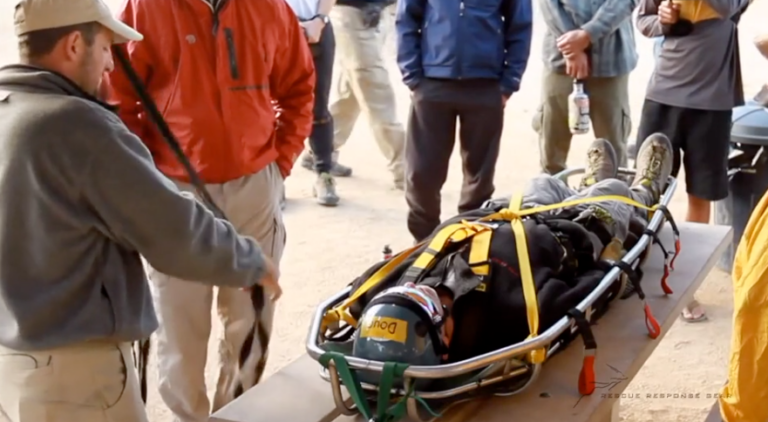
A poorly packaged patient may suffer worsening spinal injuries, respiratory compromise, circulatory issues, or hypothermia long before reaching definitive care. The guide repeatedly emphasizes that packaging must adapt to:
- Injury type
- Terrain
- Weather exposure
- Duration of transport
- Rope system orientation
- Environmental hazards
Effective packaging includes:
- Spinal immobilization when indicated
- Fracture stabilization
- Padding and void filling
- Thermal protection
- Continuous monitoring access
- Secure tie-in systems
- Stable litter orientation during raises and lowers
In prolonged rescues, patient comfort directly impacts survivability. Pressure points, exposure, and movement fatigue become operational problems if ignored.
The best rescue teams understand that patient packaging is not a setup step. It is a continuous process throughout the mission.
Team Coordination Is the Hidden Skill
Most technical rescue discussions focus heavily on hardware. But operational success usually depends more on communication and coordination than on equipment selection.
The guide reinforces the importance of:
- Defined team roles
- Standardized commands
- Rotation systems
- Scout assignments
- Continuous terrain reassessment
- Attendant coordination
- Fatigue management
Even advanced systems fail when communication collapses.
This becomes especially visible during:
- Edge transitions
- Vertical lowers
- Direction changes
- Terrain transitions
- High-wind operations
- Confined-space movement
- Multi-team coordination
Strong rescue teams move like connected systems rather than isolated individuals.
The Future of Litter Operations
One of the more important observations in the guide is that rescue continues evolving.
Modern rescue teams are already seeing:
- Lighter litter systems
- Better patient tie-in systems
- Improved friction management
- Advanced rope devices
- Enhanced communication systems
- Drone-assisted reconnaissance
- VR-based rescue simulations
- AI-assisted terrain analysis
But even with technological advances, the fundamentals remain unchanged:
- Terrain assessment
- Patient care
- Team coordination
- Rigging precision
- Movement control
- Adaptability under pressure
Technology can enhance rescue operations, but it cannot replace operational judgment.
Final Thoughts
Litter operations and patient evacuation are where rescue theory becomes rescue reality. They force teams to combine medicine, movement, rigging, communication, terrain analysis, and human performance into one integrated operation.
Every carry, lower, raise, transition, and edge movement becomes a test of preparation and teamwork.
The strongest rescue teams are not simply skilled at rigging systems. They understand how terrain, patient condition, rope systems, ergonomics, communication, and operational pacing all interact together.
That is what transforms litter handling from transportation into technical rescue leadership.
Peace on your Days
Lance