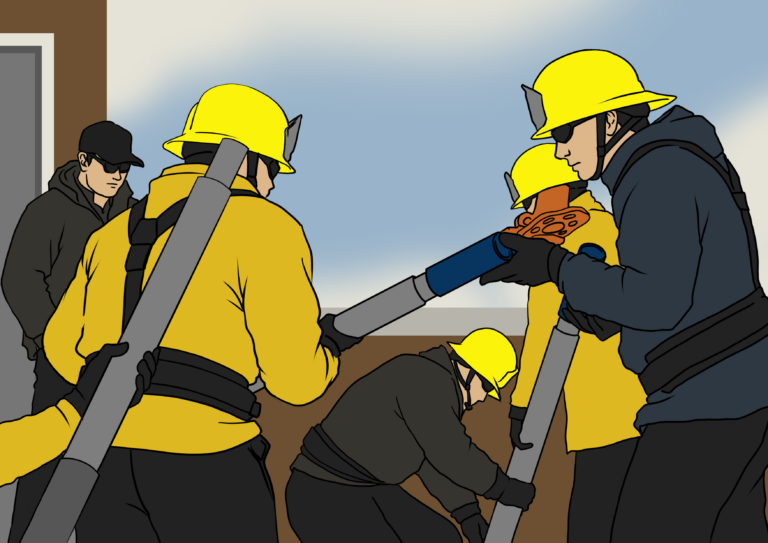
A technical rescue program is only as capable as the people expected to operate within it. Equipment, procedures, and organizational structure matter, but none of them replace competent instruction, deliberate practice, standardized systems, and honest performance review.
Building rope rescue capability is not a one-time training event. It is an ongoing process of selecting appropriate instruction, developing individual and team proficiency, documenting accepted procedures, practicing those procedures under realistic conditions, and reviewing performance afterward.
Selecting a Rope Rescue School or Instructor
The quality of rope rescue instruction varies widely. A course title, completion certificate, or instructor biography does not by itself establish the quality or relevance of the training.
Program leaders should evaluate whether the course matches the team’s expected operating environment. Training conducted on terrain similar to the team’s response area can provide greater operational value than a generic course that does not reflect local hazards, access problems, staffing, or equipment.
Outside instructors can also provide an important independent view of the team’s practices. An experienced instructor may identify assumptions, habits, or weaknesses that internal personnel no longer recognize.
Before selecting a course or instructor, evaluate:
- course content and scope
- source and meaning of any certification offered
- instructor teaching experience
- instructor rescue experience
- previous classes and references
- liability coverage
- class size
- student-to-instructor ratio
- balance between classroom instruction and field practice
- terrain used for practical training
- safety record
The central question is not whether the course appears impressive. It is whether the instruction will produce useful, transferable capability.
Instructor Qualifications
An instructor should be able to teach clearly, manage risk, demonstrate sound technical judgment, and connect the curriculum to real rescue operations.
Operational experience is especially valuable because it helps the instructor explain how systems behave under imperfect conditions. Actual incidents introduce terrain, weather, patient, communication, staffing, and time-pressure problems that controlled training environments may not fully reproduce.
Teaching ability remains equally important. Operational experience does not automatically make someone an effective instructor. A qualified instructor must be able to organize material, communicate concepts, observe student performance, correct errors, and adjust the learning process without losing control of the class.
Program leaders should determine whether the instructor has:
- relevant technical qualifications
- credible instructional experience
- field or rescue experience
- familiarity with current equipment and practices
- the ability to provide references
- a documented approach to safety
- experience teaching the intended student level
No single course can provide everything a rescuer will need throughout a career. Training should be understood as part of a larger development pathway.
Evaluating Course Quality
A strong rope rescue course establishes realistic objectives and spends sufficient time on fundamental skills.
Claims that a new student can become fully competent in a complex rescue discipline after only a brief course should be examined carefully. Training may introduce concepts and procedures, but operational competence requires repetition, supervised application, and continued development.
Program leaders should distinguish between:
- attendance
- course completion
- certification
- demonstrated skill
- team qualification
- operational competency
These are not the same.
A completion document may confirm that a person attended and met the course requirements. It does not necessarily establish that the person can perform safely within the team’s systems or under the conditions expected in the response area.
Getting the Most From Training
Students also carry responsibility for the quality of the learning process.
Rope rescue training can be physically demanding. Students may repeatedly climb towers, move across slopes, carry equipment, haul loads, operate litter systems, and work in awkward positions. Physical preparation affects both safety and learning.
Students should arrive ready to participate, ask relevant questions, and practice the assigned skills.
A productive student should:
- understand the course objectives
- prepare physically for the expected work
- participate fully in hands-on evolutions
- ask questions that clarify the lesson
- avoid disrupting the class to demonstrate unrelated knowledge;
- accept correction
- work through systems under instructor supervision
- identify areas requiring further practice
Hands-on practice connects theory to actual movement, equipment handling, communication, and system operation. Skills observed in a classroom are not retained as effectively as skills repeatedly performed and corrected.
Training Beyond the Classroom
Formal courses are only one source of development.
Books, technical manuals, manufacturer information, professional publications, rescue seminars, peer teams, conferences, and field demonstrations can all broaden understanding. These sources allow personnel to compare methods, examine different system designs, and study problems outside the limits of a single course.
Outside information should be reviewed critically. A technique used successfully by another team may not automatically fit the organization’s equipment, staffing, terrain, procedures, or risk model.
New information should be evaluated before it is adopted.

External training and observation can expose a team to different approaches, but new methods must be evaluated before being incorporated into standard operations.
Standardizing Team Systems
Standardization reduces unnecessary variation and helps personnel function as a coordinated team.
When every member learns a different method for the same task, the team may spend valuable time deciding which system to use during an incident. Standard systems allow personnel to recognize the equipment, anticipate the next step, verify the rigging, and operate with fewer explanations.
Standardization does not mean that only one system can ever be used. It establishes a dependable baseline for the incidents the team is most likely to encounter.
A standardized system should reflect:
- expected rescue environments
- available equipment
- personnel qualifications
- staffing levels
- applicable standards and regulations
- manufacturer instructions
- lessons from training and incidents
- compatibility with mutual-aid partners
New members can first learn the team’s foundational systems, participate in routine operations, and gain field experience. Advanced techniques and improvisation can then be introduced from a stable base.
The Team Manual
A team manual documents the organization’s accepted procedures, guidelines, equipment practices, and performance expectations.
It serves as:
- a training reference
- an operational reference
- a guide for new members
- a basis for self-study
- a record of team standards
- a tool for reducing confusion
- evidence of the organization’s expected performance
Writing the manual forces the team to examine its own practices. Procedures that appear obvious during training may become unclear when personnel attempt to document them step by step.
That process can reveal:
- missing decisions
- inconsistent terminology
- unclear assignments
- unnecessary complexity
- conflicting practices
- gaps between policy and actual operations
The manual does not need to reproduce every technical textbook. Published references can be incorporated where appropriate, while the team manual focuses on what the organization has adopted and how those systems are applied locally.
A maintained team library should support the manual with current technical references, manufacturer instructions, standards, and training materials.
Documentation and Accountability
The team manual also helps demonstrate the level of performance the organization expects.
If training, procedures, qualifications, or operational decisions are later questioned, a current manual provides more reliable evidence than informal recollections or differing opinions about what the team normally does.
The manual should be reviewed whenever:
- equipment changes
- procedures change
- standards or regulations are revised
- training identifies a weakness
- an incident reveals a problem
- a new capability is added
- mutual-aid operations expose compatibility issues
A manual that is not maintained can become a source of confusion rather than control.
Improvisation
Improvisation is an important rescue skill, but it must be built on a strong understanding of fundamentals.
Improvisation should not be used as an excuse for incomplete training, weak procedures, or unfamiliarity with standard systems. Effective adaptation requires rescuers to understand why the normal system works, which parts are essential, and what consequences follow when the configuration changes.
Standardized foundational skills create the judgment needed for responsible improvisation.
A team that performs routine systems consistently is better prepared to recognize when the situation requires a different approach. It can adapt from a known baseline rather than inventing a system without understanding its behavior.
Reviewing Performance
A team that does not examine its own performance cannot improve.
Training evolutions and actual rescues should be reviewed from beginning to end. The purpose is not to assign blame or simply praise a successful outcome. It is to identify what worked, what created delay or confusion, where risk increased, and what should change.
A useful review should examine:
- planning
- command and assignments
- communication
- equipment
- rigging
- patient care
- system transitions
- time management
- personnel performance
- safety decisions
- unexpected problems
Even an operation that appeared successful may contain opportunities to improve speed, clarity, efficiency, or safety.
The review should also identify practices that worked exceptionally well. Effective decisions and techniques should be reinforced so they become part of the team’s continuing development.
Accidents, near misses, and procedural failures require objective examination. The strongest teams are willing to critique their own work and modify procedures when the evidence supports a better approach.
Leadership Application
Program leaders must build a complete competency system rather than relying on isolated courses.
That system should connect:
- instructor selection
- formal training
- internal practice
- qualification
- standardized systems
- team documentation
- operational evaluation
- continuing education
- performance review
The objective is not merely to accumulate certificates. It is to create personnel who can perform reliably within the team’s systems and adapt responsibly when conditions change.
Lesson Takeaway
Rope rescue competency is developed through qualified instruction, deliberate hands-on practice, standardized systems, current documentation, and honest review.
Training provides the foundation, but sustained capability depends on how the organization reinforces, evaluates, and improves what its members have learned.
Peace on your Days
Lance