Sometimes a patient has to cross a gap: a canyon, a drainage, the space between two rims. The obvious answer is a highline, a tight rope across the span with the load riding on it. But a highline buys its clearance with very high tension, and that means highline-grade anchors and hardware on both sides.
A two-rope offset moves the same load across the same gap at a fraction of the force. It does that by giving up the idea of a fixed line entirely. Two live rope systems, one from each side, hold the package between them and move it by working together.
This post covers what a two-rope offset is, why it is not a trackline, the geometry that keeps its forces low, how the load actually moves, and why the teams’ coordination is part of the system’s structure.
What a two-rope offset is
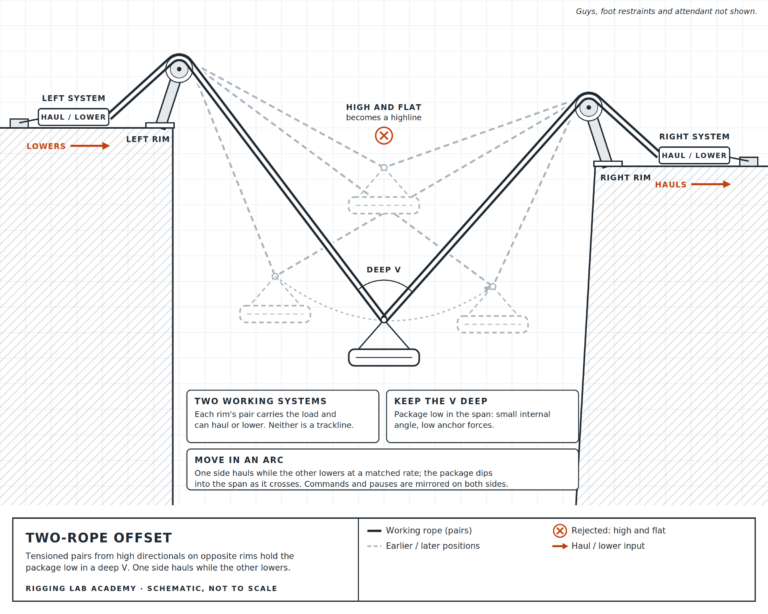
A two-rope offset is two independent rope systems, anchored on opposite sides of a gap, that meet at the rescue package. Each side typically runs through an elevated directional so its rope path clears the edge. Seen from the side, the two ropes form a V with the package at the bottom.
Both ropes are working ropes, and both carry the load. Each side has its own control and its own mechanical advantage, and either one can haul or lower.
Why it is not a trackline
The easiest mistake is to picture the offset as some kind of track. It is not.
- In a highline, a trackline is pre-tensioned and stays static. The load rides along it on a carriage, and the trackline carries the full vertical weight.
- In a tracking-line offset, a mainline and belay carry the weight, and a separate tracking line only nudges the load sideways to position it.
- In a two-rope offset, neither rope is static and neither is just a positioning aid. Both systems are live, both support the load, and the package’s position is set entirely by the balance of rope in and rope out between them.
The load moves because the ropes themselves move, not because anything travels along a fixed line. Treat an offset like a track and you will make the wrong force assumptions and tension it the wrong way.
Keep the package low, keep the V deep
The safety of a two-rope offset comes from its geometry. Specifically, it comes from the internal angle where the two ropes meet at the package.
With the package low in the span, the V is deep and the internal angle is small. Most of each rope’s tension points upward, holding the load, and the sideways pull on the anchors stays small. Pull the package up toward the line between the two directionals and the V flattens. The internal angle opens toward 180°, less of each rope’s tension goes into holding the load, and the tension climbs to make up for it.
For a symmetric V, each rope’s tension is:

Here W is the load and α is the internal angle between the ropes.
| Internal angle | Tension in each rope |
|---|---|
| 60° | 0.58 × load |
| 120° | 1.0 × load |
| 150° | 1.9 × load |
| 170° | 5.7 × load |
A deep V keeps each rope below the weight of the load. A flat V multiplies it several times over, and every bit of that lands on the directionals and anchors.
Two points follow from this. First, sliding the package toward one rim does not lower the forces; the rope angle does. Second, an offset held high and flat is no longer an offset. It is a highline, built without the anchors, hardware or design a highline needs.
How the load moves
The package crosses the gap through a push-pull exchange. One side hauls while the opposite side lowers at a matched rate. Rope taken in on one side is rope paid out on the other, and the package shifts toward the hauling side.
The path is an arc, not a straight line. As the package moves across, it dips into the span, which keeps the V deep and the tension low the whole way. That arc can look inefficient, but it is the system managing its own forces.
The same exchange works when the destination is higher than the start. Offsets are often used to move a load horizontally or diagonally upward. In those cases the mechanical advantage provides the movement, not the slope, so the teams have to work even more deliberately.
Coordination is part of the structure
Because both systems are live, neither side controls the load on its own. Geometry sets up the potential for movement, but the haul team and the lower team decide how that movement actually happens. In a two-rope offset, communication is a functional component of the system, not a courtesy.
When the teams fall out of sync, the problems show up immediately:
- Lowering side too fast: the package sags unexpectedly and can lose its clearance from the terrain.
- Hauling side too fast: the V flattens, tension rises quickly, and force spikes reach the anchors, directionals and mechanical systems.
- Mismatched speeds back and forth: the package oscillates or whips sideways instead of moving smoothly, which is hard on both the patient and the system.
- Teams working against each other: one system cross-loads the other, and tension builds with no movement at all.
The fix is operational. Commands are mirrored and clearly understood on both sides. Pauses are called together, so tension, guying and alignment can be adjusted with the load stable.
Summary
A two-rope offset moves a load across a gap using two live rope systems from opposite sides, with no fixed line and no carriage.
- Both ropes are working ropes. Each side supports the load and can haul or lower. Neither is a trackline.
- Geometry sets the forces. Keep the package low and the V deep, and each rope stays near or below the load’s weight. Pull it high and flat, and it becomes an under-built highline.
- The load moves in an arc. One side hauls while the other lowers at a matched rate, and the package dips into the span as it crosses.
- Coordination is structural. Mirrored commands and shared pauses keep the two systems from sagging, spiking or fighting each other.
If the system has to stay high, it is no longer an offset. It is a highline, and the anchors must be built for one.
Peace on your Days
Lance