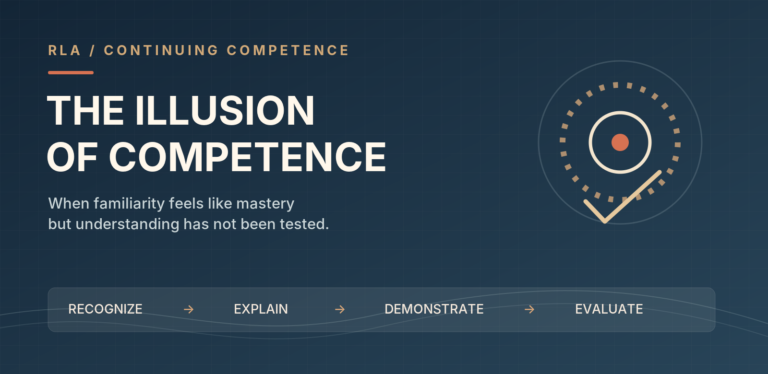
The Illusion of Competence: When Rope Rescue Confidence Outruns Capability
Why familiarity, experience, and certification do not always reveal what a rescue technician truly understands.
The Confidence That Comes With Experience
Experience has a remarkable way of making difficult things appear simple. A rope rescue technician who has spent years building anchor systems, operating mechanical advantage systems, and working through complex rescue scenarios develops a familiarity with equipment and procedures that becomes almost instinctive. Connections are recognized quickly, familiar configurations require less deliberation, and technical decisions begin to feel increasingly natural.
This confidence is an important part of professional development. It allows experienced technicians to work efficiently, recognize problems, and contribute valuable judgment when conditions become demanding. Yet it also introduces a subtle challenge: the easier a familiar system becomes to recognize, the easier it can be to assume that recognition represents complete understanding.
A technician may know how to build a system that has worked repeatedly without fully understanding every relationship responsible for its behavior. The difference becomes apparent when something changes, particularly when a system must operate outside the conditions in which it was originally learned.
This is the illusion of competence. It does not imply that experienced rescuers are careless or inadequately trained. Rather, it invites us to consider whether the confidence developed through familiarity remains supported by the ability to explain, evaluate, and demonstrate the principles behind our work.
When the System Looks Right but the Understanding Is Incomplete
One of the clearest demonstrations of this distinction appears in the evaluation of an anchor focal point. A technician approaches an arrangement, examines the connectors and rigging plate, checks the orientation of the equipment, and recognizes a configuration that appears entirely appropriate.
But what has actually been evaluated?
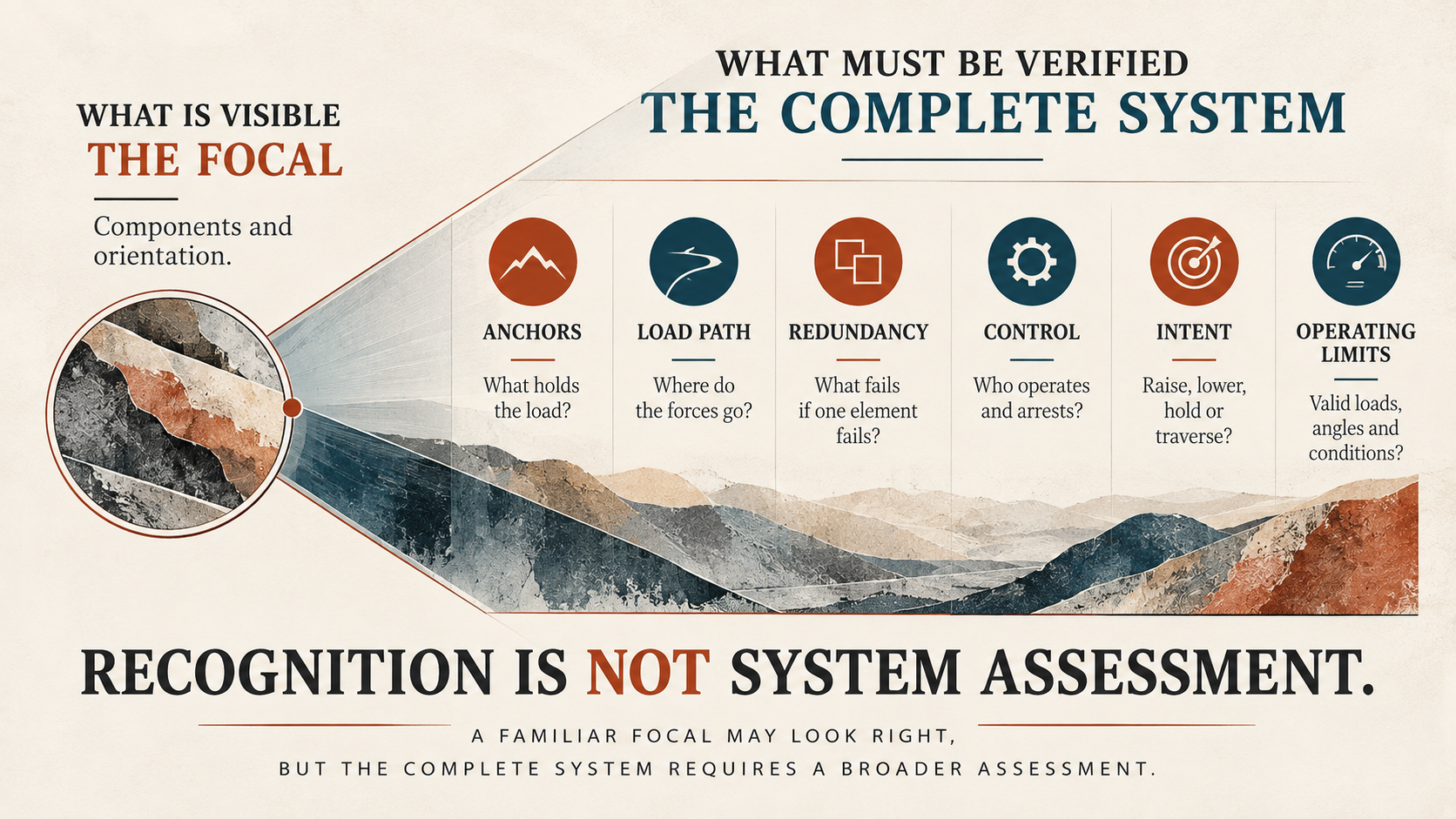
In The Focal Is Not the System, we examine the limitations of concentrating an assessment on the components immediately visible at the focal. The equipment may be correctly selected and connected while important questions remain unanswered about the anchors, load paths, redundancy, operational control, and intended purpose of the arrangement.
A properly oriented connector does not establish the adequacy of the anchor supporting it. A familiar rope-control device does not independently establish that the larger system will behave as intended. Understanding requires the technician to extend the assessment beyond the visible components and account for the complete operational arrangement.
This distinction is particularly meaningful during training because the familiar appearance of a system can encourage an equally familiar assessment. The technician recognizes the arrangement, identifies the equipment, and becomes satisfied that the system is understood.
However, when asked to explain the consequences of a changing load direction, an altered anchor angle, or the loss of a critical component, that understanding must move beyond recognition into technical reasoning.
A Practical Lesson From Mechanical Advantage
Mechanical advantage offers another particularly useful illustration because the appearance of a rigging arrangement can suggest something different from its actual mechanical behavior.
Consider two independent 3:1 haul systems operating in parallel on a shared load. The arrangement involves additional equipment, multiple working ropes, and potentially two hauling teams. At first glance, it may appear that combining these systems produces twice the mechanical advantage.
But two parallel 3:1 systems do not create a 6:1 mechanical advantage. Their efforts are distributed between the systems rather than compounded into a single higher-ratio arrangement.
This distinction is examined through documented comparative testing in Why Parallel Haul Systems Don’t Double Mechanical Advantage in Rope Rescue. The article compares individual, parallel, and compound haul arrangements, including measured input forces and the influence of friction.
The important learning opportunity extends beyond the calculation itself. It demonstrates how easily the visual complexity of an arrangement can be mistaken for greater mechanical performance.
A technician who memorizes the appearance of a mechanical advantage system may identify its components correctly while misunderstanding how force is developed or distributed. A technician who understands the underlying relationships can explain why two parallel systems share the work, how compounding differs, and why friction reduces actual performance.
The equipment may be familiar in both cases, but the depth of understanding is not necessarily equivalent.
What Happens When the Geometry Changes?
The distinction becomes even more consequential when rescue systems begin moving.
An artificial high directional may be correctly established, appropriately restrained, and positioned to manage a load through a difficult edge transition. While the load remains stationary, the arrangement presents a particular set of forces and directions. As the rescue package moves, however, the geometry surrounding the elevated directional can change.
The forces acting on the frame may change in magnitude and direction even though the equipment itself has not been repositioned.
Our article, Why the Force on a High Directional Keeps Changing, examines this behavior through illustrated configurations involving edge transitions and horizontal movement. The article demonstrates why an initial assessment of a high directional must account for the changing geometry throughout the intended operation.
For an experienced technician, the challenge is not merely recognizing an appropriate frame configuration. It is understanding the relationship between rope direction, resultant force, frame position, and the restraints responsible for maintaining stability.
An arrangement that appears familiar during the initial setup may behave differently as the load passes through the edge. Understanding those changes requires the technician to follow the forces through the entire movement rather than relying exclusively on the appearance of the equipment at the beginning.
This is where continuing technical education offers particular value. Revisiting the physical principles behind familiar configurations strengthens the ability to evaluate situations in which the arrangement, loading, or operational objective changes.
Certification, Skill Fade, and the Importance of Continuing Understanding
Formal training and certification provide essential foundations for technical rescue. They establish learning objectives, introduce recognized methods, and create opportunities for supervised practical assessment. These achievements deserve recognition because they represent substantial investments of time, effort, and professional development.
However, the successful completion of training establishes what was demonstrated under the conditions of that training. It does not guarantee that every aspect of the acquired knowledge and capability will remain equally accessible indefinitely.
In Why Rope Skill Fades Between Certifications, we explored the broader issue of skill retention and the importance of continued practice between formal training events.
The illusion of competence introduces an additional consideration. Even when technical understanding or practical proficiency has weakened, the sense of familiarity associated with previous training may remain.
A technician may remember the terminology of a system while needing renewed practice to operate it proficiently. An experienced team may recall an established procedure while overlooking an important dependency when adapting that procedure to changing conditions.
Neither situation invalidates previous training. Instead, both reinforce the importance of continuing education, deliberate practice, and meaningful evaluation throughout a technician’s career.
Confidence Within the Rescue Team
Individual competence is only part of the larger picture. Rescue operations depend upon multiple technicians understanding their responsibilities and working within a coordinated system.
A team may contain highly experienced members who have developed different habits, preferences, and interpretations of familiar procedures. These differences may remain unnoticed during routine training, particularly when everyone is working with systems they already recognize.
The consequences become more apparent when an operation requires coordinated transitions, changes in system configuration, or decisions involving multiple interacting components.
Maintaining a common technical foundation helps teams develop consistent ways of evaluating those situations. This does not require every technician to approach every problem with identical experiences or perspectives. Rather, it establishes shared principles through which different members can explain their decisions, evaluate system behavior, and operate within accepted procedures.
In Building Rope Rescue Team Competency, we examine how effective instruction, standardized systems, continuing education, and performance review contribute to organizational capability.
The objective extends beyond ensuring that everyone has attended the same classes. It involves developing an environment where knowledge can be examined, technical questions are encouraged, and practical performance can be evaluated against clearly understood requirements.
Developing Confidence That Can Be Demonstrated
The most constructive response to the illusion of competence is not to diminish confidence, but to strengthen the understanding supporting it.
Technical questioning provides one opportunity. Asking a technician to explain a load path, predict the effect of changing geometry, or evaluate the consequences of a component becoming unavailable encourages active examination of familiar principles.
Scenario discussions provide another opportunity by introducing changing conditions that require technicians to reconsider their assumptions. Those discussions become particularly valuable when connected with supervised practical exercises in which the proposed understanding can be demonstrated and evaluated.
Rigging Lab Academy’s CORE membership supports the academic foundation of this continuing process through structured Classic Courses, technical Playlists, and an extensive library of rescue and rigging knowledge. These resources allow technicians and teams to revisit important principles, explore unfamiliar system relationships, and prepare for practical training under their organization’s established procedures.
The value of that continuing education lies in developing understanding that remains useful beyond the original classroom or training exercise.
Experience provides an important foundation, and familiarity allows technicians to work with increasing efficiency. Yet the strongest confidence develops when those qualities are continually supported by sound technical reasoning and demonstrated practical capability.
As rescue environments, equipment, and operational requirements change, the willingness to revisit familiar principles becomes an essential part of professional growth.
The goal is not simply to remember how a system was assembled during previous training, but to understand why it worked, what conditions made it appropriate, and how those relationships must be evaluated when circumstances change.
That is the difference between confidence derived from familiarity and confidence supported by continuing competence.
Continue developing your technical foundation through RLA CORE — Technician and Crew Memberships.
Peace on your Days
Lance