The load on an elevated anchor is not fixed
Most rescuers size up a high directional once: the load hangs below, the frame looks well aligned, the guys are tight. Then the operation starts, and the geometry they checked begins to move.
An elevated anchor sits between ropes that change direction every time the load moves. Through an edge transition, across an offset, or along a highline, the force on the frame grows, shrinks and swings. A system that was well aligned in its first position can be loaded quite differently a few metres later.
This post walks through why, using five schematics.
Start with the site, not the equipment
On a real structure, the geometry is set before anyone chooses a frame. The opening is where it is. The steel is where it is. The job is to find a rope path that lets the load move cleanly, then decide what will hold that path.
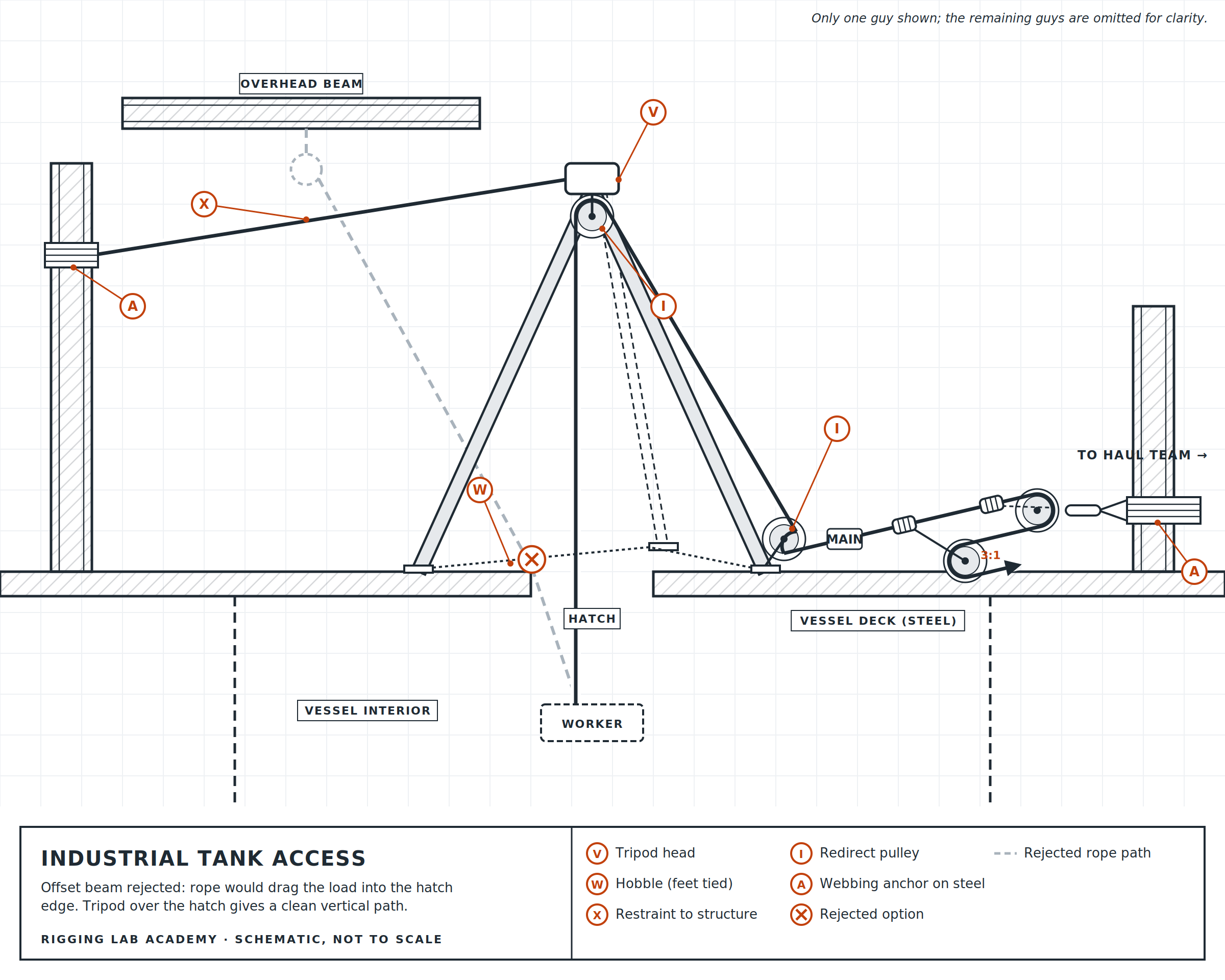
Take a worker who must come up through a hatch on top of a processing vessel. There is a strong overhead beam on the deck, but it is offset from the hatch. A pulley hung from that beam would pull the rope across the hatch edge and drag the load into the side of the opening. The beam is strong, but its position is wrong.
A tripod set over the hatch gives a clean vertical line instead, with the haul coming off a redirect at the tripod’s foot and the surrounding steel used for restraint. On another site the answer might be different: a beam directly over the opening would make the frame unnecessary. The point is that the decision follows the geometry.
The edge is a phase, not a moment
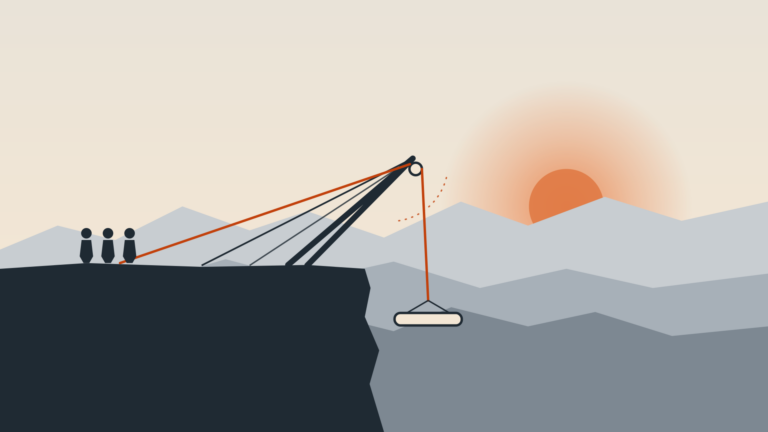
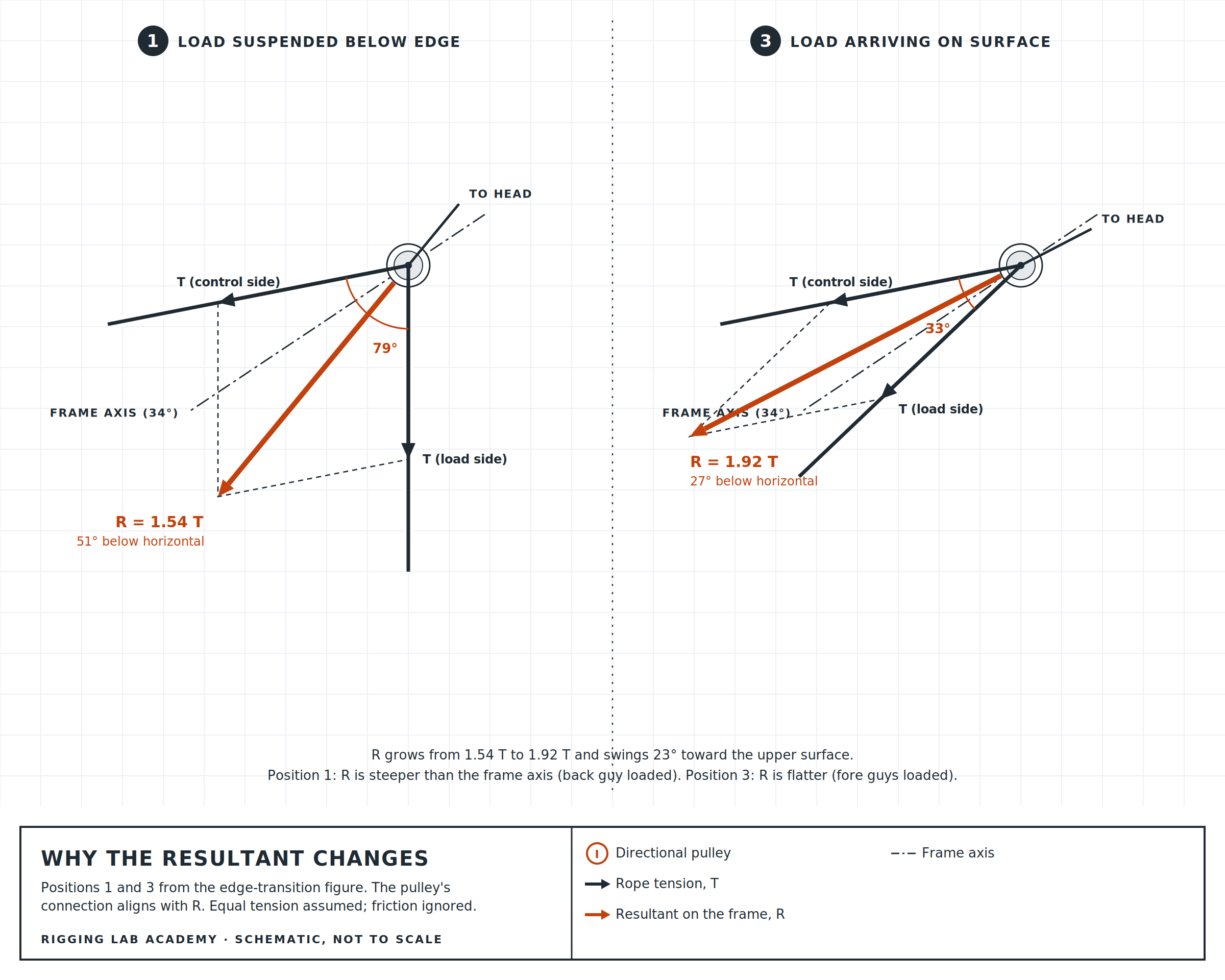
A litter raised over an edge passes through three distinct conditions. It hangs freely below the edge. It enters the transition, where its head end clears the lip and it starts to rotate. Then it is supported on the upper surface.
An elevated directional earns its place in that middle phase. By lifting the mainline above the lip, it keeps the rope off the edge and makes the pulley the place where the rope changes direction, rather than the rock or the parapet. It also gives the attendants room to rotate the package without fighting the rope.
Throughout all three positions, the frame and the control-side rope stay exactly where they were set up. Only the rope from the pulley to the load changes direction. That single change is what drives everything that follows.
[Figure: The Edge Transition]
What actually happens at the pulley
A directional pulley carries two rope tensions at once: the load side and the control side. The frame carries their sum, the resultant R. With equal tension T on both sides and friction ignored, its size depends only on the angle between the ropes:
R = 2T \cos(\theta / 2)In our edge example, the angle between the ropes is 79° while the litter hangs below the edge, so R = 1.54 T. When the litter arrives on the surface, the load-side rope swings back toward the control side and the angle closes to 33°. R rises to 1.92 T. The load the frame carries has grown by about a quarter, and nothing about the setup changed.
The direction changes too, and that matters more for guying. R swings 23° toward the upper surface, from 51° below horizontal to 27°. The frame’s own axis sits at 34°. In the first position R is steeper than the frame, so it tries to tip the head out over the edge and the back guy carries it. In the last position R is flatter than the frame, so it tries to push the head back, and the fore guys take over.
A frame guyed only against the first position would have nothing resisting the second.
Moving sideways changes the geometry again
When the load has to cross a gap instead of going straight up or down, there are two broad ways to do it, and they behave very differently.
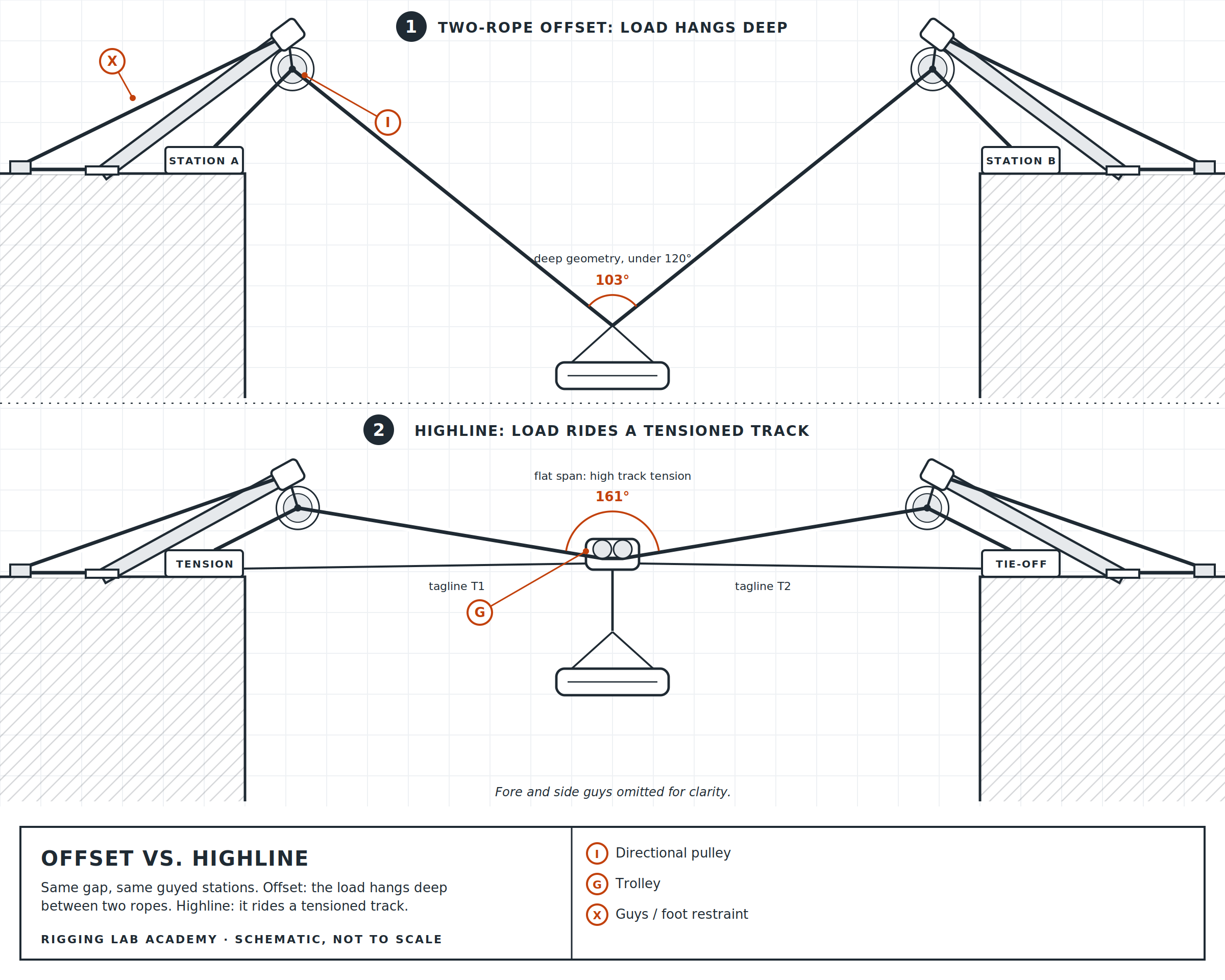
In a two-rope offset, the load hangs deep between two stations, each running its own rope. One station takes in while the other pays out, and the package moves across while staying well below both. In our schematic the angle between the two ropes at the load is 103°, comfortably under 120°, so each rope carries about 0.8 of the load’s weight, less than the full load.
A highline instead carries the load on a tensioned track spanning the stations. The track runs much flatter, at 161° in the same schematic, and that flatness is exactly why highline anchor forces are so sensitive to sag. Offsets deliberately keep their deep geometry so they never enter that tension regime.
In both systems the elevated anchors do the same job: they are the edge stations that lift the ropes clear and set how the ropes enter and leave the movement. They don’t create the horizontal movement themselves.
Watch the station, not just the litter
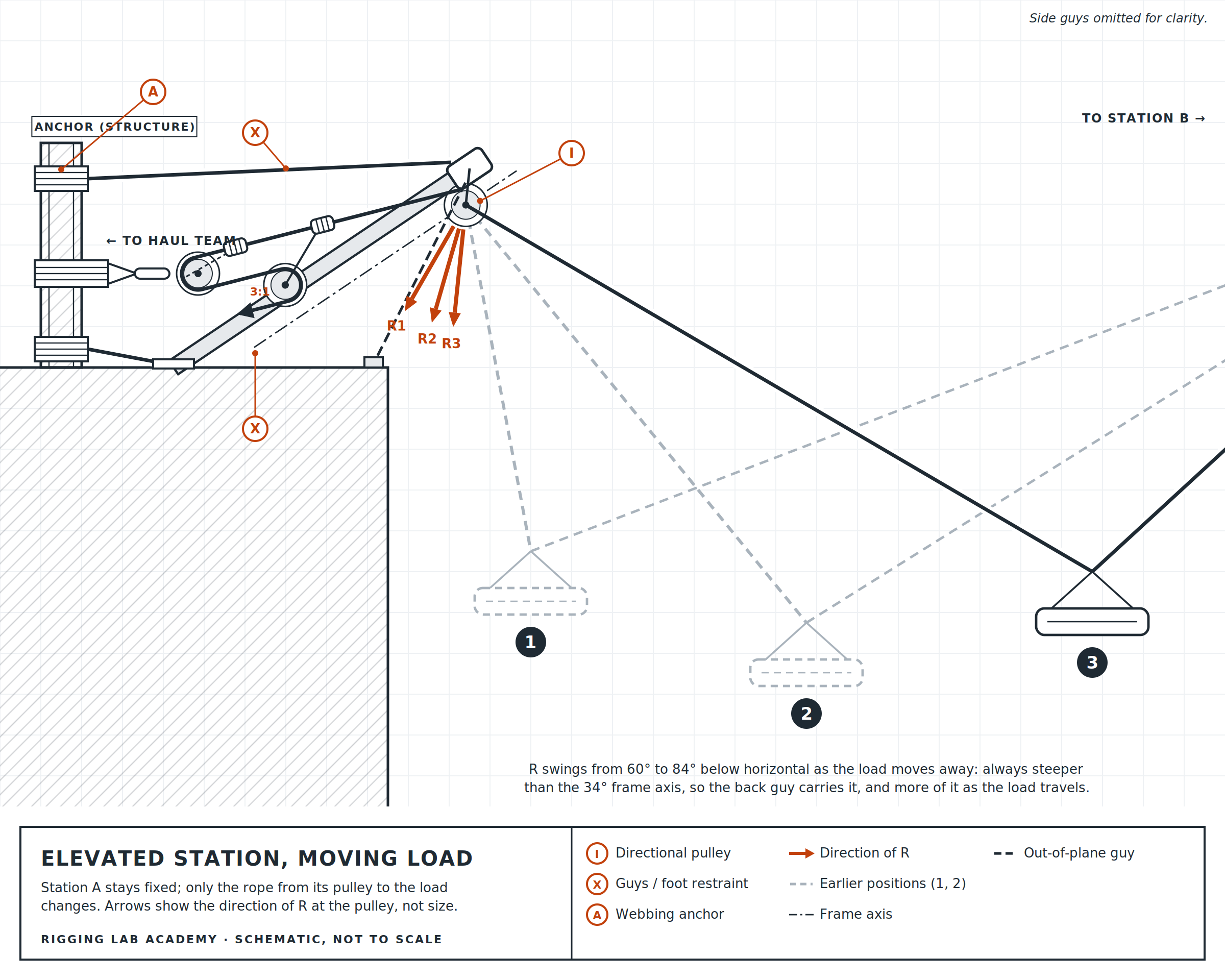
During a horizontal transfer, the load is deliberately changing its position relative to each elevated point. The station itself never moves, but the rope from its pulley to the load sweeps across the span.
Follow one station as the load moves from near it, to mid-transfer, to well across the gap. The direction of the resultant at its pulley swings from 60° below horizontal to 84°, turning outward over the gap. It stays steeper than the 34° frame axis the whole way, so the back guy carries it, and carries more of it the further the load travels.
That is why the people at each station have to keep watching their own system while the load is moving:
- head position and any displacement
- feet or structural anchors shifting
- guy and restraint tension
- rope alignment through the directional
- rope contact with the frame or surrounding structure
The opposite station sees the mirror image, with its own resultant swinging as the load approaches.
The geometry is alive for the whole operation
An elevated anchor doesn’t remove force from a system. It organizes it, at a point you chose. That point is only useful if the structure, the guys and the restraints can carry the resultant through every position the load will pass through, not just the one it started in.
So check the frame against the whole movement: the start, the transition and the finish. Guy it for every direction the resultant can swing. Then keep watching it while the load moves, because preload only proves the geometry you expected; observation proves the geometry you actually have.
Rigging Lab Academy teaches rope rescue from first principles, with the geometry worked out rather than memorized. Explore Rigging Lab Academy →
Peace on your Days
Lance