Debunking the Myth of Multiplying Mechanical Advantage
In technical rope rescue, clarity and precision matter—especially when it comes to understanding mechanical advantage. One common belief that continues to circulate in the rescue and rigging world is that two parallel 3:1 systems hauling a single load equals a 6:1 advantage. It sounds intuitive. It looks clean on a whiteboard. But when tested in real systems with real forces, the math simply doesn’t hold.
This blog will unpack the physics, testing, and field logic behind parallel haul systems—and explain once and for all why their advantage doesn’t stack the way some think it does.
The Assumption: More Ropes = More Advantage?
Let’s begin with the intuitive—but incorrect—assumption:
“If I build a 3:1 MA system on Rope A and another 3:1 MA system on Rope B, and both pull the same load at the same time, I’ve got a 6:1 system.”
That line of thinking misses a critical point: mechanical advantage is not additive in parallel systems—it’s shared. The load doesn’t care how many systems you’ve built; it only cares about how much work is being done and how force is distributed.
Controlled Testing: One Load, Multiple Configurations
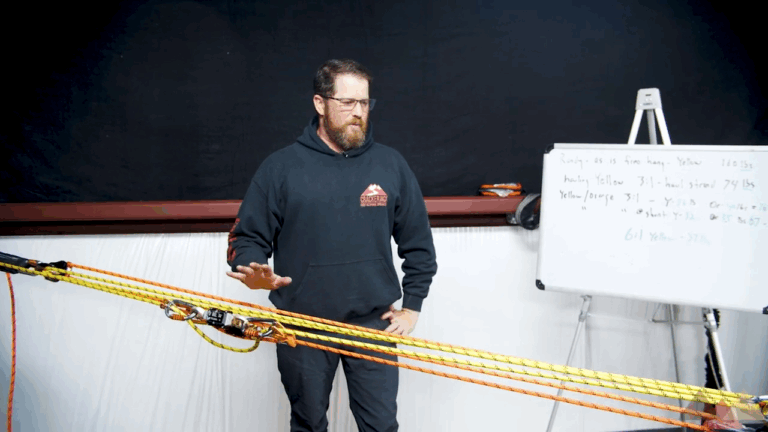
To settle this question, real-world testing was performed using a 160–180 lb test load (Randy), load cells, and various MA setups:
Test A: Single 3:1 Haul System
-
Setup: One 3:1 MA system
-
Result: ~74 lbs of input force required to lift 160 lbs
-
Effective MA: 2.16:1 (due to friction)
Test B: Two 3:1 Systems in Parallel (Separate Ropes)
-
Setup: Two separate haul teams, each running their own 3:1 MA
-
Result: ~36 lbs on Rope A, ~40 lbs on Rope B → Total ~76 lbs
-
Observation: Total input force stayed nearly the same as single 3:1
Test C: Two 3:1 Systems on One Load, Joined via a Shunt
-
Setup: Both haul systems tied together at a single pull point
-
Result: ~67 lbs total input force
-
Slight improvement possibly due to gear substitution (e.g., lower-friction pulleys), not system change
Test D: True 6:1 System (Compound MA)
-
Setup: A 2:1 MA added to the haul line of a 3:1 system
-
Result: ~37 lbs of input force
-
Effective MA: ~4.3:1 (realistic for field systems with friction)
What the Physics Tells Us
1. Work Done = Force × Distance
In a parallel haul system, each rope moves the load the same distance. You’re not trading distance for force, as you would in a compound system. The total amount of work required to raise the load doesn’t change—it just gets divided between the two haul systems.
2. Mechanical Advantage Comes from Direction, Not Duplication
Mechanical advantage is a function of how the system redirects and amplifies force. Building two separate amplifiers on parallel tracks doesn’t multiply their effect—it just splits the force requirement. This is load sharing, not force multiplication.
3. Parallel MA = Redundancy, Not Efficiency
Running two 3:1 systems in tandem provides:
-
Redundancy in case of system failure
-
Shared effort between haul teams
-
Reduced peak load on each individual system
But it does not reduce the total amount of input force needed to move the load.
Why This Matters in Rescue Work
In real-world rope rescue, particularly under time-critical conditions or awkward terrain, decisions about system design must be informed by physics—not assumptions.
-
If your goal is efficiency, build a compound mechanical advantage system.
-
If your goal is redundancy or balanced team input, go with parallel haul systems—but don’t expect to gain a higher MA.
Twin Tension Systems (TTRS) as Context
In TTRS, where both lines are load-bearing and actively managed, it’s common to see identical MA systems on both lines. But again—this setup helps with balance and control, not greater force multiplication.
Summary: The Real MA Truth About Parallel Hauls
| Setup Type | MA Claimed | MA Measured | Total Input Force | Key Role |
|---|---|---|---|---|
| Single 3:1 | 3:1 | 2.1:1 | ~74 lbs | Baseline system |
| Parallel 3:1 (Separate Ropes) | 6:1 (myth) | 2.1:1 | ~76 lbs | Redundancy, not efficiency |
| Parallel 3:1 (Shunted Pull) | 6:1 (myth) | ~2.4:1 | ~67 lbs | Slight friction advantage |
| True 6:1 (Compound MA) | 6:1 | 4.3:1 | ~37 lbs | Real MA improvement |
Final Thought: Know What You’re Building
In rescue systems, we don’t get to guess. Parallel haul setups might look like more horsepower, but they aren’t. If you’re pulling with two 3:1s, you’re splitting the job—not reducing it. True MA improvements require compound rigging that trades distance pulled for reduced force input.
Before you rig, think like a physicist. Your system’s success—and someone’s life—depends on it.
Peace on your Days
Lance