Z-rig

Understanding Pulley Systems for Mechanical Advantage

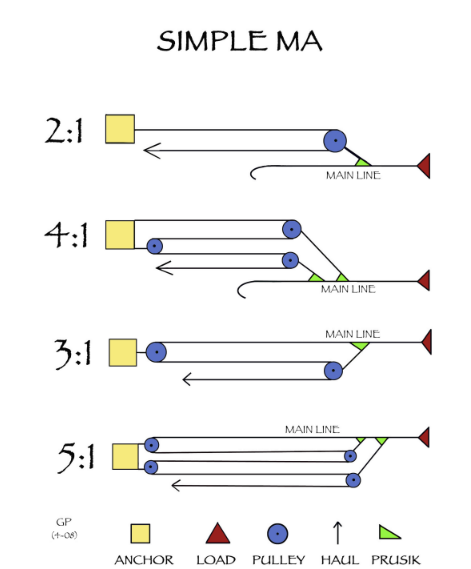
Pulley systems have been used for centuries to move loads with greater control and less effort. The same basic principles once used in maritime rigging still apply in modern rope rescue, industrial access, and technical hauling systems. While pulley arrangements can appear complicated, five simple rules make it easier to identify the theoretical mechanical advantage […]

Understanding Pulley Systems for Mechanical Advantage Read More »

pretension-back-tie-anchor-system

Mechanical Advantage and Anchor Systems in Rope Rescue

In rope rescue, mechanical advantage and anchor systems are never separate subjects. Every haul system depends on an anchor, and every anchor must be capable of resisting the forces a mechanical advantage system creates. That relationship is often misunderstood. Rescuers may focus on the efficiency of a 3:1 or 5:1 system, yet overlook how redirects,

Mechanical Advantage and Anchor Systems in Rope Rescue Read More »

Building the Minimal Mechanical Advantage Kit

Building a Minimal Mechanical Advantage Kit with the 20–80 Rule

The 20–80 Rule in Action: Building the Minimal Mechanical Advantage Kit In rope rescue, complexity can be your enemy. Too many devices, too much gear, and too many choices under stress can slow a team down and increase risk. That’s where the 20–80 Rule comes in: with about 20% of the gear, you can accomplish

Building a Minimal Mechanical Advantage Kit with the 20–80 Rule Read More »

Basic mechanical advantage systems enable efficient lifting with simple pulleys. Learn the essentials of the 3:1 Z-rig for safe rescues - How is Weight Redistributed Through a 3:1 Mechanical Advantage System? - Eccentric Progress Capture in Mechanical Advantage Systems

How is Weight Redistributed Mechanical Advantage Systems?

How is Weight Redistributed Through Mechanical Advantage Systems?  A 3:1 mechanical advantage system, also known as a Z-rig, is a fundamental tool in technical rope rescue that enables rescuers to lift heavy loads with significantly less effort. But how exactly is the weight redistributed in this system, and what forces are acting on the pulleys,

How is Weight Redistributed Mechanical Advantage Systems? Read More »

Anchors TTRS and Hauling Systems

Anchors TTRS and Hauling Systems

Understanding anchors, Tensioned Twin Rope Systems (TTRS), and hauling systems isn’t just about rigging; it’s about safety, efficiency, and adaptability in high-pressure situations. These systems form the backbone of rescue and rigging operations, ensuring stability and control when it matters most. 1. Anchors: The Bedrock of Stability A strong anchor is the foundation of every

Anchors TTRS and Hauling Systems Read More »

Basic mechanical advantage systems enable efficient lifting with simple pulleys. Learn the essentials of the 3:1 Z-rig for safe rescues - How is Weight Redistributed Through a 3:1 Mechanical Advantage System? - Eccentric Progress Capture in Mechanical Advantage Systems

Basic Mechanical Advantage Systems in Rescue Operations

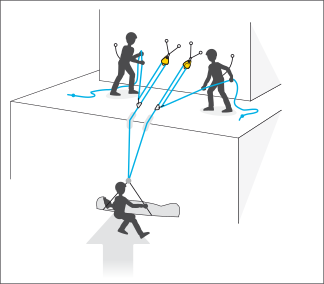
Basic Mechanical Advantage Systems & Simple Pulley Setups For many rescue scenarios, simplicity is key. Basic MA systems, like the 3:1 “Z-rig,” use straightforward pulley configurations to achieve force multiplication. The Z-rig setup resembles a “Z” shape and can effectively reduce the amount of effort needed to lift a load. For instance, applying 100 pounds

Basic Mechanical Advantage Systems in Rescue Operations Read More »

Essential Rope Rescue Equipment - Mastering Mechanical Advantage Systems

Mastering Mechanical Advantage Systems

Mastering Mechanical Advantage Systems: Tools for Efficient Raising and Lifting In the world of engineering and technical rescue, mechanical advantage (MA) serves as the foundation for designing systems that safely and efficiently raise or lift heavy loads. Whether it’s rescuing a patient from a vertical drop, hauling gear in wilderness settings, or performing industrial lifts,

Mastering Mechanical Advantage Systems Read More »