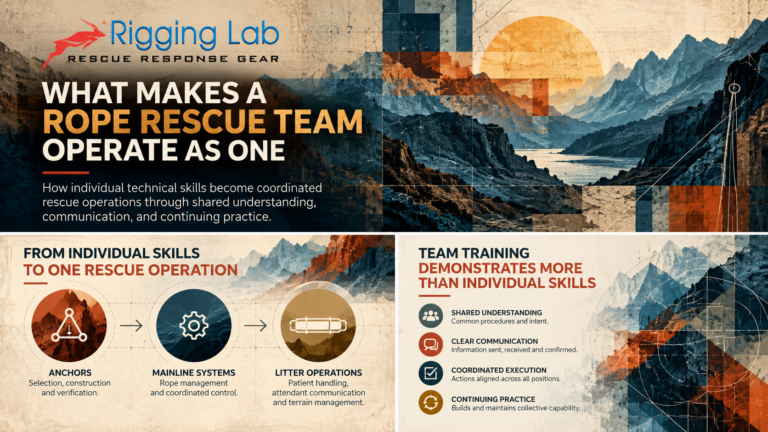
What Makes a Rope Rescue Team Operate as One
How individual technical skills become coordinated rescue operations through shared understanding, communication, and continuing practice.
From Individual Skills to One Rescue Operation
A well-trained rope rescue team is built upon a collection of individual capabilities developed through instruction, repetition, and practical evaluation. Technicians learn to construct anchors, operate rope-control systems, manage mechanical advantage, and perform litter movements under the supervision of qualified instructors. Each discipline has its own principles, equipment requirements, and performance expectations, allowing personnel to develop proficiency within an established training program.
However, a rescue operation rarely presents these responsibilities as isolated activities. The anchor system must support the intended movement, the working lines must remain appropriately controlled, and the litter team must coordinate its progress through terrain that may introduce additional requirements. Every element contributes to the same operational objective, but no single element determines the success of the complete operation.
This relationship offers an important perspective on continuing training. A technician may retain excellent proficiency in an assigned discipline while having fewer opportunities to practice how that responsibility connects with the work of others. A department can maintain standardized procedures across its shifts and still benefit from recurring exercises that bring those disciplines together.
The distinction is not between departments that follow procedures and those that do not. It is between demonstrating individual skills and demonstrating how those skills function collectively.
In our article Building Rope Rescue Team Competency, we examine how standardized procedures, qualified instruction, practical training, and performance review contribute to operational capability. The next consideration is how those elements are brought together during a complete training evolution.
Training the Connections Between Systems
Consider an illustrative training exercise involving the controlled movement of a packaged patient in a litter from a lower position through an exposed edge transition. The department uses its established equipment, approved procedures, and qualified personnel. The instructor has defined the training objectives and established the conditions under which the evolution will be conducted.
Preparation begins with anchor selection and system verification. Personnel assigned to the anchor systems evaluate the intended loading, attachment arrangements, and suitability of the selected locations. Their responsibilities extend beyond assembling equipment to confirming that the anchor arrangements meet the requirements of the planned movement.
As discussed in Introduction to Anchors and Anchor Systems, selecting and constructing anchors requires consideration of the anticipated forces, loading directions, and the suitability of the supporting structure. Those decisions establish the foundation upon which the other rescue functions depend.
The next stage brings the working-line operators into the exercise. Personnel assigned to the mainline or twin tension rope systems must understand the intended movement, confirm their assigned responsibilities, and coordinate their actions according to the department’s established commands.
RLA’s Teaching the Twin Tension Rope System in the Classroom emphasizes that operating two active working lines involves more than understanding the individual control devices. The operators must coordinate the management of the load, communicate appropriately, and maintain the intended operating relationship between the systems.
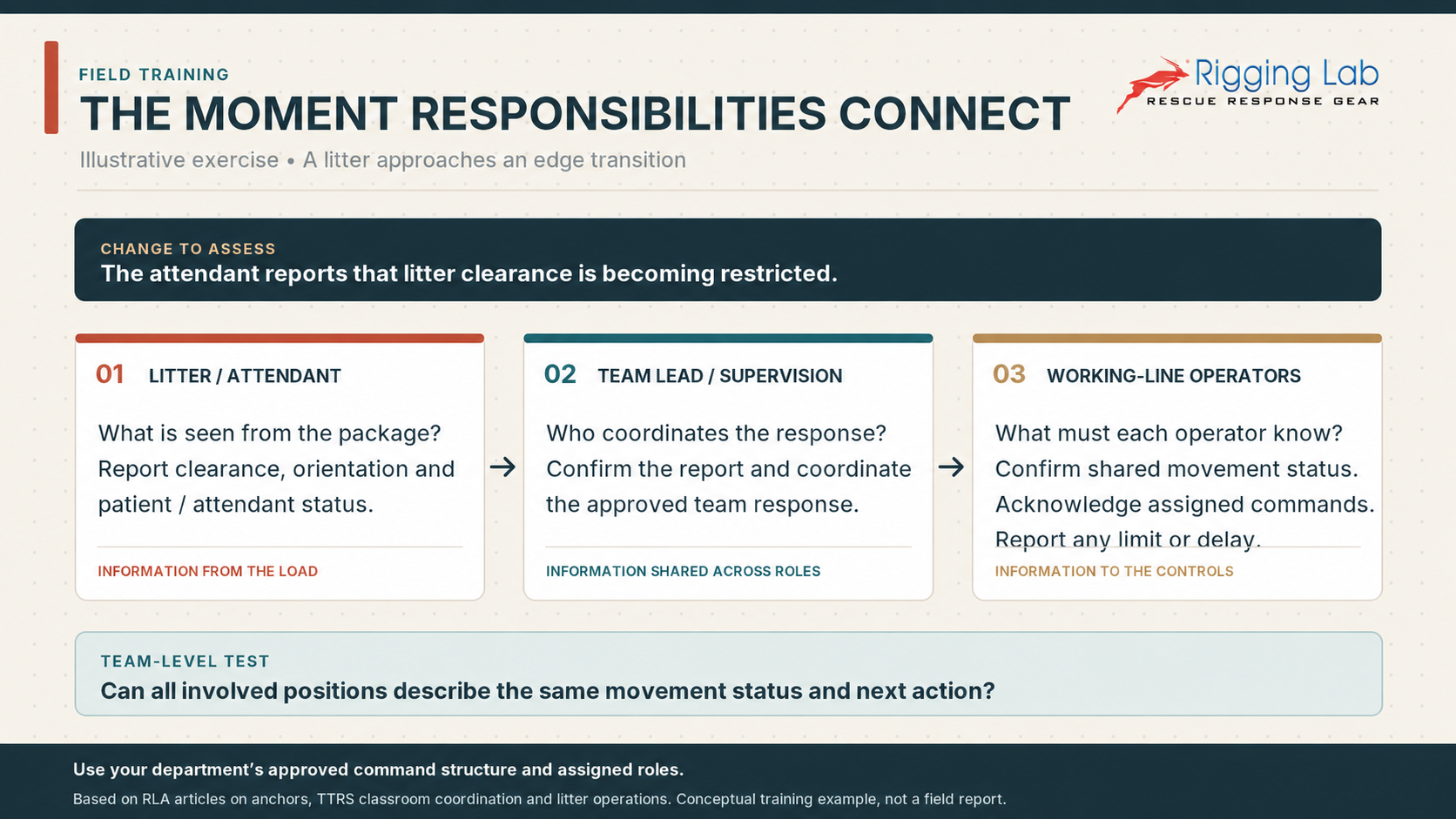
The litter team introduces another set of responsibilities. Patient packaging, litter orientation, attendant communication, and terrain management must remain connected to the movement being controlled by the rope-system operators.
In Litter Operations and Patient Evacuation in Technical Rescue, we examine how litter handling integrates patient care, terrain assessment, rigging, and coordinated movement. These responsibilities become especially important when the rescue package approaches an obstacle or transitions between different terrain conditions.
During the training evolution, the litter attendant may identify a condition requiring the movement to stop while the package is repositioned. The communication must reach the appropriate personnel, the working lines must remain under coordinated control, and movement must resume only through the established operational process.
The individual skills involved are familiar. What the exercise examines is how effectively they function together.
What Team Training Must Demonstrate
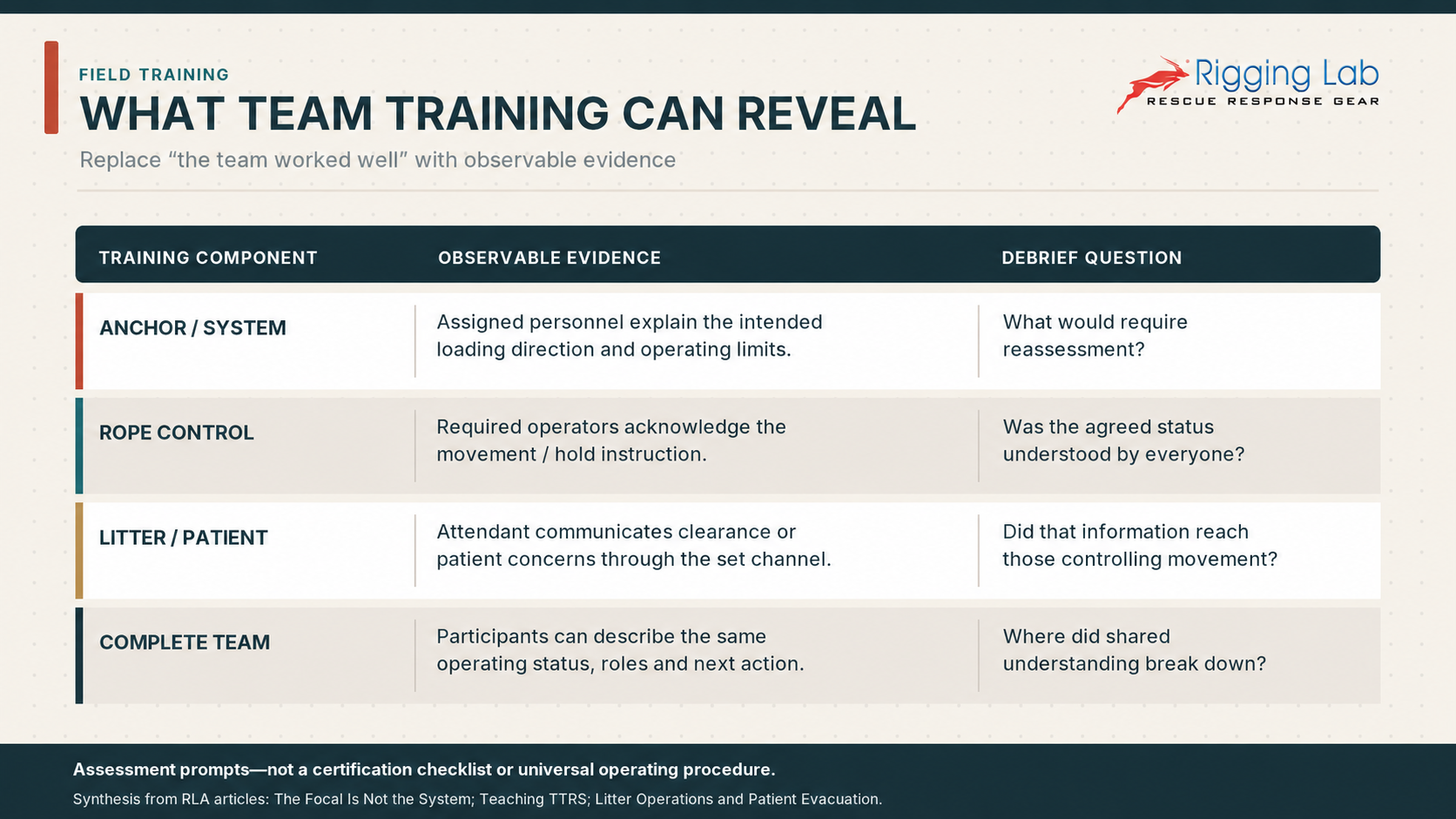
An integrated training exercise provides instructors with an opportunity to observe aspects of performance that may be less apparent when technical disciplines are evaluated separately.
Anchor construction can be assessed for correctness, but the exercise also reveals whether the completed arrangement has been evaluated in relation to the intended movement. Mainline operators can demonstrate proficiency with their devices, while the instructor observes how effectively their actions remain coordinated throughout the operation.
Similarly, the litter team can demonstrate packaging and handling skills while its communication with the rope-system personnel is evaluated during movement and transition.
These observations concern the working relationships between assigned responsibilities rather than differences in departmental procedures.
Our article The Focal Is Not the System provides a useful framework for examining this distinction. A correctly assembled focal point represents only one part of the rescue arrangement. The complete assessment includes anchors, load paths, redundancy, system intent, operational control, and the conditions within which the arrangement remains appropriate.
During integrated training, these considerations become connected responsibilities shared across the personnel involved in the operation.
This also provides a meaningful basis for performance review. Rather than concentrating exclusively on whether the rescue package reached its destination, instructors can examine how the operation progressed, whether communication remained clear, how transitions were managed, and whether the team’s actions remained consistent with its established procedures.
A completed movement is an important outcome, but reviewing the process provides information that can strengthen the next evolution.
Maintaining Collective Capability
The original Why Rope Skill Fades Between Certifications article examined what happens when trained capabilities receive insufficient reinforcement. That concern applies to the individual skills within rope rescue, but it also raises a useful question about the opportunities teams have to practice those skills together.
Anchor construction, rope-control operations, and litter handling may each appear regularly within a department’s training schedule. Their integration requires additional attention because a complete rescue involves communication and coordination across several technical responsibilities.
Continuing team training provides opportunities to reinforce these relationships while preserving the department’s accepted procedures. Academic review can refresh the principles supporting the equipment and systems, while practical exercises allow personnel to demonstrate how those responsibilities connect under realistic, supervised conditions.
Rigging Lab Academy’s CORE membership supports the academic portion of this continuing development through its Classic Courses, technical Playlists, and extensive library of rope rescue and rigging resources. These materials allow technicians and instructors to revisit important principles, prepare for practical exercises, and maintain a common technical foundation between formal training events.
CORE does not replace the department’s instructor, operational authority, or hands-on performance evaluation. Its role is to support the knowledge that personnel bring into those activities.
A capable rescue team is not defined simply by the number of individual skills its members possess. Its collective capability is demonstrated when those skills are brought together through established procedures, shared understanding, and coordinated execution.
As technicians continue developing their individual proficiency, recurring team exercises help ensure that their knowledge remains connected to the people and systems with which they operate.
The strongest measure of a rescue team’s preparation is not merely whether its members can perform their individual assignments, but whether they can bring those capabilities together to accomplish the operation as one coordinated team.
Continue Developing Your Team’s Technical Foundation
Explore the structured technical education available through RLA CORE Technician and Crew Memberships.
Peace on your Days
Lance