The Twin Tension Rope System — TTRS — represents one of the most significant shifts in rescue rigging philosophy in recent decades. For a long time, the standard approach meant one tensioned mainline doing the work while a second rope sat in a slack belay configuration, ready to catch a failure but contributing nothing to the actual load. On paper, it sounds like a reasonable safety net. In practice, it creates a dangerous gap: if the mainline fails, the slack belay must arrest a falling load, and that arrest generates shock force — a sudden, violent spike in tension that can blow anchors, damage equipment, and injure the people attached to the system.
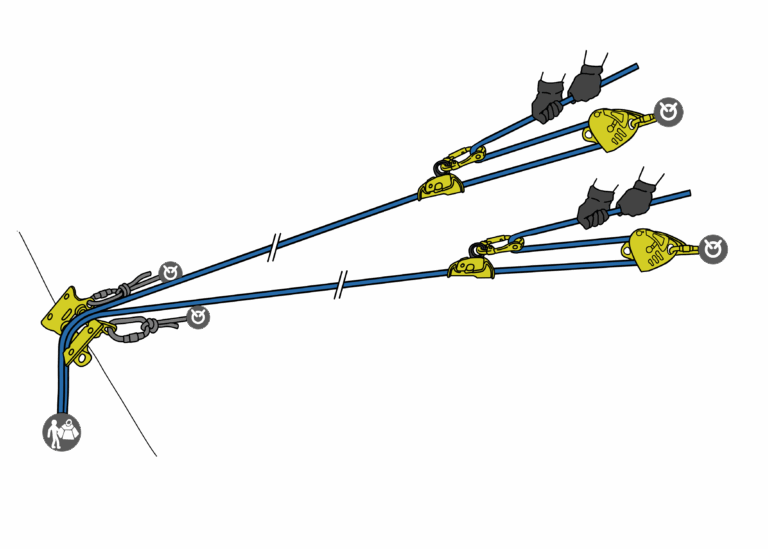
TTRS eliminates that gap entirely. Both ropes are tensioned and load-sharing simultaneously, anchored independently, and running through matched control devices operating in parallel. The load is split equally between the two lines at all times, and if one line fails, the other is already under tension and already carrying half the load. The transfer is immediate and seamless — no drop, no shock, no arrest event. That is what zero-drop redundancy means, and it is the foundational reason TTRS has become the modern standard in technical rescue.
Teaching it well, however, requires more than explaining the physics. TTRS is as much a communication system as it is a rigging system, and that distinction shapes everything about how it should be introduced in the classroom.
Start With the Why
Before any hardware is laid out, students need to understand what problem TTRS is solving. That means spending real time on the mechanics of shock load — what causes it, how it scales with drop distance, and why even a short fall on a slack belay can produce forces far in excess of what the system was rated to hold. Instructors who skip this step often find that students can build the system correctly but don’t truly understand why every detail matters. When something goes wrong in the field, that understanding is the difference between a team that can adapt and one that freezes.
The concept of zero-drop redundancy should be introduced as a design goal, not just a feature. Ask students: what would a system look like if you wanted to guarantee that a single-component failure never produces a shock load? Walk them through the logic. You’d need both lines tensioned. You’d need equal load distribution. You’d need matched devices so neither side can outpace the other. By the time you’ve answered the question, you’ve described TTRS — and students who arrive at the configuration through reasoning tend to retain it far better than those who simply memorize a setup.
Component Identification and the Mirrored Layout
Once the concept is established, move to hardware. The physical configuration of a TTRS is built around the mirrored principle: every element on the left side has an exact counterpart on the right. Two ropes, two devices, two anchor points, two operators. Nothing is shared between the two sides except the load itself.
Device selection is one of the most important decisions in the build, and students should understand why certain devices are appropriate and others are not. The CMC Clutch, the CMC MPD, and the Petzl Maestro are the most commonly specified options for TTRS use. All three provide auto-locking function — meaning they hold the load without active effort from the operator — along with smooth, controllable movement and integrated progress capture. These are not nice-to-have features. In a TTRS, where two operators must move in precise coordination, a device requiring constant manual engagement introduces a variable that works against the system’s core requirement: symmetry.
Mixing device types between the two sides is strongly discouraged. Different devices have different feel, different response characteristics, and different learning curves. An operator running a CMC MPD on one side while their partner runs an unfamiliar device on the other is a recipe for asymmetry before the load ever moves.
Anchor selection follows the same logic. Each device must be anchored to a separate, independent anchor point. Shared anchors defeat the purpose of full redundancy. If both devices connect to the same point and that point fails, the system fails completely — regardless of how well the ropes and devices were rigged. The mirrored layout is not an aesthetic preference; it is the structural basis of the system’s safety.
Equalizing Tension Before Loading
One of the most critical steps in building a TTRS — and one that is frequently rushed — is equalizing tension across both lines before any load is applied. Unequal tension at the start means one line is already carrying more than its share. As the load increases, the imbalance compounds. What began as a minor setup error can become a situation where one line is approaching its working load limit while the other is barely engaged.
The whistle test is the standard method for confirming equalization in a classroom setting. With both lines tensioned and the system ready to load, each side is checked for consistent tension by feel and by observation of the devices. A whistle signal initiates a brief, controlled test load — typically a light, controlled pull — to confirm that both sides respond equally before committing to a full operational load. Students should practice this until it becomes automatic, not because the step is difficult, but because skipping it is a habit that is dangerous to form.
Operating as a Team
TTRS is, at its core, a two-person skill. Each operator controls one side of the system, and the load moves only as smoothly as their coordination allows. When one operator feeds rope faster than the other during a lower, the load tilts toward the slower side. A hesitation on one side during a raise lets the other take up slack, and the load shifts. In both cases, the redundancy that makes TTRS superior to main-and-belay is temporarily erased — not because the system failed, but because the team did.
This is why verbal commands are not optional. Every movement — every raise, every lower, every pause — should be initiated by a clear, shared command that both operators acknowledge before acting. The command structure does not need to be elaborate. It needs to be consistent, and it needs to be practiced until it is second nature. Teams that skip command protocol during training drills tend to improvise in the field, and improvisation under load is where systems fail.
Edge transitions require their own dedicated briefing before any live load. The moment a load crosses an edge is the highest-friction, highest-risk point in the operation. Rope angles change, device behavior shifts, and communication becomes harder precisely when it needs to be most reliable. Dry runs at the edge — with no load attached — are not optional preparation. They are part of the operation itself.
The Numbers That Govern the System
Operational parameters for TTRS are not suggestions. Minimum breaking strength for all system components is 20 kN. The arrest force must remain at or below 12 kN, with any stopping distance capped at one meter. In horizontal configurations, the 60-degree rule governs rope geometry: keep interior rope angles at 60 degrees or less. Beyond that threshold, the forces imposed on anchor points increase exponentially — a 120-degree interior angle, for example, can place forces on each anchor equal to the full load, eliminating the load-sharing benefit entirely.
These numbers should be memorized, but more importantly, students should understand the physics behind each one. A parameter that is understood is one that can be applied correctly in an unfamiliar configuration. A parameter that is only memorized is one that gets forgotten under stress.
The Debrief Is Not Optional
After every practice evolution — whether it goes smoothly or not — the debrief is where the learning consolidates. Ask specifically: where did asymmetry appear? What communication broke down, and at what point? Was the whistle test performed correctly? Did the edge transition briefing cover everything it needed to?
Students who can answer those questions honestly are developing the diagnostic instincts that keep real operations safe. The classroom is the only place where it is safe to make these mistakes and learn from them. That opportunity should not be wasted by rushing to the next evolution before extracting every lesson from the one that just happened.
TTRS is a better system than what it replaced. Teaching it well means giving students not just the mechanics of how to build it, but a genuine understanding of why every element exists and what happens when any element is neglected. That understanding is what makes the difference between a team that can rig a TTRS and a team that can be trusted to operate one.
Sources
- Introduction to TTRS — The Modern Standard (RLA CORE members)
- TTRS Raising and Lowering Operations (RLA CORE members)
- Rescue Rigging Systems Overview
Peace on your Days
Lance