Hybrid High-Directional Systems for Vertical and Horizontal Rescue Operations
Technical rescue systems are often categorized by their primary function. Some systems are designed to manage vertical movement. Others are designed to support horizontal transportation. Complex terrain, however, rarely presents a single movement problem. Rescuers may need to raise a patient from below a cliff edge, transition the load through an elevated directional, and then transport the litter across a gap before reaching a suitable extraction point. In these situations, a single structure can become overloaded with competing responsibilities. A hybrid high directional system offers an alternative approach by assigning specific movement functions to dedicated structures.
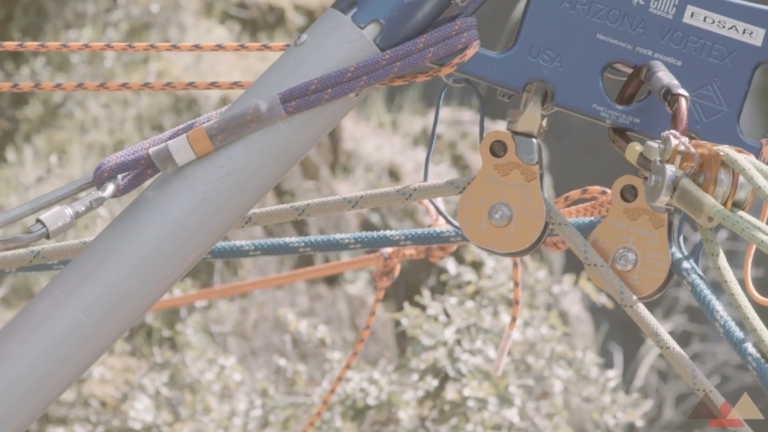
This operation utilizes a sideways A-frame and a monopod working together as a unified movement system. The sideways A-frame supports the Twin Tension Rope System (TTRS) during the vertical phase of the rescue, while the monopod supports the skate block and tensioned track line used for horizontal transportation. Rather than forcing a single structure to manage both phases of movement, each structure is assigned a specific role within the overall rescue strategy. The result is a system that remains organized, predictable, and adaptable as the movement requirements change.
Assigning Vertical and Horizontal Functions
The effectiveness of the system begins with role separation.
The sideways A-frame serves as the primary elevated anchor structure for the TTRS. Its purpose is to support the rope systems responsible for raising and positioning the litter during the vertical phase of the rescue. By elevating the rope path above the edge, the structure improves clearance, reduces terrain interference, and creates a more efficient path between the load and the rope systems.
The monopod performs a different task.
Rather than supporting the vertical movement system, it supports the skate block and tensioned track line used during the horizontal phase. This allows the track line to occupy its own position within the system without competing with the rope paths associated with the TTRS.
The result is a clear division of responsibilities:
- Sideways A-frame supports the vertical movement phase.
- Monopod supports the horizontal movement phase.
- The litter moves between the two systems as the rescue evolves.
Supporting a Continuous Movement System
Although the structures perform different functions, they are not independent operations.
The litter moves through a continuous sequence:
- Vertical movement using the TTRS.
- Positioning into transfer location.
- Connection to the skate block.
- Transfer onto the tensioned track line.
- Horizontal transportation to the landing zone.
The objective is not to complete one rescue system and then build another. The objective is to create a movement corridor that allows the litter to pass from one phase to the next with minimal interruption.
This approach reduces unnecessary handling and allows rescuers to maintain control throughout the evolution.
Managing the Transfer Point
The transfer between the TTRS and the tensioned track line represents the most significant technical phase of the operation.
During this transition, the litter moves from a system designed primarily for vertical movement into one designed for horizontal transportation. The transfer requires rescuers to manage load progression carefully while maintaining control of litter position and orientation.
Several factors must be verified before movement continues:
- Attachment points are confirmed.
- Skate block engagement is verified.
- Track line tension is established.
- Litter alignment is maintained.
- Movement responsibilities are clearly defined.
The goal is a controlled transfer in which the litter remains continuously managed while support shifts from the TTRS to the track line system.
Structural Modularity in Complex Terrain
One of the primary advantages of the hybrid configuration is modularity.
The sideways A-frame and monopod do not need to perform identical functions. Each structure can be optimized for its specific purpose while remaining part of the larger rescue system. This allows rescuers to adapt more effectively when terrain requires multiple movement directions within the same operation.
The configuration also provides flexibility during planning. Depending on terrain, available anchors, and movement objectives, the relationship between the structures can be adjusted without fundamentally changing the operational concept. The structures remain specialized, while the overall system remains adaptable.
A Unified Approach to Complex Movement
The value of the hybrid system is not found in either structure individually. Its value comes from how the structures work together to support different phases of the same rescue. The sideways A-frame manages the vertical movement requirements associated with the TTRS, while the monopod supports the skate block and tensioned track line used for horizontal transportation. Together they create a continuous movement system capable of handling terrain that requires both elevation change and lateral travel.
As rescue environments become more complex, the ability to assign specific functions to specialized structures becomes increasingly valuable. Hybrid high directional systems provide rescuers with a practical method for integrating vertical and horizontal movement into a single coordinated operation while maintaining control, efficiency, and adaptability throughout the rescue.
Peace on your Days
Lance