From Two-Tensioned Rope Systems to Tensioned Track Lines
Managing Redundancy, Load Sharing, and System Transitions in Canyon Rescue
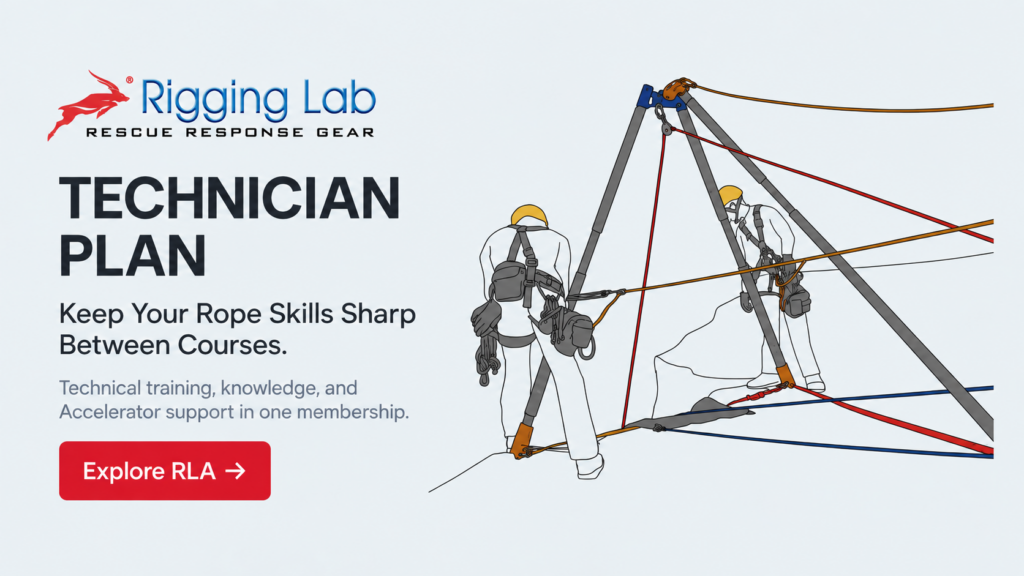
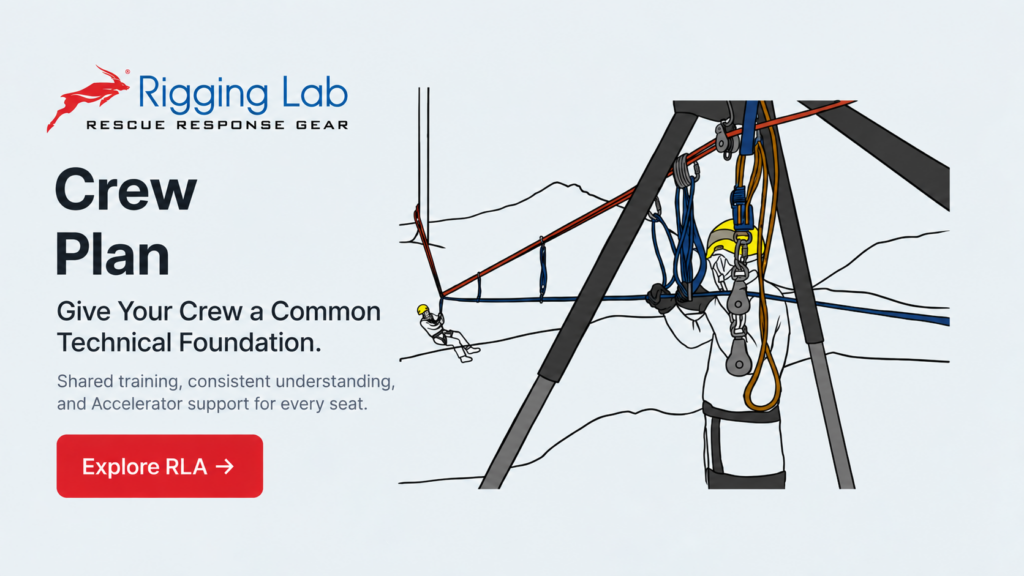
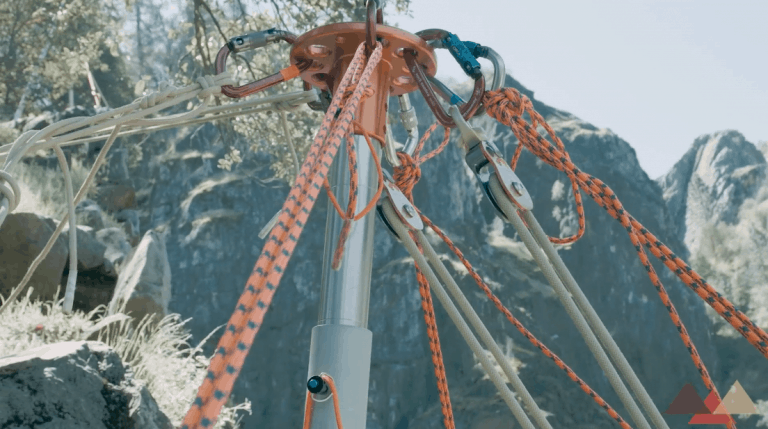
Technical rescue operations rarely fail because rescuers cannot build a lowering system. They fail because rescuers lose control of force during transitions. This becomes especially apparent in canyon environments where a rescue may begin as a vertical lowering operation and evolve into a horizontal transportation problem. The operation examined here demonstrates precisely that challenge—a Two-Tensioned Rope System (TTRS) lowering a litter from a canyon rim before transferring the load onto a tensioned track line for final evacuation.
The significance of the operation is not the litter lower itself. The significance lies in maintaining system control while moving a load between fundamentally different rigging environments.
Why TTRS Changes the Conversation
Traditional rescue doctrine often separates a working line from a dedicated belay line. In a TTRS configuration, both ropes are designated as operational systems capable of supporting and controlling the load.
This distinction is important.
The objective is not simply redundancy through backup. The objective is redundancy through capability.
Each rope system must be capable of:
- Supporting the entire load independently.
- Controlling movement independently.
- Arresting movement independently.
- Continuing the operation if the companion system is compromised.
Rather than relying on a passive safety system, TTRS creates two fully functional systems operating simultaneously.
This approach provides greater operational flexibility during complex terrain movement and reduces dependence on a single active control line.
Anchor Architecture and Load Path Separation
The effectiveness of a TTRS begins at the anchor system.
Both rope systems must maintain independent load paths from anchor to litter attachment.
This requires consideration of:
- Anchor placement.
- Resultant force direction.
- Edge geometry.
- Rope routing.
- Hardware compatibility.
- Operational access for rope teams.
The goal is not merely building two anchors. The goal is preventing a failure in one system from propagating into the second.
This is why force-path analysis becomes more important than hardware selection. Hardware can be redundant and still create shared vulnerabilities if force paths converge through common components.
The question is never whether there are two ropes.
The question is whether there are two truly independent systems.
The Edge Transition as a Force Event
Most rescuers view the edge transition as a movement problem.
It is more accurately described as a force-management problem.
As the litter moves from supported terrain into suspension, the system experiences a rapid shift in loading characteristics.
Several changes occur simultaneously:
- Terrain support is removed.
- Rope tension increases.
- Resultant force direction changes.
- Anchor loading stabilizes.
- Litter attitude becomes more sensitive to rope adjustments.
The objective during the edge transition is not simply moving the litter over the lip. The objective is controlling the conversion from ground-supported load to rope-supported load without introducing instability into either tensioned rope system.
This is where edge personnel contribute most significantly. Their role is force management through litter control.
Operating Under Dual Tension
Once the litter becomes fully suspended, both rope systems remain active.
Unlike traditional main-and-belay configurations, each system contributes to load management.
Small adjustments on one rope influence:
- Litter position.
- Load distribution.
- Rope tension.
- Attendant orientation.
- System balance.
This requires continuous communication between operators.
The operational challenge is maintaining predictable load sharing without creating unnecessary tension differentials between the systems.
- The objective is not equal loading.
- The objective is controlled loading.
- Those are not the same thing.
Perfectly equal tension is neither practical nor necessary. What matters is that both systems remain capable of immediately assuming full operational responsibility if required.
Edge Protection and Resultant Control
The canyon edge becomes a significant force-management point.
Both ropes experience:
- Directional change.
- Abrasion potential.
- Contact pressure.
- Cyclic loading.
Edge rollers and redirects perform more than protective functions.
They influence the resultant force entering the anchor system.
As rope angles change during the descent, the relationship between load, redirect, and anchor changes as well. Understanding those relationships allows rescuers to anticipate changing forces rather than simply reacting to them.
This is particularly important during long lowers where rope stretch, terrain geometry, and litter position continue to evolve throughout the operation.
Transitioning from Vertical to Horizontal Systems
The most technically demanding portion of the operation occurs when the litter reaches the transfer point and moves from the TTRS into a tensioned track line system.
At this moment, rescuers are not simply changing equipment.
They are changing force environments.
The TTRS primarily manages vertical force vectors.
The tensioned track line introduces:
- Horizontal force vectors.
- Increased anchor forces.
- Span-induced loading.
- Sag management considerations.
- Track line tension requirements.
The transition must occur gradually.
Load ownership moves progressively from the TTRS to the track line while maintaining continuous control of the litter.
- No shock loading.
- No uncontrolled unloading.
- No ambiguity regarding which system currently controls the load.
- The transfer itself becomes the operation.
The Tensioned Track Line as a Force Multiplier
Once attached to the track line, the rescue enters a different phase entirely.
The objective is no longer lowering.
The objective is controlled horizontal transportation.
Track line systems allow rescuers to move patients across terrain that would otherwise require extensive manpower, hazardous terrain access, or multiple intermediate lowering and raising operations.
However, the efficiency of the system comes at a cost.
As track line tension increases, anchor forces increase as well.
This makes anchor design, span management, and force analysis critical considerations.
The system may appear simple from a distance, but the forces acting within the anchors often exceed those experienced during the lowering phase.
Understanding the Rescue as a Unified System
The operation demonstrates an important principle within modern rope rescue.
The rescue is not a lowering operation followed by a track line operation.
It is a single movement system composed of multiple force environments.
The TTRS, edge transition, rope path management, load transfer, and tensioned track line all function as interconnected components of the same operational objective.
Understanding how force moves between those components is what separates equipment operators from rigging analysts.
The challenge is never simply moving the litter.
The challenge is maintaining control as the force environment changes around it.
Peace on your Days
Lance