A rescue package must travel across a gap between two elevated positions, and the clearance beneath the crossing is limited. The crew has to move the load while managing the forces placed on the system that supports it.
A two-rope offset, a highline and a two-rope dynamic directional can all accomplish that movement, but each one works through a different mechanical arrangement. All three are shown here with dual-tension rope pairs, and every pair runs on two 3:1s in parallel. Those parallel hauls appear in all three systems, so the difference between the systems lies in the geometry and in where the load is held, not in the number of ropes or hauls.
What a Parallel Haul Is
A parallel haul is two ropes on the same load, each with its own mechanical advantage system, hauled at the same time. It is tempting to add the two systems together, so that two 3:1s become a 6:1, but mechanical advantage does not add that way.
Take a 180 lb load on a single rope. An ideal 3:1 on that rope needs 60 lb of input to move it. Now share the same load between two ropes, so that each rope carries 90 lb, and put an ideal 3:1 on each: each haul needs 30 lb, and together they still need 60 lb, exactly what the single 3:1 needed. A true 6:1 would move the same load with only 30 lb of total input.
| Ideal, 180 lb load | Tension per rope | Input per haul | Total input |
|---|---|---|---|
| One rope, one 3:1 | 180 lb | 60 lb | 60 lb |
| Two ropes, a 3:1 on each (parallel haul) | 90 lb | 30 lb | 60 lb |
| One rope, a true 6:1 | 180 lb | 30 lb | 30 lb |
Load-cell testing confirms it. With a 160 lb load, a single 3:1 took 74 lb of input, two 3:1s side by side took 76 lb between them, and a true 6:1, built by ganging a 2:1 onto the haul line of a 3:1, took 37 lb.
A parallel haul halves the tension in each rope and halves the pull each team must supply, and the second rope adds redundancy. It never reduces the total input or the total force on the system; more mechanical advantage has to be built into the system itself.
The Question That Separates Them
One question sorts the three systems: where is the load held, and does the rope end there or pass through? In a two-rope offset, the ropes terminate at the package. On a highline, the trackline passes over a carriage that travels along it. In a two-rope dynamic directional, the mainline passes over a pulley held in the air by other ropes, and the package hangs below that point.
A rope that changes direction over a pulley it does not terminate on is a directional, whether that pulley sits on an AHD head, rides on a trackline, or is held mid-span by other ropes. The structure holding a directional carries the resultant of the rope legs, not just the tension of one rope. Every system here uses directionals at the rims; what changes is what happens at the point over the gap.
The Two-Rope Offset
In The Two-Rope Offset, rope systems anchored on opposite rims run over elevated directionals and terminate at the rescue package, so the package is held directly by two live, independently controlled systems. It moves only through coordinated hauling and lowering: one side takes in rope while the other pays out at a matched rate, and the package follows an arc set by the changing geometry of the supporting ropes.
As the package moves, the angle between the ropes changes, and so do the forces each rope and its anchors carry. A deeper V keeps each rope’s tension lower but needs more clearance beneath the load; pulling the package high and flat multiplies the tension and turns the offset into a highline without highline anchors.
Each side here runs as a tensioned pair, with each rope on its own 3:1. Those two 3:1s are parallel hauls: each rope carries about half of that side’s tension and each team pulls about half as hard, but together they need the same input as a single 3:1, so the pair adds redundancy, not mechanical advantage.
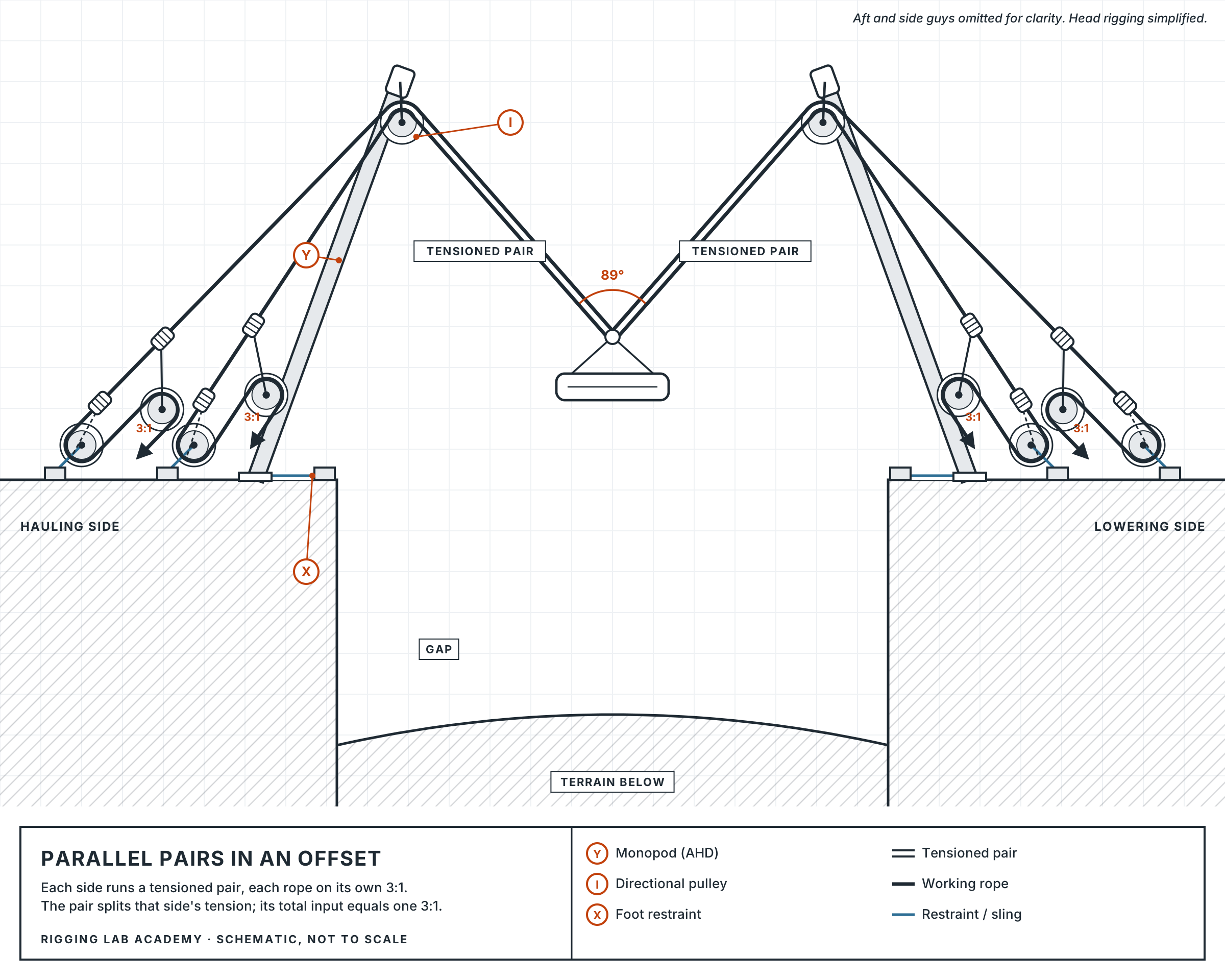
Two-rope offset. Each side runs a tensioned pair, each rope on its own 3:1; the pair splits that side’s tension, and its total input equals one 3:1.
The Highline
A highline uses a pre-tensioned trackline that stays static while the load rides along it. The trackline passes over the carriage’s sheaves without terminating, which makes the carriage a traveling directional, and control lines from each side move it along the span.
The two trackline legs at the carriage must support the load’s weight, so the flatter the line runs, the less of each leg’s tension points upward and the higher that tension must climb. The crew therefore has to evaluate the span, trackline tension, sag, anchor loading and the clearance needed for the complete rescue package.
Each trackline here is tensioned by its own 3:1, and those tension systems are parallel hauls too. Each trackline carries about half of the trackline tension, yet splitting that tension between two ropes does not reduce the anchor load, which the load and the sag still set.
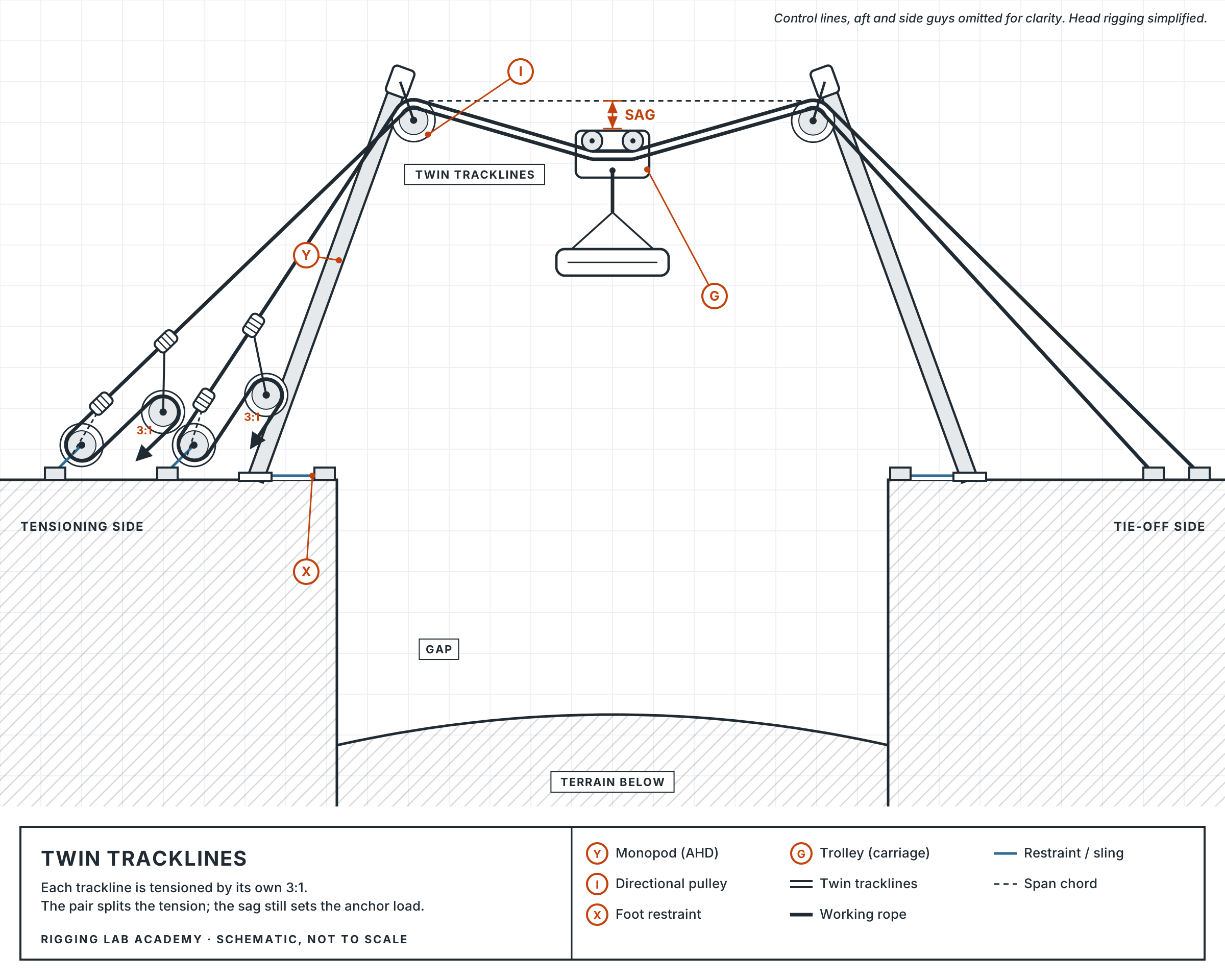
Highline. Each trackline is tensioned by its own 3:1; the pair splits the trackline tension, while the sag still sets the anchor load.
The Two-Rope Dynamic Directional
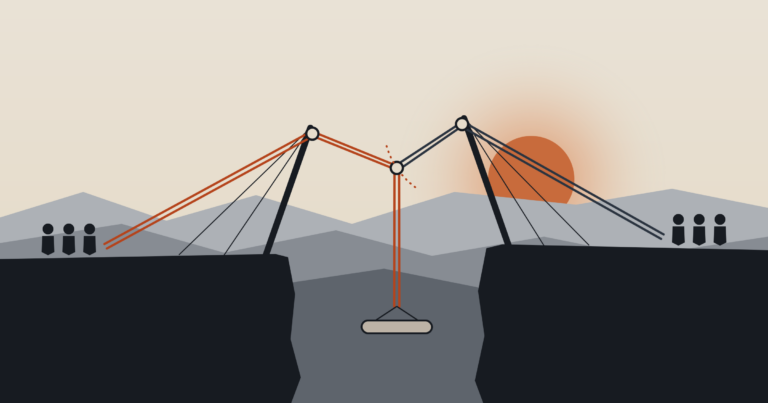
The third arrangement looks like an offset from a distance, since ropes from both rims meet over the gap, but it works as a vertical two-rope system. A mainline pair runs from one rim over an elevated directional, out to pulleys in the span, and then straight down to the package. Those pulleys are held by a pair of directional lines from the opposite rim, and the directional is dynamic because those lines can be hauled or released during the operation to place it over the point where the package must go.
The package is raised or lowered on the mainline pair along a single fall line beneath that point, so it does not depend on the push-pull exchange of an offset. Each mainline rope carries about half the load, while the directional lines carry the resultant of the mainline’s bend at the pulleys, which grows as that bend sharpens. The directional lines and their anchors therefore have to be built for a force comparable to the load itself, not for a light positioning pull.
The mainline pair and the directional lines each run on parallel 3:1s. Raising the package on two 3:1s takes the same total input that one 3:1 would, and the directional lines divide the resultant between them without reducing it.
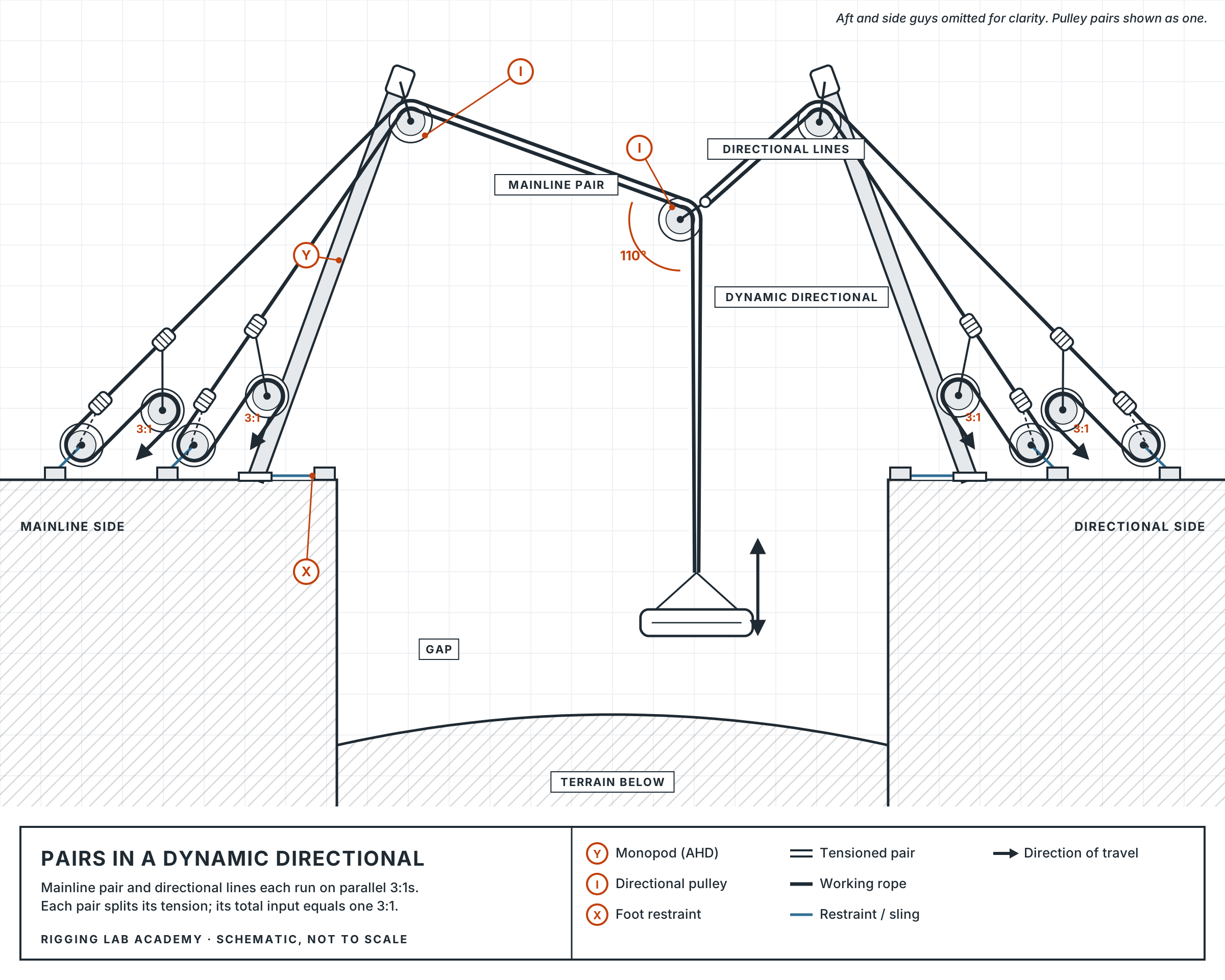
Two-rope dynamic directional. The mainline pair and the directional lines each run on parallel 3:1s; each pair splits its tension, and its total input equals one 3:1.
Side by Side
| Two-rope offset | Highline | Two-rope dynamic directional | |
|---|---|---|---|
| Where the load is held | Ropes terminate at the package | Carriage rides the trackline | Package hangs below a directional held mid-span |
| How the load moves | One side hauls, the other lowers | Control lines move the carriage along the span | Mainline raises or lowers along one fall line |
| What sets the tension | The V angle at the package | Trackline sag | The mainline’s bend at the directional |
| What the crew must manage | Coordination between both sides and a deep V | Trackline tension, sag and anchor loading | The directional lines’ load and the drop beneath the directional |
Choosing the System
Each of these systems can carry a package across the same gap, and each can be built with the same tensioned pairs and the same parallel 3:1s. What separates them is where the load is held and what governs the tension once it is moving: the V angle in an offset, the sag of the trackline in a highline, and the bend of the mainline at the directional in a two-rope dynamic directional. Parallel hauls sit inside all three, dividing the work between ropes and teams and adding redundancy, but they never add mechanical advantage or lower the force the geometry places on the anchors.
That is why none of these arrangements can be judged simply by whether the technician knows how to construct it. The right choice comes from understanding how the system will behave through the entire movement, from the first pull at the rim to the moment the package arrives where it needs to be.
Peace on your Days
Lance