The ability to span a canyon, river, industrial void, or structural gap is one of the most demanding skills in advanced rope rescue. While offsets, tracklines, and guided systems are essential tools, the true test of technician-level capability is the high-tension highline. Unlike everyday rigging, high-tension systems do not forgive misunderstandings in geometry or guesswork around force behaviour. Their forces grow exponentially—not gradually—and they expose errors instantly and brutally.
This article converts highline theory into a practical, system-driven narrative. The goal is simple: show exactly why high-tension systems are so dangerous, how to engineer them correctly, and what separates competent field rigging from disciplined, technician-level highline operations.
1. Highlines vs. Offsets: The Distinction That Shapes Every Decision
Before managing forces, rescuers must understand the difference between true highlines and offset systems. These two systems look similar to beginners, but their physics and anchor requirements could not be more different.
A highline spans a full gap with the load completely off the ground. Clearance is essential, and sag must be minimised. That requirement—less sag—creates the foundation for the enormous forces that make highlines so risky.
By contrast, an offset simply redirects a primary line around a feature. Offsets need only enough tension to swing the load clear of terrain, not enough to suspend it midair over an entire span.
This difference drives every rigging choice:
-
Highlines
-
Designed to fully suspend the load
-
Require high initial tension
-
Generate force multipliers that can exceed ten times the load
-
Used across rivers, industrial voids, canyons, and large gaps
-
-
Offsets
-
Guide or steer a load around a hazard
-
Operate with minimal tension
-
Impart comparatively low force into anchors
-
Used on cliff overhangs, industrial obstructions, and structural edges
-
This competency is not optional. NFPA 1006 requires technicians to understand the vector forces behind tensioned systems because once sag is reduced and the span grows long, the anchors see forces that no everyday rigging scenario ever produces.
2. The Real Physics: Why Highline Forces Multiply Exponentially
The greatest danger in rigging a highline is not equipment failure—it is operator misunderstanding. A highline is a geometry problem disguised as a rope system, and the critical variable is the trackline angle at the anchors.
As the angle widens (that is, as the line becomes flatter), the load on each anchor climbs at an accelerating rate, not a linear one. A small reduction in sag can produce massive increases in anchor tension.
To help visualise:
-
At 120 degrees, each anchor sees roughly the full load (100% of the load).
-
At 150 degrees, each anchor sees about double the load (200%).
-
At 170 degrees, each anchor sees nearly six times the load (573%).
-
At 175 degrees, each anchor sees more than eleven times the load (1147%).
These multipliers are not academic. They determine whether an anchor survives or fails catastrophically. Most inexperienced teams continue tensioning a trackline until it “looks right,” not realising they are driving tension into the explosive end of the curve.
This same principle shows up in anchor choice:
-
A two-point anchor system supporting a suspended 100-kg load at 90 degrees distributes tension so each anchor sees roughly 71 kg.
-
A single directional pulley carrying that same 100-kg load concentrates both rope legs into one point—producing about 141 kg on the anchor.
A single redirect nearly doubles the anchor force compared to a simple two-leg suspension. The pattern is consistent: geometry multiplies forces far more than equipment ratings will ever reveal.
3. Anchor Systems: The Bombproof Foundation of All Highlines
Because highlines generate massive forces, the anchor system must be stronger than anything normally used in rescue. In high-tension environments, the phrase “bombproof anchor” is literal: the anchor cannot shift, rotate, settle, twist, or creep—not one millimetre.
Highline anchors fall into two groups:
-
Static Anchor
The fixed end of the trackline. It absorbs the full multiplied force. It must not move under any condition. -
Tensioning Anchor
Houses the mechanical advantage system. It feels dynamic forces during tensioning and must be equally robust.
Key techniques separate competent anchors from catastrophic ones:
Tensionless Anchor (High Strength Tie-Off)
This method is the gold standard for maximising rope strength.
-
By eliminating a force-bearing knot, it avoids the 50% strength reduction associated with knotting.
-
Multiple wraps around a large-diameter object (minimum three inches) carry nearly all tension.
-
The final securing knot sees almost no load, preserving rope strength close to its full rating.
Removable Bolts (RBs) for Load-Sharing in Rock
In austere environments, rescue teams rely on removable bolts:
-
A 3/4-inch RB rated near 5000 lbs becomes a modular anchor point.
-
Multiple bolts must be used and load-shared to exceed expected highline forces.
-
In twin-tension highlines, clean load distribution between bolts is mandatory.
An anchor that is “good enough” for everyday rescue is wildly insufficient for high-tension systems. Highlines punish anchor weakness without warning.
4. Tension and Sag: The Delicate Balance
Highline rigging is ultimately the discipline of managing tension and sag. You must allow enough sag to keep anchor forces survivable—yet limit sag enough to prevent the load from touching the ground.
This creates the central dilemma:
More tension increases clearance but escalates anchor forces.
Less tension reduces anchor forces but sacrifices clearance.
Technicians solve this through disciplined sag management:
The 10% Sag Rule
A professional standard: pre-tension the trackline until unloaded sag equals approximately 10% of the span length.
-
This provides a predictable safety buffer.
-
It limits peak anchor forces once the load is applied.
-
It reduces the temptation to overwork.
Bundled Systems for Minimal Sag
When sag must be minimal—swiftwater, wide industrial gaps—the solution is not to over-tension one rope.
Professionals use multiple parallel tracklines:
-
Two-line or four-line bundles distribute the load.
-
Each rope carries less tension.
-
Sag decreases without creating destructive anchor forces.
Load Cells for Real-Time Monitoring
Highline forces are too great to guess.
Inline dynamometers provide essential data:
-
Confirm anchor loads stay within allowable limits
-
Verify equal load distribution across twin tracklines
-
Identify dangerous spikes during movement or transitions
The Slipping Clutch System
A highline fuse is built into the tensioning system:
-
Often created with three wraps of 8mm cord in Prusik form
-
Slips at a pre-determined load
-
Prevents uncontrolled escalation in anchor tension
No high-tension highline should be deployed without an active method of force validation and a mechanical fuse to prevent catastrophic overload.
5. Advanced Highline Configurations and Specialised Hardware
Advanced systems provide the tools needed to control clearance, manage forces, and maintain redundancy in long-span or high-demand applications.
Artificial High Directionals (AHDs)
AHDs create elevated rope paths that dramatically improve highline geometry.
-
Bipod (A-Frame)
-
Highly versatile
-
Excellent for horizontal highlines and offsets
-
Requires strong guying for stability
-
-
Monopod (Gin Pole)
-
Ideal in narrow or vertical terrain
-
Requires multiple guy lines
-
Offers exceptional reach but demands more technical discipline
-
-
Tripod
-
Best for confined spaces
-
Not recommended for lateral force patterns in horizontal systems
-
Twin Highline Systems
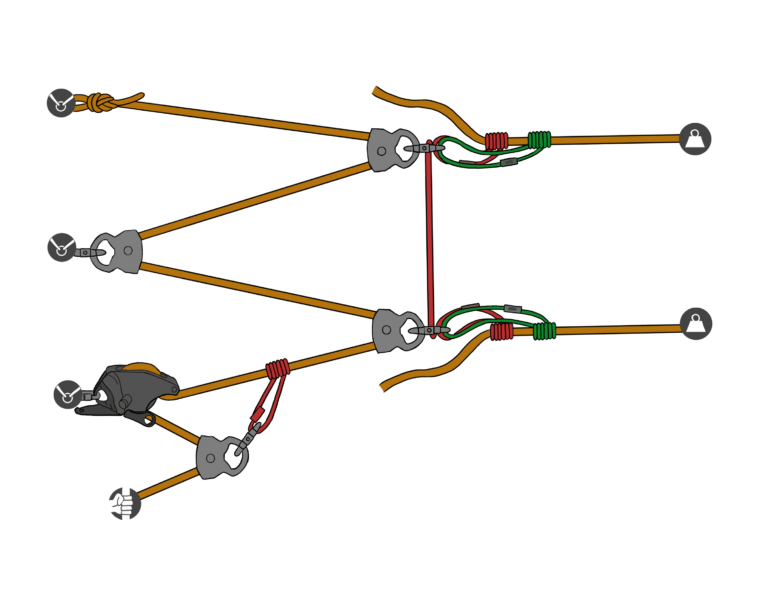
When spans lengthen or loads increase, single tracklines become unsafe. Twin systems distribute the load and reduce sag naturally.
-
Flying W Method
-
Uses twin2:1ss
-
Allows mid-operation tension adjustments
-
Excellent control for long spans
-
-
Tandem Tensioning System
-
Uses paired 8mm Prusiks
-
Prevents point loading
-
Ensures balanced tensioning across both ropes
-
Reeving Systems for Vertical Movement
Sometimes the load must be raised or lowered while travelling horizontally.
-
English Reeve
-
Compound 6:1 MA
-
Smooth “elevator-like” movement
-
Ideal for deep, narrow terrain
-
-
Norwegian Reeve
-
Also 6:1
-
Simplifies rigging by terminating the reeve line at the pulley
-
Requires identical pulley diameters to avoid friction imbalances
-
Each of these systems solves a specific set of operational constraints. Highline design is never one-size-fits-all—it is the synthesis of geometry, load control, and redundancy.
6. Conclusion: High-Tension Systems Demand Disciplined Physics
A high-tension highline is the most unforgiving rope system used in rescue. Its forces escalate exponentially, not predictably. The anchors bear loads far beyond intuitive expectation. Small adjustments to sag create massive changes in force. Operator misunderstanding is the most dangerous variable in the system.
For the advanced technician, mastery requires:
-
Rigging based on calculation, not appearance
A highline that “looks flat” may be hiding an eleven-times-load anchor force. -
Managing sag deliberately
The 10% sag rule limits force growth while maintaining clearance. -
Avoiding overtension through bundled systems
More ropes—not more force—solve minimal-sag problems. -
Using load cells and slipping clutches to validate safety
Active measurement and mechanical fuses make catastrophic overload avoidable.
High-tension systems are not built on strong gear alone. They are built on disciplined thought, predictive physics, and a refusal to rely on intuition when the consequences of misjudgment are catastrophic. When done correctly, the highline becomes a precise, engineered bridge across an otherwise impassable void—stable, redundant, and safe.
Peace on your Days
Lance