Dynamic Directional Offset Systems in Technical Rope Rescue
In technical rope rescue, terrain can present challenges that a conventional vertical lower cannot adequately address. Steep canyon walls, restricted access, and limited clearance may require a load to move both vertically and horizontally to reach a safe destination. For fire rescue and search and rescue (SAR) technicians, a dynamic directional offset provides a means of managing this diagonal movement while maintaining control throughout the transfer.
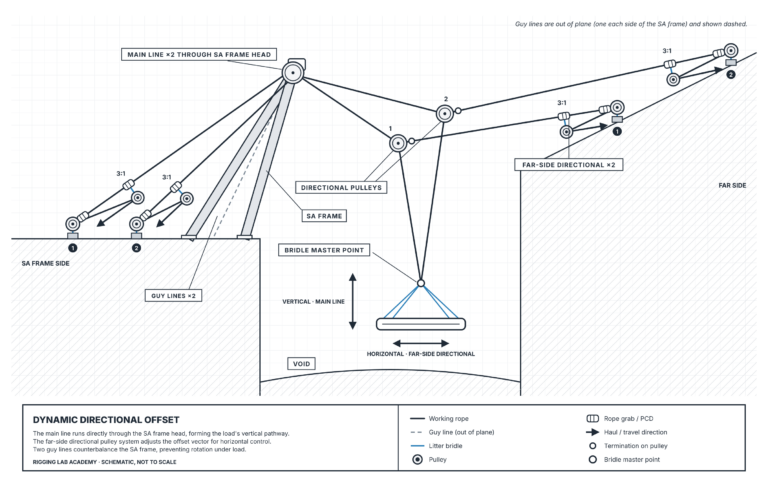
In this demonstration, we construct a dynamic directional offset using a sideways A-frame (SA frame) as the primary pivot point. The frame is securely guyed on both sides to provide lateral and vertical stability under load. The main line passes directly through the SA frame head, establishing the load’s vertical pathway, while a directional pulley system positioned on the far side provides horizontal control. Together, these components establish a managed diagonal offset across the canyon.
<
The stability of the SA frame is central to the system’s performance. Two guy lines counterbalance the frame and resist rotation as the load moves through the offset. The far-side directional pulley system adjusts the horizontal component of the load’s travel, allowing the offset vector to change as the load progresses across the void. This coordinated relationship between the frame, main line, and directional system allows technicians to manage horizontal movement and vertical travel simultaneously.
The dynamic directional offset is particularly applicable in steep canyons, locations with confined access on one side, and rescue operations requiring a combination of vertical and horizontal evacuation. Where a conventional lower cannot provide sufficient separation from terrain or obstacles, the offset creates an alternative load pathway. Maintaining frame stability, controlling the directional movement, and preserving adequate clearance are essential to the success of the operation.
For fire and SAR rescue teams, the value of this system lies in its ability to address complex terrain through coordinated load management. The SA frame establishes the pivot, the main line manages the vertical pathway, and the far-side directional controls horizontal displacement. By integrating these elements into a stable, controlled system, rescue technicians can accomplish diagonal transfers that would be difficult or impractical using a vertical lower alone.
Peace on your Days
Lance