Why Nothing in Technical Rope Rescue Stands Alone
Ask any experienced rope rescue practitioner what separates a competent technician from a truly dangerous one, and you will hear some version of the same answer: the dangerous one knows the pieces but not how they fit together.
They can build a mechanical advantage system — but they haven’t internalized that the anchor must be engineered to handle what that system generates. They can rig a highline — but they haven’t thought through the vector forces that will load every component. They can package a patient — but they haven’t connected their packaging choices to what the mainline system can accommodate. Piece by piece, they are competent. System by system, they are a liability.
This is the central challenge of technical rescue education: the subject matter is deeply interconnected, but most curricula teach it in isolated modules. Students move from Anchors to Mechanical Advantage to Mainline Systems as if crossing items off a list, rarely pausing to understand what each module owes to the ones before it and what it will be asked to contribute to the ones ahead.
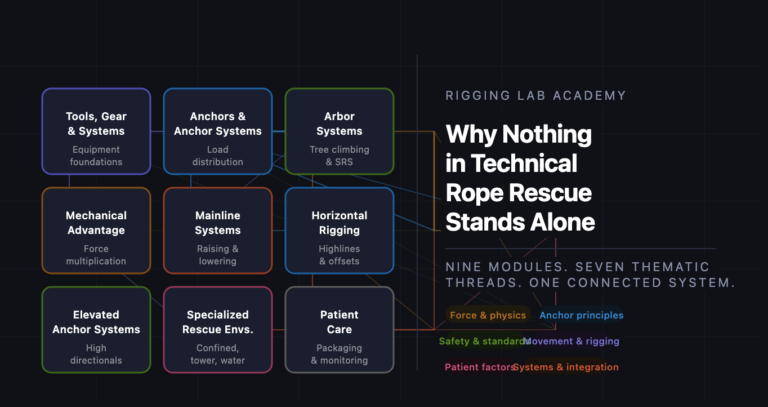
The curriculum at Rigging Lab Academy was built with a different premise: that every module is a node in a network, not a stop on a line. The nine core elements of the program share concepts, vocabulary, mathematical foundations, and operational habits in ways that compound across the curriculum. Understanding those connections — explicitly, not just intuitively — is what turns a collection of skills into genuine system-level competency.
The nine elements of the curriculum
The Rigging Lab Academy curriculum is organized around nine core modules. Each stands on its own as a complete body of knowledge with its own standards, techniques, and assessments. Together, they form a comprehensive framework for technical rope rescue and rigging operations:
- Tools, Gear and Systems — The foundation. NFPA standards, equipment lifecycle management, rope and webbing selection, harnesses, carabiners, pulleys, and specialized hardware. This module establishes the hardware literacy every subsequent module depends on.
- Anchors and Anchor Systems — The most critical single component of any rope system. Single and multi-point configurations, the ERNEST framework, vector force management, specialized devices, and advanced anchor configurations including slack, tensioned, and contingency systems.
- Arbor Systems — The transition from traditional doubled rope technique (DdRT) to modern stationary rope systems (SRS). Ascent methods, canopy navigation, redundancy practices, and anchoring strategies for complex arboricultural environments.
- Mechanical Advantage — The physics of force multiplication. IMA, AMA, TMA, and PMA ratios, the T-Method, pulley classifications, system progression from simple to complex, and powered hauling systems including winches and capstans.
- Mainline Systems — Where theory becomes operational. Raising and lowering systems, progress capture, belay redundancy, Twin Tension Rope Systems (TTRS), tensioned track systems, knot-passing, and advanced patient movement techniques.
- Horizontal Rigging — Spanning gaps and moving loads laterally. Vector forces in highline geometry, Artificial High Directionals (AHDs) for horizontal applications, Norwegian and English reeve methods, twin highlines, and precision load positioning.
- Elevated Anchor Systems — High directionals in depth. The Arizona Vortex, TerrAdaptor, and improvised systems. Physics of elevated redirect, AHD configurations, guy angle calculations, and integration with offset and highline systems.
- Specialized Rescue Environments — Applying the full curriculum under challenging conditions. Confined space rescue, atmospheric monitoring, tower rescue, swiftwater operations, and the A.T.L.A.S.T. response framework.
- Patient Care in Rescue Operations — The human dimension. Assessment and scene management, packaging and immobilization, litter operations across all terrain types, continuous monitoring, and psychological care for patients and rescuers.
A tenth thread runs through all nine: Strategic Program Leadership, which governs how these elements are managed, documented, and sustained at the program level.
Seeing the connections: an interactive thematic overlap map
To make the connections between modules explicit and navigable, we built an interactive curriculum map. Select any of the nine modules and the map reveals every shared concept it holds with every other module — organized by theme and expandable to show the detail of each connection, why it matters, and what goes wrong when students don’t make it.
Seven thematic threads run through the curriculum:
- Force and physics — Vector decomposition, resultant forces, shock loading, mechanical advantage ratios, and the geometry that amplifies or concentrates load across the system.
- Anchor principles — Equalization, redundancy, load-rated hardware, the ERNEST framework, and the progression from simple single-point anchors to complex multi-point configurations.
- Safety and standards — NFPA 1006, 1670, and 2500; OSHA 29 CFR 1910.146; inspection protocols; SOP-driven lifecycle management; and the mindset that separates systematic safety from improvised judgment.
- Movement and rigging — Rope handling, device selection, redirect geometry, descent control, and the principles governing how loads and people move through rope systems.
- Patient and human factors — Packaging decisions, continuous monitoring, rescuer ergonomics, psychological care, and the ways that human variables — weight shift, agitation, medical deterioration — affect technical systems.
- Systems and integration — How individual components combine into functional rescue systems, where those systems are interdependent, and what happens at the boundaries between modules.
- NFPA and compliance — Regulatory requirements that apply across multiple environments and competency levels, and the difference between knowing a standard and building programs around it.
The interactive map is embedded below. Click any module card to see its full overlap network. Expand any pairing to read the detailed explanation of what is shared, how it transfers, and why it matters instructionally.
[ Interactive curriculum map embeds here via iframe ]
The live interactive version is available at rigginglabacademy.com.
What to do with this
For students, the map is a study tool and a preview. Before starting a new module, look at which modules it overlaps most heavily with. Those are your prerequisites in substance, not just sequence. If you felt uncertain in Mechanical Advantage, know that the same force mathematics reappears in Anchors, Elevated Systems, Horizontal Rigging, and Mainline — addressing it now pays dividends across the rest of the program.
For instructors, the map is a curriculum design tool. The most critical cross-module dependency in the program is Mechanical Advantage feeding into Mainline Systems — students who cannot apply the T-method cannot verify that their haul systems are safe. The second most consequential pairing is Anchors and Elevated Anchor Systems: the anchor engineering principles that govern AHD deployment are identical to those that govern ground-based multi-point systems, and students who missed that connection are building AHDs on under-engineered ground anchors without knowing it.
The map also reveals which concepts earn their place through sheer repetition. Force and physics appears in every module. Anchor principles appear in seven of nine. Safety standards and inspection protocols are never far from any operational topic. These aren’t redundancies in the curriculum — they are load-bearing concepts that the program returns to deliberately, because the goal is not coverage but automaticity.
Technical rescue is not a collection of skills. It is a system of systems, and every component of that system must be understood in relation to every other. The map is a tool for building that understanding — explicitly, visibly, and at whatever level of detail the moment requires.
The nine elements are covered in full through Rigging Lab Academy’s curriculum. Explore the modules at rigginglabacademy.com.
Peace on your Days
Lance