Applying Elevated Anchor Systems to Real Structures (or lack of one)
A technician approaching a vertical shaft, tower platform, tank opening, or industrial access point is no longer choosing a high directional in the abstract. The operating environment has already established many of the constraints. The opening may be narrow, the working surface may be limited, existing steel may provide useful elevated attachment points, and the load may have to travel through several distinct positions before reaching a safe working area.
The purpose of the elevated anchor is therefore not simply to gain height. It is to establish a rope pathway that supports the intended movement of the load while keeping the applied forces, structural supports, restraints, and operating area under control.
Vertical-access environments such as tanks, vaults, and confined industrial spaces are specifically identified in the source material as applications where elevated anchor points improve rope routing and allow raising and lowering through controlled geometry. Towers and other industrial structures present the same fundamental problem, although the available space and structural features may be very different.
Vertical Access — Building Above the Opening
Vertical access is the most direct application of an elevated anchor system. The load moves primarily through a vertical opening, and the high directional establishes a working point above that opening so the rope can remain clear of the surrounding edge.
A tripod is often well suited to this geometry because three supporting contacts can surround or straddle the access point while the working point remains above the opening. The geometry is relatively straightforward when the suspended load remains beneath the frame, but the technician must still account for the rope system attached to the head, the location of the operating crew, and any tendency for the load or haul line to move away from the center of the supporting area.
The opening itself also influences the setup. A tank hatch, utility vault, shaft, or confined-space entry may limit leg placement or prevent all three feet from being positioned symmetrically. The surrounding surface may consist of concrete, steel decking, grating, or a combination of structural members. The technician therefore applies the principles established in Unit 4: evaluate what actually supports each foot, establish the required footprint, and verify that the loaded structure remains stable before personnel depend upon it.
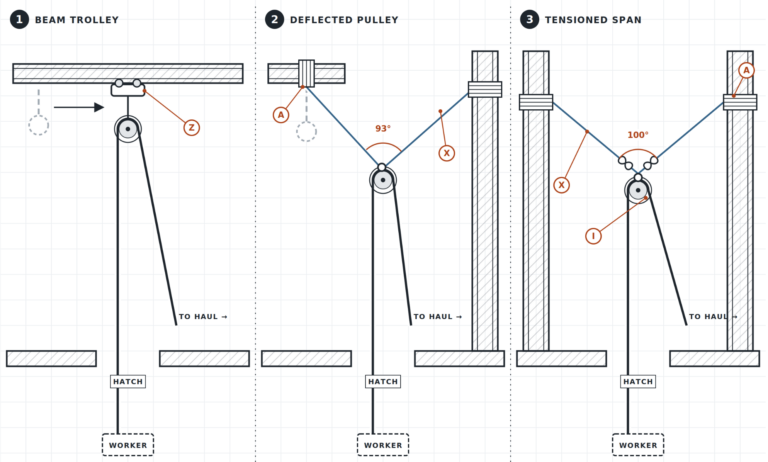
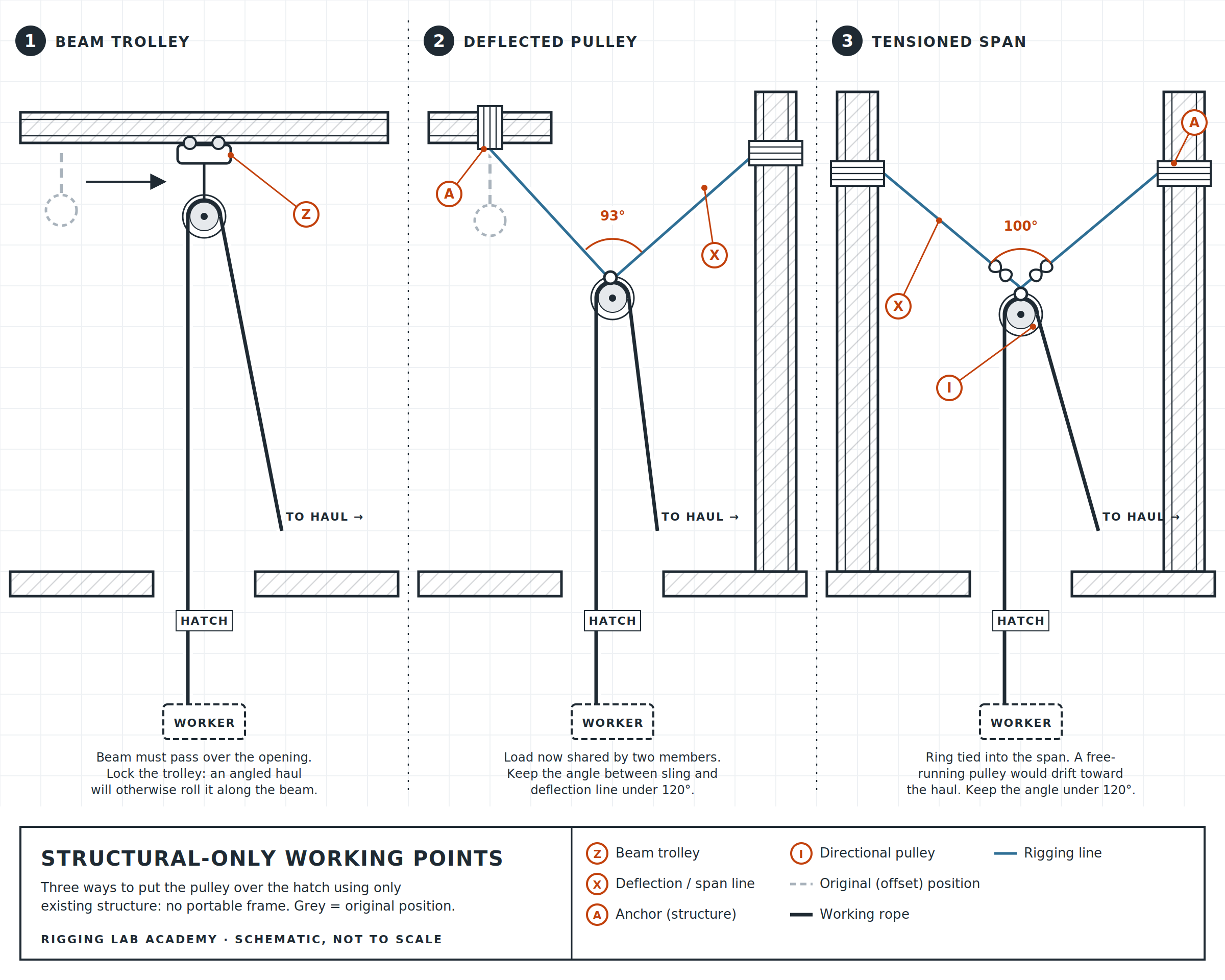
Where a portable frame cannot be positioned effectively, an existing structural high point may provide the required elevation. Permanent steel members, concrete elements, and other structural features can function as elevated anchors when their suitability and load path are established. The source course treats these pre-existing structural features as part of the broader natural or structural high-directional category rather than limiting elevated anchors to portable equipment.
Moving a Load Through the Opening
The mechanical problem changes as the load approaches the elevated working point. A rescuer or litter suspended well below a hatch may produce a relatively straightforward vertical line of action. As the load reaches the opening, however, the technician may need to move it laterally, rotate it, or transition it onto the working surface.
That movement can change the rope angles at the head and therefore change the applied force acting on the frame or structural directional. The system that was stable when the load was centered below the opening must remain appropriate as the load moves through the transition.
For this reason, a vertical-access setup should be evaluated for the entire expected movement, not just the initial suspended position. Clearance at the head, available space around the opening, the working position of the attendants, and the path the load will follow after reaching the surface all belong to the original system design.
This is one reason elevation is useful. The elevated point provides room for the load to approach the opening while reducing direct contact between the working ropes and the edge. It also allows the operating system to remain above the obstruction rather than forcing the rope to bend sharply around the lip of the opening.
Towers — Limited Space and Existing Structure
Tower operations often provide excellent structural material but very little working space. Steel members, columns, platforms, ladders, and bracing may surround the technician, yet the location where the load must move may offer only a small area for a portable frame.
The first question is therefore whether an artificial high directional is needed at all.
A suitable permanent structural member may already provide the required elevated working point. In that case, the technician can use the existing structure as the primary high directional, provided the attachment and supporting load path are appropriate for the anticipated forces. The source material includes steel I-beams, concrete pillars, and other permanently affixed structural features within its definition of existing high directionals. 05-Elevated-Anchor-Systems-Chun…
Where the existing structure does not provide the required position, a compact portable system can establish the missing geometry. Monopods and gin poles are particularly useful where multiple supporting legs would interfere with the platform or surrounding steel. The course source specifically identifies the monopod as an option for towers, confined areas, and industrial environments where space restricts multi-leg configurations.
This does not make the monopod the default tower solution. It means its small footprint can solve a particular geometry problem when the required working point cannot be established directly from the structure.
Working With the Tower Rather Than Around It
Tower structures also create opportunities for hybrid arrangements. A portable high directional may provide the precise elevated point required by the rope system while the permanent structure provides restraint anchors, supporting surfaces, or secondary structural elements.
The technician must be careful not to confuse availability with suitability. Handrails, ladder components, cable supports, and secondary attachments may be conveniently located but may not be intended to receive rescue loads. The complete load path must extend beyond the visible attachment and into structural members capable of carrying the imposed forces.
This is the same reasoning introduced in Lesson 3.4. The member receiving the sling or connector is only one part of the system. Its connections, supporting members, and the direction in which the rescue load is introduced all determine whether the structural high point is appropriate.
The value of the tower is therefore not that it eliminates force analysis. It provides more structural options from which the technician can build the required load path.
Industrial Structures — Geometry Before Equipment
Industrial environments combine many of the challenges found in vertical access and tower work. Tanks, processing vessels, machinery, pipe racks, elevated platforms, bridge structures, catwalks, and maintenance areas can all limit direct access to the load while providing numerous possible structural attachment points.
The operating question remains consistent: where does the load need to move, and what elevated point provides the cleanest controllable rope pathway?
Sometimes the answer is an existing beam or column. Sometimes a portable tripod can straddle the access point. A bipod may be more effective where the system must project beyond a platform edge. A monopod may be appropriate where the available footprint is narrow. In other cases, a portable frame and permanent structural anchor may be combined.
The source course specifically recognizes industrial access, towers, bridge inspection, confined-space maintenance, and vertical lifting as environments where elevated-anchor geometry is applied.
The configuration should follow the problem rather than the equipment inventory.
Selecting the Elevated Working Point
In an industrial environment, the highest available point is not automatically the best working point. Additional height may create clearance, but it can also lengthen structural members, change guy angles, increase the space required for the frame, or create a more difficult rope pathway for the operating crew.
The useful working point is the one that provides enough elevation to clear the obstacle while maintaining a manageable structural arrangement.
The technician should be able to follow the system from the load through the elevated point and into the supporting structure. If the rope passes through a directional pulley, the resulting applied force must be understood at that location. If the rope terminates on the elevated structure, the termination load must be followed into the supporting members and restraints.
The same reasoning applies whether the working point is a manufactured headset or a permanent steel beam. The hardware changes; the mechanical problem does not.
Operating Space Around the High Directional
Industrial and tower operations frequently fail to provide the open workspace found in training areas. The frame may share a platform with rescuers, control devices, mechanical-advantage systems, litter attendants, and existing machinery.
The arrangement must therefore account for how the team will actually work around it.
Important operational considerations include:
- keeping the working and control ropes clear of frame legs, structural edges, and moving equipment;
- preserving access to control devices without forcing operators into exposed or unstable positions;
- maintaining visibility of critical feet, restraints, anchors, and the elevated head where practical;
- providing sufficient clearance for a litter or suspended rescuer to pass through the intended route;
- anticipating where the load will be placed after it reaches the platform or opening.
These are not separate from structural stability. A system that forces operators to move ropes around legs during the evolution or reposition hardware under load may change the geometry the frame was originally designed to maintain.
Structural High Directional or Portable Frame?
The availability of permanent structure creates a recurring decision in industrial rescue: use the building, or introduce an artificial high directional.
A permanent structural high point can reduce equipment, eliminate a temporary footprint, and provide excellent elevation when its capacity and load path are appropriate. It is also fixed in place, which means the technician has limited ability to change its geometry.
A portable frame provides adjustability. Its head can be positioned according to the load pathway, its leg geometry can be adapted to the site, and its restraints can be configured around the available anchors. That adaptability comes with additional requirements for footing, hobbling, guying, assembly, and verification.
A hybrid system may combine both advantages. A structural element can serve as an anchor or restraint while the portable high directional establishes the precise rope position required by the operation. The source material explicitly recognizes this combination of existing structure and artificial directional as a useful approach when the environment provides strength but not ideal geometry.
The decision is therefore functional rather than categorical. The technician selects the arrangement that provides the required rope pathway with a load path that can be understood and controlled.
Operational Scenario — Industrial Tank Access
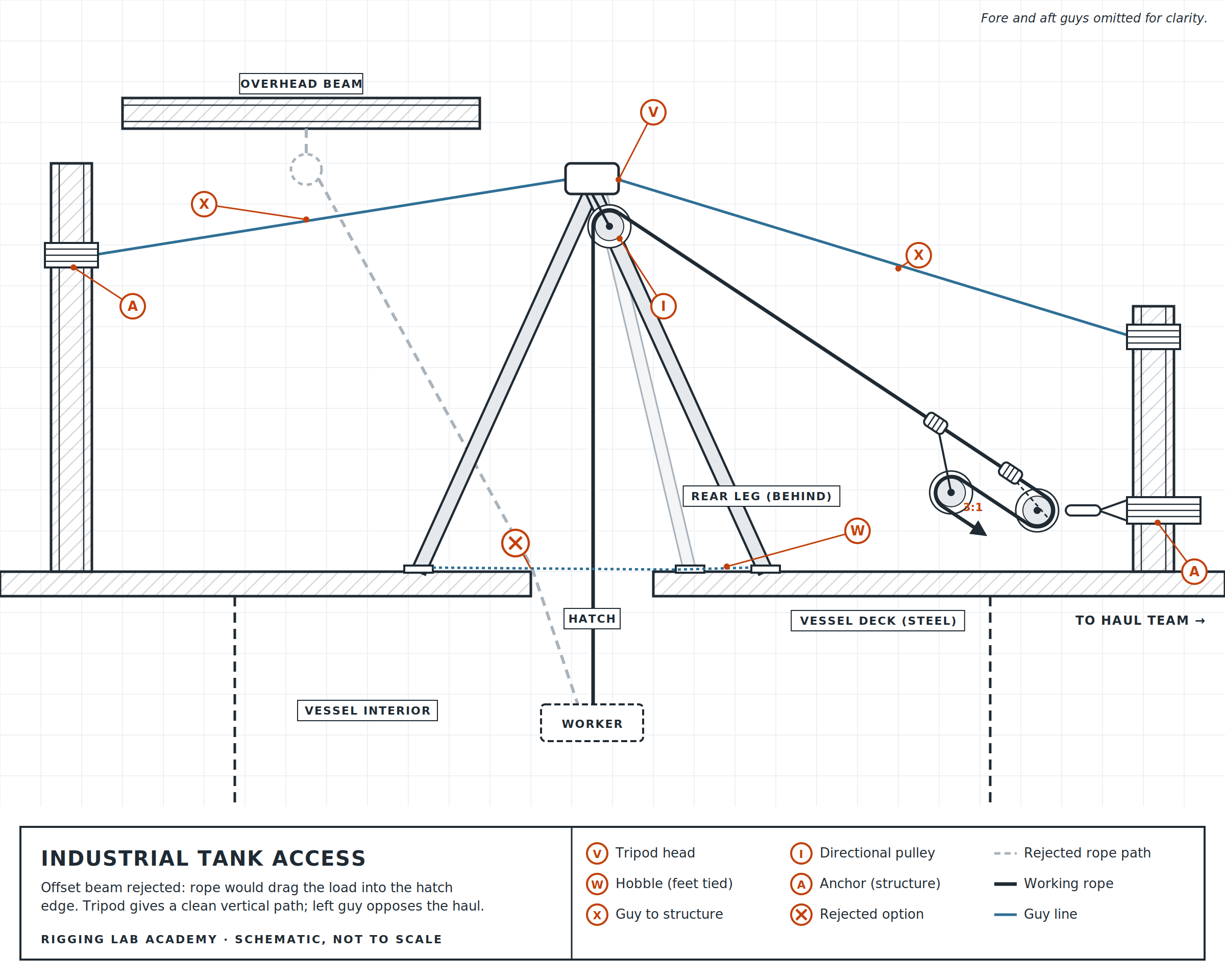
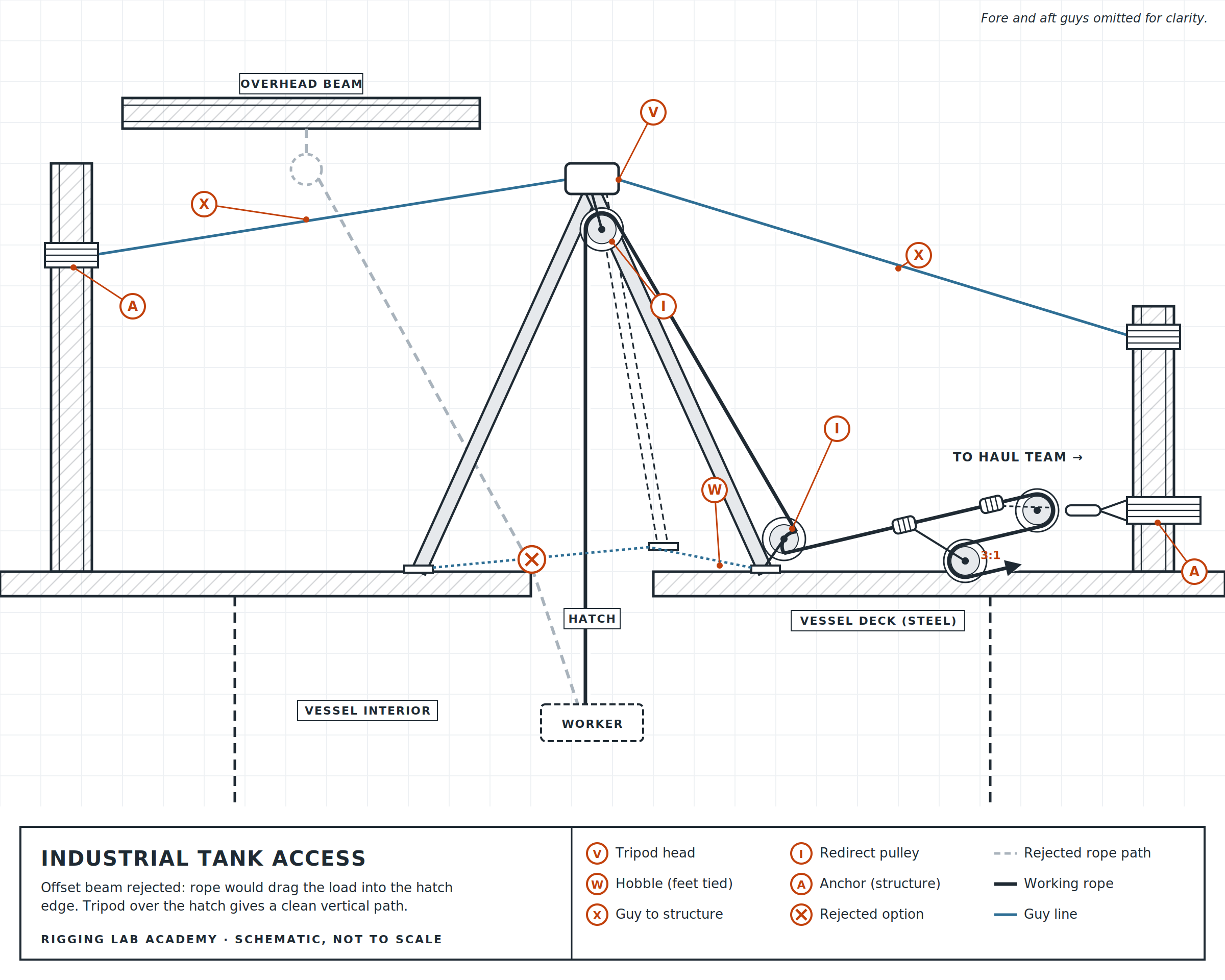
Consider a worker who must be removed through a vertical access hatch on top of a processing vessel. The surrounding deck provides structural steel and several permanent members, but the hatch is positioned away from the most convenient overhead beam.
The team first evaluates whether the existing structure can provide a suitable elevated working point. The available beam is strong and permanent but places the rope at an angle that would drag the load into the side of the opening.
A portable elevated frame positioned over the hatch produces a cleaner vertical path. The frame is placed so the load can rise through the opening, while the surrounding structural steel provides suitable locations for restraint. The system is assembled, positioned, preloaded, and verified according to Unit 4.
As the litter reaches the hatch, the team observes the changing rope geometry and maintains control through the transition onto the platform. The value of the elevated anchor is visible throughout the evolution: the system keeps the rope above the obstruction, provides clearance for the load, and allows the technicians to manage the transition from vertical suspension to platform movement without forcing the rope against the edge.
The same reasoning could produce a different answer on another site. If a structural beam were directly above the opening, the portable frame might be unnecessary. If the platform were too narrow for a tripod, a monopod or structural directional might provide the better solution.
Applying the System Rather Than the Device
Vertical access, tower rescue, and industrial structures demonstrate why elevated-anchor training cannot be limited to a single manufactured AHD.
The technician may use a tripod, bipod, monopod, permanent structural member, or a combination of those elements. The selection changes with the environment, but the required reasoning remains the same: establish the rope pathway, identify the applied forces, understand the supporting structure, control the movement tendencies, and verify the system under load before the operation progresses.
The elevated anchor is successful when it makes the required movement easier to control without creating a new structural problem elsewhere in the system.