
Understanding Artificial High Directionals as Structural Systems
Artificial High Directionals, often referred to as elevated anchor systems, are sometimes treated as specialized accessories used only when terrain or structure presents a difficult edge. In practice, they are much more significant. These systems function as structural components that influence geometry, manage force vectors, improve movement efficiency, and expand the capability of a rescue operation. When viewed solely as edge tools, much of their real value is missed. Their importance lies not only in what they support, but in how they affect the behavior of the entire rigging system.
That broader understanding begins with purpose. The most visible contribution of an elevated anchor system is improved edge management. By lifting rope paths above abrasive or high-friction surfaces, these systems reduce drag, protect rope from damage, and improve transitions when loads move from vertical to horizontal planes. In litter operations or difficult terrain, those improvements can significantly reduce resistance and increase control. Yet experienced teams do not deploy directionals only because an edge is problematic. They deploy them because an elevated anchor can improve the mechanics of the system itself.
That improvement often centers on vector control. Every rigging system develops a line of action, and the quality of that geometry determines much of the system’s efficiency and stability. Elevated anchors allow rescuers to influence that geometry rather than accept whatever terrain imposes. They can improve rope alignment, reduce undesirable force concentrations, and create cleaner force pathways through the system. This frequently results in lower friction losses, improved hauling performance, and more predictable load movement. These are not isolated gains. They influence the behavior of the full rescue system.
Several practical benefits often emerge from that improved geometry:
- Reduced drag and friction at edge transitions.
- Better alignment of rope paths and load vectors.
- Improved efficiency in hauling and lowering systems.
- Greater control over load movement through complex terrain.
- Increased system performance without adding unnecessary complexity.
This is why many advanced teams think of the directional not simply as support hardware, but as part of the rigging architecture.
Classifications of Elevated Anchor Systems
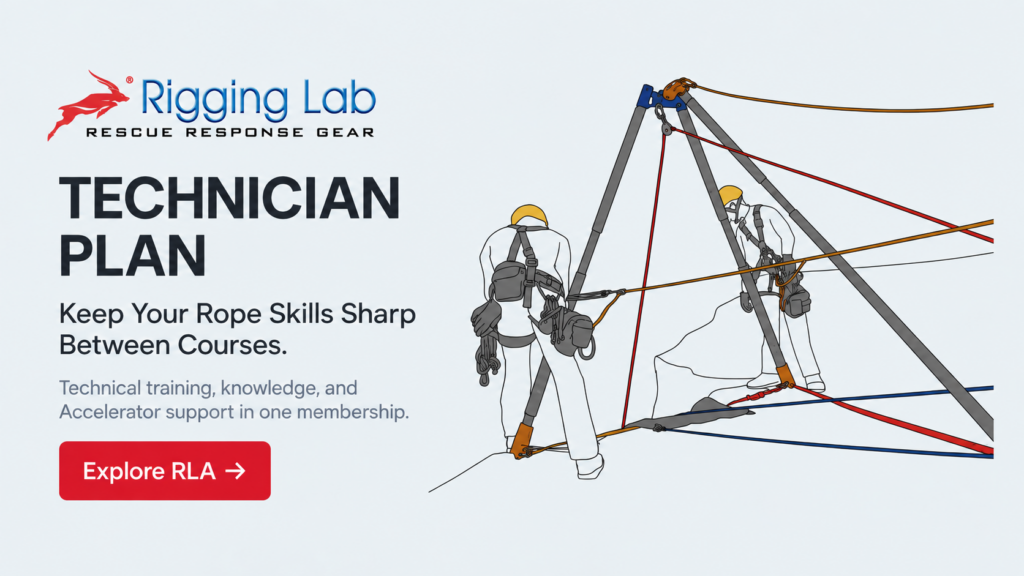
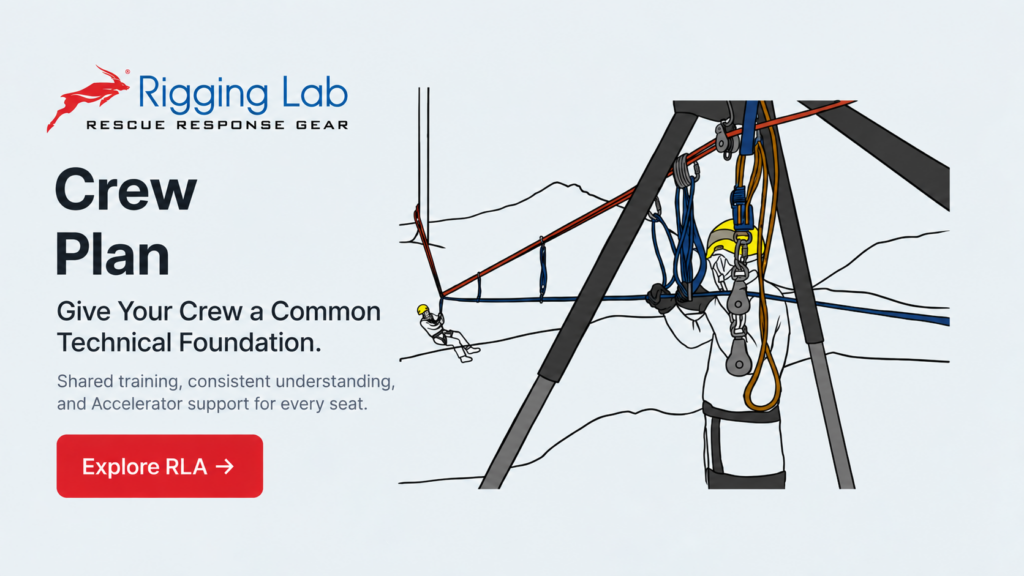
Understanding elevated anchors also requires recognizing that not all directionals solve the same class of problems. Some systems are primarily designed for vertical support and access. Tripods and gin-pole structures often fall into this category, where their strength lies in providing elevation above confined openings or access points where vertical control is the primary requirement.
Other systems operate in a broader directional role. A-frames, side frames, and modular multi-leg structures are often selected because they support vector management and complex movement, not merely vertical support. In these systems, the directional often influences the mechanics of the rescue as much as it supports it.
This distinction is important because selection should be driven by the problem being solved. A system intended for confined space retrieval may not be the correct answer for a terrain-based offset problem. Likewise, a modular directional built for vector management may be unnecessary for simple vertical access. Good rigging practice begins when the directional is chosen to serve the force-path requirements of the system rather than because a familiar piece of equipment is available.
Broadly, these systems tend to fall into three practical categories:
- Support-focused directionals intended primarily for vertical access and retrieval.
- Directional frames used to manage edge transitions, offsets, and changing load paths.
- Hybrid modular systems capable of combining support and directional roles.
These categories overlap, but they help frame how the equipment should be understood.
Operational Modes
One of the most important conceptual distinctions in elevated anchor work is recognizing operational modes. The same structure may serve fundamentally different purposes depending on how it is deployed. In anchor frame mode, the directional functions primarily as an elevated support point. The objective is controlled support, improved access, and reliable elevation of the rope path above the working environment. This is common in straightforward lowering systems, vertical retrieval, and many traditional edge problems.
In directional frame mode, however, the purpose shifts from support to force-path control. Here the structure actively influences the direction and behavior of the load. It may support offsets, help maintain vector alignment in mirrored systems, or manage complex movement trajectories in broken terrain. The physical structure may appear similar, but the governing mechanics are not.
That distinction matters because many misunderstandings in AHD use arise not from hardware misuse but from failing to recognize what mechanical role the system is actually serving. A structure operating as an anchor frame is primarily reacting to forces. A structure operating as a directional frame is often actively shaping those forces. That difference changes how the system should be analyzed.
Configurations and Structural Logic
Configuration choices in elevated anchors should always follow force logic. An A-frame, for example, is often favored where balanced loading and broad stability are desired. Its geometry supports predictable reactions and efficient central loading, making it valuable in many edge transition problems.
Side-frame and offset configurations often serve different needs. Where terrain requires lateral displacement or diagonal movement, those arrangements may better support the intended load path. Monopod and hybrid systems often emerge where space is limited or anchor opportunities constrain more conventional setups.
Regardless of style, sound configuration usually depends on several common considerations, including anticipated load direction, footprint stability, anchor orientation, and potential vector shifts during movement. These factors may not be obvious in the visible rigging, but they often determine whether the structure behaves predictably under load.
Several questions should drive configuration decisions:
- Where is the expected resultant vector likely to fall?
- Does the footprint provide adequate stability for changing loads?
- How will terrain affect rope path and reaction forces?
- Could movement of the load shift vectors significantly during operation?
- Does the configuration support both current and anticipated loading conditions?
These questions move the discussion beyond setup preference and into structural reasoning.
Stability and Mechanics
This is where elevated anchor systems become less about equipment and more about engineering. Stability is fundamentally tied to the relationship between the resultant vector and the directional’s footprint. When the resultant remains within that footprint, reaction forces tend to remain controlled and predictable. When it migrates outside that zone, instability can increase rapidly.
This principle is why stability cannot be judged merely by visual confidence in the structure. A frame may appear secure while still being poorly aligned with the actual force path. Sound practice requires understanding where the forces are going, not simply whether the frame looks solid.
This often requires attention to several interacting mechanics, including compression behavior in the structure, base reactions at leg interfaces, and how vector behavior may shift as the system moves. These are not abstract concerns. They are often the very factors that determine whether a directional performs safely.
Safety and Compliance
Because elevated anchors can expand operational capability so significantly, they also carry consequences when poorly understood. Failures in these systems are often less about isolated hardware issues and more about geometry, instability, or flawed force assumptions. That is why competence in directional systems extends beyond familiarity with equipment. It requires disciplined understanding of configuration, force behavior, and the consequences of changing load paths.
Standards and compliance frameworks help reinforce those principles, but they do not replace mechanical understanding. In many cases, errors in elevated anchor systems are mechanical before they become procedural. Recognizing that is part of mature rigging judgment.
Advanced Rigging Applications
Where elevated anchor systems become especially valuable is in advanced applications where terrain, movement complexity, or anchor limitations would otherwise constrain options. In those environments, the directional often becomes more than a support structure. It becomes part of the organizing logic of the system.
This is particularly true in offset systems, twin tension operations, difficult edge transitions, and terrain problems where conventional anchor geometry begins to limit efficiency or safety. In those cases, the directional is often helping create possibilities that would not otherwise exist.
That may be their greatest value. Elevated anchors do not merely help rescue systems function more cleanly. They often make better systems possible in the first place.
And that is where they should be understood—not as accessories added to a rescue system, but as structural tools that help define how the system works.
Peace on your Days
Lance