
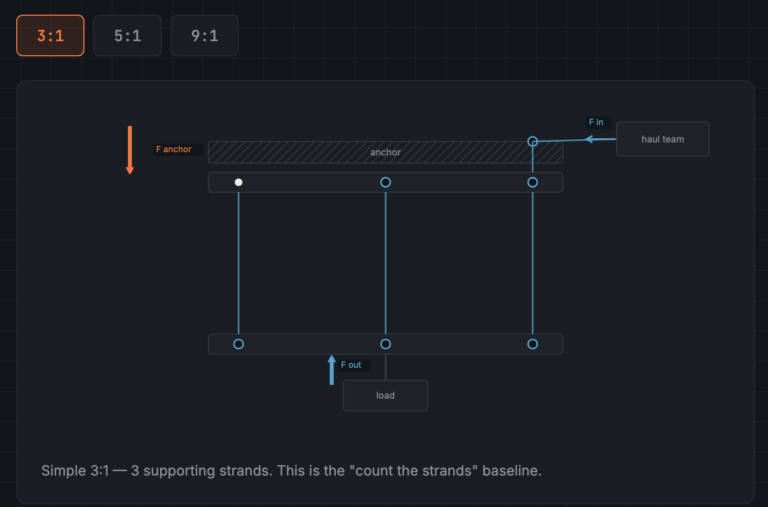
If you can count strands, you can pass a written test. Three strands running to the load, call it a 3:1, done. That’s the answer every student gives, and it’s not wrong — it’s just not the question that matters.
The question that matters is the one nobody asks in class: what does the anchor actually feel? Not the load. Not the number on your rigging plan. The real, physical force pulling on the hardware you tied off to. Counting strands doesn’t get you that number. Neither does memorizing a ratio off a cheat sheet. Getting it requires understanding what’s happening between the load and the anchor — and that’s what this piece, and the tool at the bottom of it, is for.
Theoretical Mechanical Advantage (TMA) is just the strand count. Three strands supporting the load means three to one. That’s the whole calculation, and it’s exact, because it’s geometry, not physics. It tells you nothing about friction, nothing about hardware, nothing about what your haul team actually has to overcome.
Practical Mechanical Advantage (PMA) is what you actually get once friction takes its cut. Every pulley the rope crosses costs you something. A good ball-bearing pulley might only cost five percent. A rough carabiner used as an improvised redirect can cost a lot more than that. The gap between TMA and PMA is the entire reason this conversation exists — a 3:1 at 90% efficiency per pulley isn’t putting out three times your input force, it’s putting out closer to 2.4 times. Drop efficiency further and that gap only widens.
Not every pulley in the system is doing the same job. A moving pulley travels with the load — it’s doing real mechanical work, and it earns its keep in your advantage calculation. A fixed pulley stays anchored in place; it never moves, so it never adds advantage, it only changes direction. A change-of-direction (CD) pulley looks identical to the others in the system, but mechanically it adds zero advantage. All it does is redirect force — and as you’ll see below, that redirect matters more than it looks like it should. Confuse a CD pulley for a moving pulley and your strand count is wrong before you’ve even started building the system.
Simple systems add up differently than compound systems. A simple system is one continuous rope producing one mechanical advantage. A compound system is one simple system hauling another — and the ratios multiply, they don’t add. A 3:1 hauling another 3:1 comes out to nine to one, not six. That’s not a rounding error or a rule of thumb; it’s how the math actually works, and it’s exactly where students’ mental shortcuts fall apart.
Here’s the full calculation, start to finish. The haul team pulls with a set amount of input force. Multiply that by your real PMA — not your TMA — and what’s left is what actually reaches the load.
Now here’s the question that actually matters: what does the anchor see? Not the load. Not just the output force you just calculated. When the haul line redirects back through the anchor — which it usually does, because that’s exactly what a CD pulley at the anchor is for — the anchor sees the load and the haul team’s pull, combined. Run the numbers on a simple 3:1 at 90% efficiency with a 50 lbf haul: your anchor isn’t holding 122 lbf of output force. Depending on the angle between the haul line and the load line at that redirect, it’s holding somewhere between 72 and 172 lbf. That range is bigger than almost anyone expects the first time they see it calculated out.
Summary
Strand counting gives you a starting point, not an answer. The real anchor-selection number depends on your actual pulley efficiency, whether your system is simple or compound, and — critically — whether and how the haul line redirects back through your anchor. Skip any one of those and you’re rigging off a guess dressed up as a fact.
The interactive tool below lets you build this intuition yourself. Switch between a 3:1, a 5:1, and a 9:1 system, drag the efficiency down to see how fast PMA falls off a “good” 90% baseline, and flip the anchor redirect on and off to watch the force-on-anchor number change in real time. Spend five minutes in it before your next system walkthrough — it’ll change how you look at every anchor you tie off to.
Simplified teaching model — PMA is approximated as TMA × efficiency^(strands − 1), and anchor force as output force plus input force when the haul line is redirected back through the anchor. Not a substitute for manufacturer strength ratings, testing, or a proper engineering load calculation.