Patient packaging is the bridge between patient care and technical rescue.
Before a litter is attached to a rope system, before a haul team begins raising, and before a lowering operation moves over an edge, rescuers must first address a more immediate concern: preparing the patient for transportation. The technical rescue environment introduces forces, movement, and hazards that can affect both patient safety and medical outcomes. A patient who is not properly packaged may be exposed to unnecessary movement, environmental hazards, or additional injury during transport.
For this reason, patient packaging should never be viewed as a simple collection of straps, harnesses, or tie-in techniques. Instead, it represents a systematic process designed to secure, protect, and support the patient throughout the rescue operation. Every component of the packaging system serves a purpose. Positioning helps maintain comfort and stability. Tie-in systems limit unwanted movement. Protective measures shield the patient from environmental hazards. Together, these elements create a transport-ready patient capable of safely moving through the rescue environment.
Technical rescue operations often occur in locations where conventional patient movement is impossible. Steep terrain, vertical environments, confined spaces, industrial structures, and wilderness settings all introduce unique challenges that influence how a patient must be packaged. As these challenges increase, so does the importance of a well-planned packaging system. The goal is not merely to place a patient into a litter. The goal is to create a secure environment that maintains patient stability while supporting the demands of transportation.
Patient packaging also establishes the foundation for every system that follows. Litter rigging, suspension systems, edge transitions, hauling operations, lowering systems, and transportation techniques all depend upon a properly packaged patient. A rescue team may construct an exceptional rope system, but if the patient is inadequately secured or protected, the effectiveness of that system is immediately diminished.
Throughout this chapter, we will examine the methods used to load, position, secure, and protect patients within a rescue litter. Each component contributes to a larger objective: preparing the patient for safe movement through the rescue environment. Understanding these techniques provides rescuers with the ability to create a packaging system that supports both patient care and technical transportation requirements.
Patient packaging is therefore more than preparation. It is the process that transforms patient care into patient movement while preserving safety, stability, and protection throughout the rescue operation.
Loading the Patient
The success of any patient packaging operation begins long before the first restraint is applied. Before tie-in systems, chest harnesses, or protective coverings are considered, rescuers must safely transfer the patient into the litter and establish a position that supports both patient care and transportation requirements.
This stage is often overlooked because it appears straightforward. In reality, loading the patient is the first critical step in creating a transport-ready system. Poor positioning at the beginning of the process can create challenges that follow the patient throughout the entire rescue operation.
The method used to load a patient depends largely on the environment, the patient’s condition, and the resources available to the rescue team. A patient located on a trail, slope, tower, industrial structure, or cliff face may require different techniques to achieve the same outcome. Regardless of the environment, the objective remains consistent: move the patient into the litter while minimizing unnecessary movement and maintaining patient stability.
Low Angle Slope
Low-angle environments often present unique challenges because the patient, rescuers, and litter may all be positioned on uneven terrain. Gravity is constantly working against the operation, increasing the likelihood of patient movement during the transfer process.
In these situations, rescuers must control both the patient and the litter while maintaining footing and stability on the slope. The litter should be positioned to support a smooth transfer, reducing the need for lifting, twisting, or repositioning once the patient is inside.
The goal is not speed. The goal is control.
Every movement should contribute to placing the patient into a stable position that can be secured and protected as packaging continues.
Vertical
Vertical environments create a different set of challenges. Patients may be suspended, positioned against a structure, or located in an area where conventional loading methods are not possible.
In these situations, rescuers often work within restricted spaces while managing both patient care and system control. The transfer process becomes a coordinated operation requiring communication, positioning, and deliberate movement.
Unlike low-angle environments, vertical loading frequently requires rescuers to think beyond the litter itself. The surrounding structure, available anchor points, access routes, and patient condition all influence how the transfer is performed.
Regardless of the specific technique used, the objective remains unchanged. The patient must be moved into the litter while preserving stability and minimizing additional stress or movement.
Patient Position
Once the patient has been transferred into the litter, positioning becomes the next priority.
Position is more than comfort. It directly influences how the patient will respond to movement, suspension, terrain transitions, and environmental conditions throughout the rescue.
Proper positioning helps maintain stability within the litter while providing a foundation for the restraint systems that will follow. A patient who begins in a stable and supported position is easier to secure, easier to protect, and easier to transport.
Positioning also affects how forces are distributed throughout the packaging system. As the litter changes orientation during transportation, the patient’s position becomes a critical factor in maintaining overall stability.
Before any tie-in system is applied, rescuers should evaluate the patient’s placement within the litter and confirm that the position supports both patient care and transportation objectives.
A properly positioned patient creates the foundation for every subsequent step in the packaging process.
The loading phase is now complete. The patient has entered the litter, a stable position has been established, and the packaging process can move to its next objective: securing the patient within the transport environment through the patient tie-in system.
Patient Tie-In System
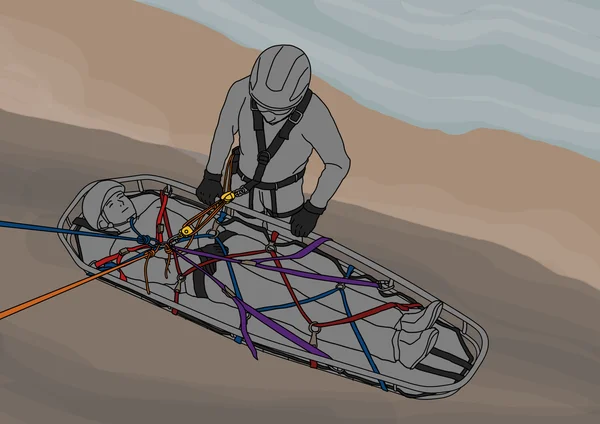
Once the patient has been loaded and positioned within the litter, the next objective is to establish a restraint system capable of maintaining that position throughout transportation.
Patient movement inside a litter can occur gradually or suddenly. Changes in terrain, litter orientation, edge transitions, hauling operations, lowering operations, and obstacles encountered during transport all create forces that can influence how the patient interacts with the litter. The purpose of the patient tie-in system is to manage those forces while maintaining patient stability.
A common misconception is that patient tie-ins exist simply to prevent a patient from falling out of the litter. While that is certainly one function, the larger purpose is maintaining consistent patient positioning throughout the rescue. A properly secured patient is less likely to shift, slide, rotate, or migrate within the litter as conditions change during transportation.
The tie-in system works in conjunction with patient positioning. Position establishes the starting point. The tie-in system helps preserve that position throughout movement.
Just as importantly, restraint systems should complement patient care rather than interfere with it. Packaging decisions must account for access to the patient, ongoing assessment requirements, and the need to monitor the patient’s condition during transport.
The tie-in process is therefore more than securing straps. It is the deliberate construction of a restraint system designed to maintain patient stability while supporting the broader objectives of the rescue operation.
Step 1
The first stage of the tie-in process establishes the primary connection between the patient and the litter.
At this stage, rescuers begin securing the patient while confirming that body position, alignment, and overall placement within the litter remain appropriate. Early adjustments are often easier to make before additional restraints are added to the system.
This phase also provides an opportunity to verify that the patient remains comfortable and properly supported. Small corrections made now can prevent larger problems later in the packaging process.
The objective is not maximum restraint. The objective is to establish the foundation upon which the remainder of the tie-in system will be built.

Step 2
As the tie-in process continues, additional restraint components begin working together to limit unwanted movement within the litter.
Rather than relying on a single attachment point or restraint element, patient packaging typically distributes control across multiple locations. This approach helps manage movement in different directions while creating a more stable overall system.
Each component added during this stage should support the larger objective of maintaining patient position throughout transportation. Restraints should work together rather than function as isolated elements.
Rescuers should continue evaluating patient comfort, positioning, and access as the system develops. Effective packaging balances security with patient care requirements.

Step 3
The final stage of the tie-in process completes the primary restraint system.
At this point, the patient should be securely integrated into the litter while maintaining a position that supports both transportation and patient care. The various restraint elements now function collectively rather than individually.
Before moving forward, rescuers should perform a final assessment of the packaging system. This includes verifying restraint integrity, confirming patient position, and identifying any areas that may require adjustment before transportation begins.
A properly completed tie-in system creates a stable foundation for the additional packaging and protection measures that follow.

The patient is now positioned and secured within the litter. The next phase of patient packaging expands beyond the primary tie-in system and introduces additional methods used to manage patient stability, beginning with improvised tie-ins and internal pelvic restraint systems.
Improvised Tie-Ins
Not every rescue environment provides ideal equipment, ideal access, or ideal conditions. Rescue teams may encounter situations where standard restraint systems are unavailable, damaged, incompatible with the litter, or simply insufficient for the challenges presented by the incident. In these circumstances, improvised tie-ins provide rescuers with additional options for securing and stabilizing the patient.
The objective of an improvised tie-in is not to replace sound packaging practices. Rather, it is to supplement the overall restraint system while maintaining the same goals of stability, protection, and transport readiness. An effective improvised restraint should integrate into the larger packaging system without creating new hazards or compromising patient care.
As with all packaging components, the focus remains on controlling patient movement while preserving access for assessment, treatment, and ongoing monitoring. The effectiveness of any improvised system is measured not by its complexity, but by its ability to contribute to a stable and secure patient environment.
Improvised tie-ins demonstrate an important principle of technical rescue: successful outcomes depend more upon understanding the function of a system than simply memorizing specific equipment configurations. When rescuers understand the purpose of a restraint system, they are often able to adapt their methods while still achieving the desired outcome.
Internal Pelvic Tie-In
The pelvic region serves as one of the most important control points within the patient packaging system. Because the pelvis represents a central mass of the body, controlling movement at this location helps reduce unwanted shifting throughout the litter during transportation.
An internal pelvic tie-in helps secure the patient to the litter while establishing a stable foundation for the remainder of the restraint system. As transportation forces act upon the patient, the pelvic restraint helps resist migration within the litter and supports overall body alignment.
This becomes particularly important as the rescue environment changes. Hauling systems, lowering systems, edge transitions, uneven terrain, and changes in litter orientation can all create forces that encourage movement within the packaging system. Without adequate pelvic control, those forces may gradually shift the patient from the position originally established during loading.
The internal pelvic tie-in is not intended to function independently. It operates as one component within a larger packaging strategy that includes positioning, primary tie-ins, chest restraints, external tie-ins, and environmental protection measures. Together, these elements create a layered system designed to maintain patient stability throughout transportation.
Rescuers should evaluate the effectiveness of the pelvic restraint within the context of the entire packaging system. A properly constructed restraint should contribute to stability without creating unnecessary pressure points, compromising patient comfort, or interfering with patient care considerations.
When properly applied, the internal pelvic tie-in provides a critical anchor point within the overall restraint system. It helps preserve patient position, supports transportation objectives, and contributes to the creation of a secure and transport-ready patient environment.

Chest Tie-In
While pelvic restraints help manage movement through the center of the body, patient packaging must also address movement of the upper torso. As transportation forces act upon the litter, the chest and shoulders can experience significant movement if not properly controlled.
The purpose of the chest tie-in is to maintain upper-body stability while supporting the overall restraint system. It helps preserve patient position during transportation and assists in managing the forces created by changing litter orientations, terrain transitions, and movement through the rescue environment.
An effective chest restraint should work with the pelvic restraint rather than function independently. Together, these systems create complementary control points that help maintain alignment throughout the body.

Option A
One approach to chest restraint focuses on creating a secure connection that limits upper-body movement while maintaining patient comfort and access. The objective is to establish stability without creating unnecessary restriction or interfering with patient assessment and treatment.
As with all restraint systems, proper adjustment is critical. The restraint should be secure enough to contribute to patient stability while avoiding excessive pressure that could affect comfort or ongoing patient care.
Option B
Alternative chest restraint configurations may be used depending upon patient needs, available equipment, litter design, or operational preferences.
Although the arrangement may differ, the underlying objective remains unchanged: maintaining upper-body stability throughout transportation. Rescuers should evaluate the effectiveness of the restraint based on how well it contributes to the larger packaging system rather than on the specific configuration itself.
Different methods may achieve the same result when they support the broader goals of patient protection and transport readiness.
Illustration Placement: Chest Tie-In Option B
Lifesaver Victim Harness
The Lifesaver Victim Harness provides another method of supporting upper-body control within the packaging system. Like other restraint methods, its value lies in its ability to contribute to patient stability while integrating with the broader packaging strategy.
As transportation forces act upon the litter, maintaining control of the upper torso becomes increasingly important. Properly applied chest restraint systems help preserve patient position and reduce the likelihood of unwanted movement during transport.
The specific method selected should always support the overall objective of creating a secure, protected, and transport-ready patient environment.
Illustration Placement: Lifesaver Victim Harness
The patient is now secured through both lower-body and upper-body restraint systems. The next phase of packaging expands beyond internal control and examines external tie-in methods used to further integrate the patient with the litter system.
External Tie-In
The primary restraint systems established through the patient tie-in, pelvic restraint, and chest tie-in are designed to stabilize the patient within the litter. As the packaging process continues, external tie-ins provide an additional layer of security by integrating the patient more completely with the litter system.
Technical rescue transportation rarely occurs under ideal conditions. Patients may be moved across uneven terrain, through confined spaces, over edges, up steep slopes, or through vertical environments. During these movements, the litter may experience changes in direction, orientation, and loading. External tie-ins help manage the effects of those changes by reinforcing the connection between the patient and the litter.
Rather than replacing the primary restraint system, external tie-ins work alongside it. They contribute to overall packaging integrity and help preserve the position established during the earlier stages of patient packaging. When viewed as part of the larger system, external tie-ins represent another layer of protection against unwanted patient movement.
As with every packaging component, the objective remains consistent: maintain patient stability while supporting safe transportation and ongoing patient care.
External Lashing
External lashing provides additional restraint by securing the patient and packaging system as a unified assembly. While internal restraints focus on controlling specific areas of the body, external lashing helps manage movement across the entire packaging system.
This additional layer becomes increasingly valuable as transportation conditions become more demanding. Steep terrain, litter rotations, edge transitions, and prolonged movement can all introduce forces that challenge patient stability. External lashing helps resist those forces by distributing restraint across a broader area of the packaging system.
An effective lashing system should complement the existing restraints rather than compete with them. The goal is to reinforce patient security while preserving access for assessment, treatment, and monitoring whenever possible.
External lashing also provides rescuers with an opportunity to evaluate the overall packaging system. As the final restraint layers are applied, the team can verify that the patient remains properly positioned, adequately protected, and prepared for transportation.
When integrated correctly, external lashing contributes to a packaging system that functions as a coordinated whole rather than as a collection of independent restraint components.

Hands
Patient hand placement may appear to be a minor consideration when compared to larger restraint systems, yet it serves an important role in both patient protection and packaging effectiveness.
During transportation, exposed hands can become vulnerable to impact, abrasion, entanglement, and environmental hazards. Changes in litter orientation, movement through vegetation, structural obstacles, and contact with surrounding surfaces can all create opportunities for injury if the hands are not properly managed.
Proper hand placement also contributes to patient comfort and overall packaging organization. A patient whose arms and hands are positioned appropriately is less likely to experience unnecessary movement during transportation.
This consideration becomes particularly important during extended evacuations where even small discomforts can become significant over time. Attention to details such as hand placement reflects the larger philosophy of patient packaging: every component contributes to the creation of a secure and protected transport environment.
Although often overlooked, proper management of the patient’s hands supports the same objective as every other packaging element—maintaining patient safety throughout transportation.
Illustration Placement: Hands
Patient Protection
At this point in the packaging process, the patient has been loaded, positioned, restrained, and integrated into the litter system. The focus now shifts from controlling patient movement to protecting the patient from hazards encountered during transportation.
This transition is important. A patient who is properly secured is not automatically protected. Rescue environments continue to present risks long after packaging has been completed. Weather conditions, falling debris, structural obstacles, vegetation, and transportation forces can all affect patient safety during movement.
Patient protection addresses those hazards by creating additional layers of defense between the patient and the surrounding environment.
The objective is not simply to secure the patient inside the litter. The objective is to preserve patient safety throughout the entire transportation process.
As rescue complexity increases, so does the importance of these protective measures. A packaging system that effectively manages environmental hazards contributes directly to patient comfort, patient safety, and overall mission success.
The next sections examine several key areas of patient protection, beginning with one of the most critical regions of the body during transportation: the head.
Head
The head is particularly vulnerable during rescue transportation. Even when the patient is securely restrained, movement through challenging terrain can expose the head to impact hazards, vibration, shifting loads, and contact with surrounding obstacles.
Protecting the head begins with proper patient positioning but extends beyond positioning alone. Additional protective measures may be necessary depending upon the environment, transportation method, and anticipated hazards.
Rescuers should consider the entire transportation route when evaluating head protection requirements. A patient moved through dense vegetation, rocky terrain, industrial structures, or confined spaces may encounter hazards that are not immediately apparent at the packaging location.
Maintaining protection throughout the operation requires continual awareness of how the environment interacts with the litter system. Effective head protection helps reduce the likelihood of secondary injury while supporting overall patient safety during transport.
Illustration Placement: Head Protection
From the Environment
Rescue operations rarely occur in controlled environments. Patients may be exposed to rain, snow, wind, heat, cold, dust, rotor wash, or prolonged exposure during transportation. Even when a patient’s medical condition remains stable, environmental factors can influence comfort, treatment priorities, and overall patient well-being.
Environmental protection begins with awareness. Rescuers must evaluate not only the conditions present at the packaging location but also the conditions likely to be encountered throughout the transportation route. A litter operation that begins in a sheltered location may eventually pass through exposed terrain, changing weather, or areas where environmental hazards become more significant.
Protective measures should be integrated into the packaging system rather than treated as an afterthought. Blankets, protective coverings, shields, and other environmental barriers all contribute to maintaining a safer and more comfortable patient environment during transportation.
The effectiveness of patient packaging is often measured not by how well it performs at the point of packaging, but by how well it continues to perform throughout the rescue. Environmental protection plays an important role in achieving that objective.
Patient care does not stop once the patient enters the litter. In many respects, transportation introduces an entirely new set of considerations that must be managed throughout the operation.
Illustration Placement: Protection from the Environment
From Objects
The rescue environment contains more than weather-related hazards. Rocks, structural members, vegetation, equipment, debris, and other obstacles may all create risks during transportation.
As a litter moves through the environment, the patient may pass close to objects that present impact, abrasion, or entanglement hazards. In some cases, the transportation route itself becomes one of the most significant threats to patient safety.
Protecting the patient from these hazards requires both effective packaging and situational awareness. The packaging system should help shield vulnerable areas while allowing rescuers to maintain control of the litter as conditions change.
This becomes especially important during edge transitions, confined-space operations, industrial rescues, and wilderness evacuations where contact with surrounding objects may be unavoidable.
Patient protection is not limited to securing the patient inside the litter. It also includes managing the interaction between the litter system and the environment through which it travels.
By anticipating potential hazards and integrating protective measures into the packaging system, rescuers can reduce the likelihood of secondary injuries during transportation.
Illustration Placement: Protection from Objects
Using the Litter Shield
The litter shield provides an additional layer of protection between the patient and the surrounding environment. While restraint systems focus on maintaining patient position, the litter shield focuses on reducing exposure to external hazards encountered during transportation.
Depending upon the operational environment, the shield may help protect the patient from debris, vegetation, weather conditions, rotor wash, and incidental contact with surrounding objects. The shield effectively extends the protective envelope created by the litter and packaging system.
One of the primary advantages of the litter shield is its ability to provide protection without requiring significant changes to the underlying packaging system. Once the patient has been properly positioned, restrained, and protected, the shield can be incorporated as an additional safeguard during movement.
As with all components of patient packaging, the litter shield should be evaluated within the context of the overall operation. Rescue teams must consider transportation methods, anticipated hazards, patient condition, and operational objectives when determining how the shield will be used.
The shield is not a substitute for proper patient packaging. Rather, it serves as another layer within a larger protection strategy designed to support patient safety throughout transportation.
When integrated effectively, the litter shield contributes to a more resilient packaging system capable of addressing a broader range of environmental challenges.
Illustration Placement: Using the Litter Shield
Conclusion
Patient packaging represents far more than the application of straps and restraints. It is a deliberate process that prepares a patient for transportation while addressing the many challenges associated with technical rescue operations.
The process begins with loading and positioning the patient within the litter. From there, rescuers establish restraint systems that help maintain stability and preserve patient position throughout movement. Additional packaging elements—including pelvic restraints, chest tie-ins, external tie-ins, and protective measures—work together to create a secure and protected patient environment.
As the packaging system develops, the focus expands beyond patient control to include protection from environmental hazards and transportation-related risks. Every component contributes to the same objective: preparing the patient for safe movement through the rescue environment.
A properly packaged patient is a transport-ready patient.
This principle serves as the foundation of every successful litter operation. Before a rope system is tensioned, before a haul begins, and before a litter moves across terrain or over an edge, the patient packaging system establishes the conditions necessary for safe transportation.
The techniques presented throughout this chapter provide rescuers with the tools needed to create that system. When applied effectively, they help transform patient care into patient movement while maintaining stability, protection, and safety throughout the rescue operation.
The next step in that process is understanding the platform responsible for carrying the patient. With the patient packaged and protected, attention can now shift to the litter itself and the systems used to rig, suspend, and transport it through the rescue environment.