Highline Rescue Requires Precision
In rope rescue operations, moving a load across horizontal or diagonal spans—whether suspended from high directionals or tensioned lines—demands a system that’s not only stable and redundant, but also dynamically adjustable under load. This is where English Reeve and Reverse Reeve systems shine.
Both reeving systems offer unique advantages depending on terrain, equipment availability, and directional requirements. Whether you are building a litter offset, transferring loads over confined space, or conducting a slope evacuation with high directional aids, choosing the right reeving configuration affects both efficiency and safety.
What Is an English Reeve System?
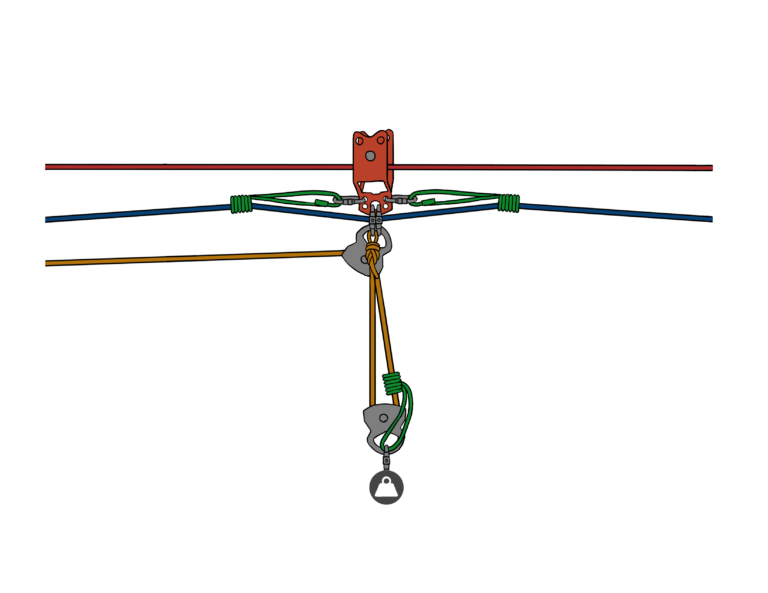
The English Reeve is a tried-and-true configuration in rope rescue highline setups. It involves running a carriage (such as the Petzl REEVE) between two tensioned lines anchored on either side of a span. This allows rescuers to move loads horizontally while maintaining control of tension, friction, and positioning.
Advantages of the English Reeve:
-
Efficient load travel across spans
-
Redundancy when used with twin lines
-
Compatible with monopods, bipods, and tripods
-
Simplifies transitions between raising and lowering
Learn More:
What About Reverse Reeve?
While less formally defined, the term Reverse Reeve typically refers to configurations that invert or mirror traditional English Reeve load paths—often adapted to complex directional needs or equipment constraints. For example, instead of pulling the carriage directly across the span, tensioning and direction may be managed from the opposite side, creating more flexibility when terrain or anchor limitations exist.
Applications of Reverse Reeve:
-
Working in tight or obstructed environments
-
Horizontal offsets where control from the “reverse” side is needed
-
Systems requiring dynamic re-direction of load tension
Supporting Resource:
Recommended Equipment
If you’re exploring these systems, consider the Petzl REEVE Carriage Pulley, specifically engineered for reeving applications. It allows multiple connections, reduces the hardware footprint, and enables a clean, strong system with minimal complexity.
Step-by-Step Learning Path
-
Start with the Basics
Understand the general mechanics of the English Reeve system.
→ The English Reeve Highline -
Explore Application in Different Structures
Learn how tripods and high directionals support reeving systems.
→ Tripod English Reeve Setup -
Compare Highline Variants
Dive into advanced reeving variations that could be used as reverse reeves in offset systems.
→ English Reeve System in Highline Rigging
Final Thoughts
Highline rigging is one of the most complex and nuanced areas of technical rescue. Knowing the difference between English and Reverse Reeve setups—and when to apply each—is not just a matter of preference, but performance. These systems form the foundation of safe lateral movement during rescue operations, particularly when combined with twin tension systems and redundant anchor strategy.
If you’re looking to gain full fluency in these setups, or want to validate the gear and theory behind your current systems, the Rigging Lab Assistant can help you get fast answers—and when you’re ready to go deeper, Rigging Lab Academy offers full courses and step-by-step training.
Peace on your Days
Lance