Why Austrian Economics Belongs in Rope Rescue
Wealth, Labor, Time, and Risk Allocation
Technical rope rescue looks like engineering. We calculate force. We build anchors. We manage friction and redundancy. Physics sets the outer limits. If we violate those limits, the system fails.
However, engineering alone does not explain how decisions unfold on scene.
In reality, every operation consumes wealth, labor, and time. Equipment represents stored capital. Skilled technicians represent human capital. Meanwhile, time acts as a nonrenewable resource. Once spent, it cannot be recovered. Because these elements interact under pressure, rescue operations resemble economic systems far more than mechanical diagrams.
For that reason, Austrian economics offers a useful lens. Unlike large-scale economic models that focus on averages or equilibrium, Austrian thought starts with individuals making choices under scarcity. It treats time as irreversible. It treats knowledge as incomplete. It assumes uncertainty as permanent rather than temporary.
Those assumptions mirror rescue work exactly.
On scene, no team possesses perfect information. No team controls all variables. Weather changes. Structures shift. Patient conditions evolve. Therefore, leaders must allocate limited means toward ranked life-safety goals before full clarity emerges. In that sense, rescue is not static engineering; it is structured decision-making under constraint.
Because Austrian economics studies that exact problem—how people allocate scarce means under uncertainty—it provides a disciplined way to examine rescue system design.
Twin Tension vs Mainline–Belay
Two Different Allocation Models
Both Twin Tension Rope Systems and Mainline–Belay systems satisfy redundancy requirements. Both can operate safely when executed well. Yet when viewed through the Austrian lens, they reveal two different philosophies of capital and risk.
The difference is not about hardware. Instead, it concerns how each system distributes wealth, labor, time, and uncertainty.
Capital Structure Over Time
First, consider capital structure. Austrian economics treats capital as organized stages extended through time. Rope rescue systems follow that same structure. Anchors feed directionals. Directionals feed lines. Lines feed devices. Devices control the load. Each stage depends on the previous stage holding.
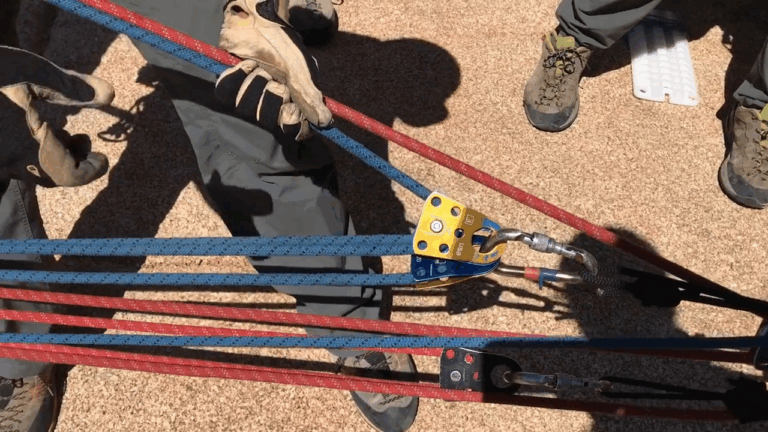
A Twin Tension system places two fully active lines into that structure. Both lines carry load. Both devices operate continuously. As a result, the system distributes force across parallel channels from the beginning.
By contrast, a Mainline–Belay system concentrates productive load in one channel during normal operation. The belay line remains lightly loaded or unloaded until activation. In other words, one channel works continuously while the other stands ready.
This distinction matters. Parallel capital smooths stress across time. Standby capital concentrates stress into a future event.
Under uncertainty, systems that smooth volatility tend to behave more predictably than systems that rely on sudden correction.
Labor Allocation and Information Flow
Next, consider labor. Austrian thought treats labor as skilled, purposeful action rather than interchangeable effort. Rescue reflects that view clearly. Not all technicians carry equal experience. Not all roles generate equal information.
In a Twin Tension configuration, both device operators receive real-time feedback because both lines carry load. Subtle changes in friction, tension, or movement appear immediately on both sides. Consequently, the system distributes information through active engagement.
In a Mainline–Belay system, the mainline operator experiences the full working load. Meanwhile, the belay operator monitors readiness but does not receive the same continuous load signal during normal movement. Information flows primarily through one channel until failure occurs.
From an Austrian perspective, dispersed knowledge strengthens adaptation. Therefore, systems that integrate more operators into live feedback loops align more closely with that principle.
Time Preference and Risk Distribution
Time plays a central role in Austrian economics. Decisions today shape consequences tomorrow. Rescue work intensifies that reality because exposure windows are finite.
Twin Tension systems “pay” for redundancy continuously. They require ongoing management and staffing commitment. In exchange, they reduce reliance on a future arrest event. Risk spreads across time.
Mainline–Belay systems defer redundancy activation. During normal operation, one line carries the working load. If failure occurs, the belay captures dynamically. Risk concentrates in that activation moment.
Neither approach violates physics. However, from an Austrian viewpoint, spreading adjustment across time often reduces shock intensity. Conversely, concentrating correction into a single event increases volatility.
Scarcity and Opportunity Cost
Every system choice consumes resources. That is unavoidable.
Allocating two fully active lines requires sustained operator attention. That attention cannot serve elsewhere. On the other hand, relying on a single working line reduces active management demands but increases dependence on a reactive capture event.
Therefore, each architecture reflects a different opportunity cost profile. One spends labor continuously. The other spends labor conditionally. One spreads force management across time. The other centralizes it until disruption occurs.
Under scarcity, leaders must ask which cost profile best fits their team size, skill level, and operational tempo.
Which System Fails Under Austrian Logic?
Mechanically, both systems can succeed. Economically, however, tension emerges.
Austrian economics favors:
-
Continuous adjustment over reactive correction
-
Distributed knowledge over centralized control
-
Risk smoothing over shock concentration
When measured against those principles, Twin Tension aligns more naturally with Austrian reasoning. It distributes load. It distributes information. It spreads risk across time.
Mainline–Belay remains structurally sound. Nevertheless, it relies on concentrated load and conditional correction. That structure introduces economic friction under high uncertainty.
Thus, under an Austrian lens, Mainline–Belay does not fail mechanically. It fails philosophically. It concentrates risk and defers adjustment, whereas Austrian reasoning prefers continuous allocation and distributed awareness.
Final Integration
Engineering defines structural limits. Austrian economics clarifies how teams allocate capital, labor, and time within those limits. When both lenses operate together, system selection becomes more disciplined.
Rather than asking which system is traditional or modern, leaders can ask:
-
How does this architecture allocate scarce labor?
-
How does it distribute risk across time?
-
How does it integrate dispersed knowledge?
Those questions improve clarity. Moreover, they sharpen decision-making under pressure. In environments where exposure windows matter and margins remain finite, disciplined allocation may matter as much as hardware strength.
Peace on your Days
Lance