In modern technical rescue, moving beyond traditional main-and-belay configurations is essential to achieving superior safety margins and operational efficiency. The shift is towards Dual Mainline Rope Systems, also known as Twin Tension Rope Systems (TTRS). These systems fundamentally change the dynamics of load control by actively engaging both ropes to share the load equally, thus providing full redundancy and eliminating the delayed system response and uncontrolled shock loads inherent in older, passive belay setups. Mastery of TTRS requires precision in rigging, synchronized operation, and a deep respect for mechanical geometry.
1. Achieving Full Redundancy Through Mirrored Symmetry
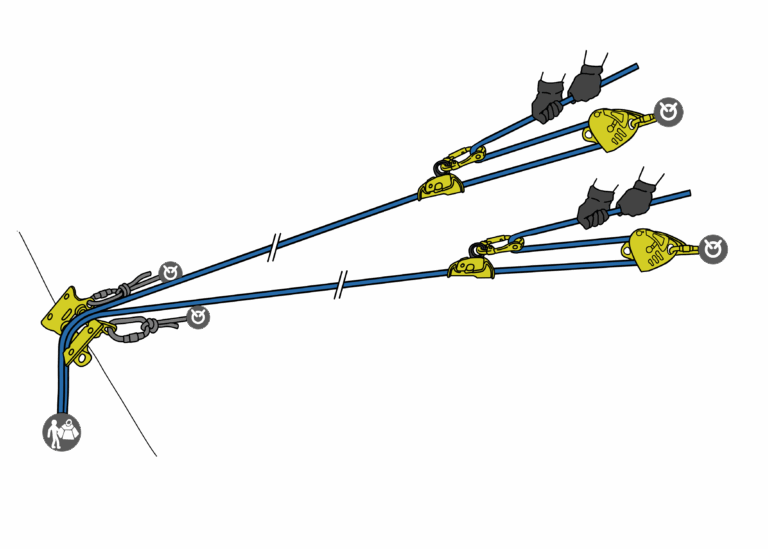
The defining characteristic of a TTRS is its complete symmetry, often called a “mirrored system“. For the system to function predictably, every component on one line must mirror the other exactly in configuration and capability.
- Independent Anchors and Load Sharing: The foundation of a TTRS must be two separate, independent anchor points, which are typically configured as a V-anchor system. This design ensures that if one anchor point fails, the second maintains system integrity, providing redundancy. Proper V-anchor geometry dictates that the internal angle between anchor legs should be degrees or less to ensure balanced load distribution and prevent force multiplication. This symmetry ensures that both lines contribute equally to movement and arrest, meaning that if one line fails, the remaining system immediately assumes full control without drop, shock, or uncontrolled motion.
- Application in Mirrored Skate Blocks: This principle is crucial in specialized horizontal rigging, such as the Mirrored Skate Block system, where two identical setups work in tandem to move loads laterally with precise control. This approach to system duplication is ideal for achieving redundancy and control in complex rescue environments like tower or confined space access.
2. Precision Control via Dynamic Devices and Friction Management
Smooth, predictable load movement in a TTRS depends on integrating advanced controlled descent devices (CDDs) that can manage friction and capture progress on both lines simultaneously.
- Integrated Progress Capture: Devices like the Multi-Purpose Device (MPD) and the CMC Harken Clutch are central to dual tension systems because they integrate a high-efficiency pulley, progress capture, and descent control into a single unit. The MPD’s design allows for rapid, tool-free transition between raise and lower modes, streamlining operations. The CMC Harken Clutch further enhances patient transport safety by integrating a force-limiting mechanism, which reduces peak impact loads during dynamic events and allows operators to maintain controlled modulation.
- Friction Management for Balance: While mechanical devices excel in efficiency, simpler, friction-based systems still hold a vital role. Tandem prusiks, for example, remain a trusted method for rescue belaying, offering redundancy through two independent friction grips. These devices excel in gradual load arresting with low shock forces, blending simplicity with field maintainability. Proper function relies on maintaining the correct rope-to-cord diameter ratio and spacing the two prusiks 4–6 inches apart to prevent mutual interference.
3. Anchor Geometry and Force Vector Alignment
TTRS stability is structurally defined by how force vectors are managed and aligned at the anchor points. Rigging is not about raw force, but about mechanical logic.
- Controlling Resultant Vectors: Every rope under tension creates a vector—a force with both magnitude and direction. In a twin-tension system, all vectors must combine at the anchor’s focal point to form a single resultant vector that aligns perfectly with the intended line of pull. Misalignment introduces side-loading and compromises the system’s predictability.
- The 60-Degree Rule in Horizontal Rigging: When rigging a horizontal system, such as a Mirrored Skate Block, correct geometric placement is crucial for minimizing tension and maximizing efficiency. Positioning anchors to achieve an interior-degree rope angle (or less) is crucial for minimizing horizontal load and preventing the exponential increase of anchor load associated with shallow angles. The physics of highline systems, where decreasing sag dramatically increases anchor load, reinforces the importance of using geometry to manage force.
Summary: Discipline and Fluency in TTRS
Mastering TTRS requires rescue professionals to think critically and operate with a system-oriented mindset. The success of these systems relies on the meticulous application of geometric principles (V-anchors and 60-degree angles), component duplication for full redundancy, and disciplined synchronization between operators managing advanced control devices like the CMC Clutch and MPD. By prioritizing structure, symmetry, and clear communication, TTRS transforms complex load management challenges into predictable, repeatable, and highly safe operations. The highest standard in rescue rigging is achieved when efficiency and safety are balanced through mechanical awareness and professional discipline.
Peace on your Days
Lance