Technical Systems Report: Principles and Architecture of Mechanical Advantage in Rope Rescue
1. Purpose and Scope of Force Analysis
In professional technical rescue, rigging must transition from intuitive guesswork to a disciplined application of structural physics. Establishing a rigorous analytical framework for force and work is the primary safeguard for system integrity. By defining these concepts mathematically, a systems engineer can predict how loads will stress an anchor, how tension distributes across a rope path, and how mechanical advantage (MA) performs under environmental friction. This approach ensures that every evolution remains within the rated capacity of the hardware and the physical endurance of the team.
Mechanical advantage is not merely a tool for reducing effort; it is a force redistribution architecture. Every unit of mechanical gain applied to reduce haul force is transferred elsewhere in the system—most often to anchors, directionals, and rope segments. Professional analysis therefore requires evaluating where the “saved” force goes, not simply how much effort is reduced at the haul team.
Fundamental Definitions
- Force: A vector quantity defined as a push or pull applied to cause motion, manifested in rigging as tension. The standard unit is the kilonewton (kN). 1 kN equals 1,000 Newtons, representing approximately 220 lbs of force. All life-safety hardware is rated in kN; therefore, all calculations must be performed in force units rather than weight estimates in pounds.
- Work: Work occurs only when force produces movement. In MA systems, we apply the force-distance trade-off: moving a load 1 foot in a 2:1 system requires pulling 2 feet of rope; a 3:1 requires 3 feet of rope for the same 1 foot of movement. Mechanical advantage reduces input force but increases input distance. Total work remains constant (Work = Force × Distance).
- Mass vs. Force (Weight): Mass (kg) is the amount of matter; weight is the force mass exerts under gravity. Rescue hardware is rated in force (kN), not mass. All calculations must convert mass into force to preserve engineering accuracy.
Vector vs. Scalar Dynamics
Rigging safety is predicated on understanding how magnitude and direction interact.
| Feature | Scalar | Vector |
| Definition | Magnitude only. | Magnitude and direction. |
| Rigging Examples | Rope length, mass (kg), time. | Anchor tension, haul direction, resultant force. |
| Operational Role | Determines resource quantity. | Predicts system stress and anchor stability. |
Failure to account for direction transforms accurate numbers into inaccurate systems. A 5 kN load acting vertically is fundamentally different from a 5 kN load redirected at 90° into a structural beam.
2. System Architecture and the Force Path
To maintain structural validity, the rigger must map the tension distribution across the system. Understanding the “Force Path” prevents anchor overloading and ensures the mechanical gain is appropriate for the load.
The force path begins at the load, travels through moving pulleys and rope segments, passes through fixed directionals, and terminates at anchors. Every change in direction modifies force distribution. Every pulley alters tension multiplication. Every redirect introduces additional anchor loading.
Professional riggers evaluate not only the ideal path but the worst-case path—accounting for shifts in direction during edge transitions, patient rotation, or terrain irregularities.
Structural Categories of MA
- Simple Systems: A single haul connection where all moving pulleys travel at the same speed and direction as the load (e.g., 3:1 Z-rig).
- Compound Systems: Created when one simple system hauls on the line of another (e.g., a 2:1 pulling a 3:1 creates a 6:1). These multiply gain but increase complexity and friction.
- Complex Systems: Configurations where pulleys move at different speeds or directions, such as the Spanish Bruton, Inside Nine, or Crevasse Rescue 5 (California 5). These require formal tension-path analysis.
Complexity increases diagnostic burden. The more moving components introduced, the greater the potential for hidden inefficiencies and miscalculated anchor forces.
The Attachment Point Rule
A critical diagnostic for any system is the point of rope termination:
- If the rope is tied to the anchor, the Ideal Mechanical Advantage (IMA) is even (2:1, 4:1).
• If the rope is tied to the load, the IMA is odd (1:1, 3:1, 5:1).
This rule provides immediate structural clarity before detailed calculation.
The T-Method (Tension Path Analysis)
The T-Method is the only reliable way to calculate complex systems because shortcuts like rope counting fail when segments carry multiple units of tension (2T or 3T).
- Assign 1T to the haul line.
- Trace the Path: Tension remains equal on both sides of a pulley.
- Sum at Moving Pulleys: Combine tensions (1T + 1T = 2T) at the pulley axle.
- Calculate Total MA: Sum all units of tension acting directly on the load.
This method exposes anchor amplification that is often invisible when relying solely on rope-strand counting.
Component Logic: Fixed vs. Movable
- Fixed Pulleys (COD): Anchored in place; provide no mechanical gain (1:1). However, they frequently double the load on an anchor (1T haul + 1T load = 2T on anchor). Direction change equals force amplification at the anchor.
- Movable Pulleys: Attached to the load or rope grab; these function as circular second-class levers and provide actual force multiplication (2:1).
Understanding which components multiply force and which merely redirect it prevents anchor underestimation.
3. Engineering Analysis and Risk Evaluation
Theoretical Mechanical Advantage (TMA) represents a frictionless ideal. Practical Mechanical Advantage (PMA) reflects reality.
TMA vs. PMA Comparison
| Feature | Theoretical (TMA) | Practical (PMA) |
| Calculation | Rope strands or geometry. | TMA × efficiency of each component. |
| Operational Use | Baseline for design. | Determines actual team effort and safety. |
TMA defines structural possibility. PMA defines operational reality.
Efficiency and PMA Calculation
To estimate PMA, multiply the TMA by the efficiency rating of every component.
- Ball-bearing pulleys: 95–98% efficient.
• Bushing pulleys: 88–92% efficient.
• Carabiners: 40–50% efficient.
Engineering Example: A 3:1 Z-rig using three 90% efficient pulleys results in a PMA of 3 × 0.9 × 0.9 × 0.9 ≈ 2.2:1. Substituting carabiners can reduce that same system to approximately 1.5:1—effectively eliminating the expected advantage.
Friction compounds multiplicatively. Each additional component reduces efficiency, meaning high-ratio systems may stall long before theoretical values are achieved.
Geometric Multipliers and ERNEST Principles
Anchors must meet the ERNEST criteria (Equalized, Redundant, Non-Extending, Solid, Timely).
Angle geometry dictates force magnification:
- Anchor Angles:
90° ≈ 71% per leg
120° ≈ 100% per leg
150° ≈ 200% per leg - Directional Pulleys:
A 90° redirect places 141% of the load on the anchor.
A 0° parallel redirect (1:1 COD) places 200% of the load on the anchor.
Mechanical advantage does not eliminate anchor stress—it often increases it. A system that reduces haul force may simultaneously double anchor loading.
4. Operational Deployment Protocol
Disciplined rigging and modularity ensure operational durability. Systems should be built for progression, allowing escalation of MA ratios without dismantling a loaded system.
Standard Progressions
- 2:1 Base: 2:1 → 6:1 → 10:1
• 3:1 Base: 3:1 → 5:1 → 9:1
Modular builds reduce reset time and maintain system continuity during dynamic operations.
Site Organization and Throw Optimization
- Housekeeping: Maintain parallel rope paths and eliminate edge friction using Artificial High Directionals (AHDs) such as tripods or A-frames. Friction reduction increases PMA and reduces unpredictable anchor loading.
- Staggered Anchors: In compound systems, subsystem anchors should not be co-located. Use the Separation Formula:
Anchor separation ≈ (outer throw − inner throw)
This synchronizes collapse cycles and maximizes rope “throw” per haul stroke. - Progress Capture Integration: Prusik Minding Pulleys (PMPs) or mechanical devices (MAESTRO, MPD) function as ratchets. These maintain load security during resets but may introduce up to 20% additional friction.
Pre-tensioning and controlled load testing prior to committing a live load reduces unexpected stall or anchor shift during initial movement.
5. Comparative Operational Insights
The choice between systems is dictated by terrain, load, personnel capacity, and time constraints.
Raising vs. Lowering
- Lowering: Preferred when possible; gravity assists movement. Friction devices (brake rack, I’D) provide controlled descent with lower systemic stress.
• Raising: High-load, high-risk evolution. Works against gravity and demands calculated MA architecture. Raising amplifies anchor stress and introduces higher surge potential.
Powered vs. Manual Systems
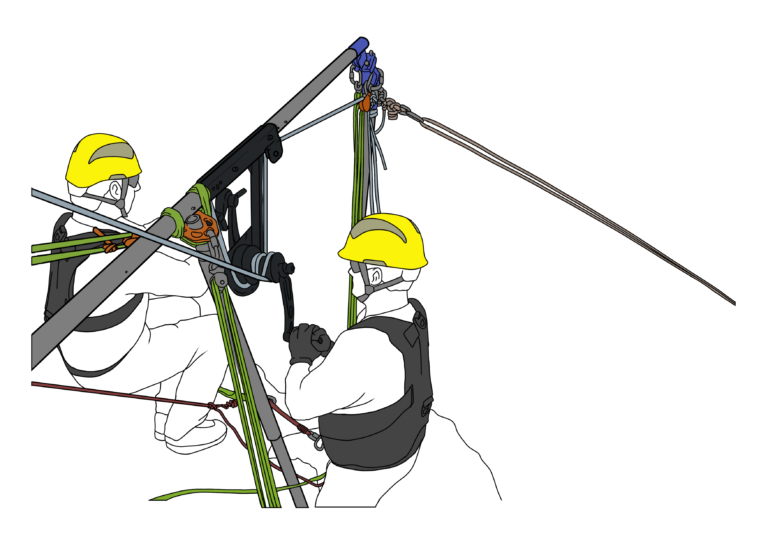
Capstan winches provide extended rope travel and reduce human fatigue.
- LokHead Winch: Two gears—13:1 for speed and 40:1 for torque.
• Engineering Constraint: Requires an 8–9° rope entry angle and minimum two wraps on the drum to prevent slippage.
Powered systems shift effort from manpower to mechanical drive but do not eliminate anchor loading concerns.
Horizontal Systems
- Two-Rope Offsets: Characterized by acute angles at the load and coordinated push-pull force. These remain relatively low-tension systems but require synchronized communication.
• Highlines: High-tension tracklines spanning gaps. Sag reduction exponentially increases anchor loads. Precision tension monitoring is mandatory.
6. System Limitations and Failure Considerations
Technical rescue systems possess finite safety thresholds. Exceeding those limits leads to catastrophic failure.
Risks of Overpowering
An “explosion of power” occurs when excessive MA or too many haulers override system feedback. Resistance signals friction, snag, anchor shift, or geometry change. Increasing power without diagnosis compounds failure risk.
Safety Indicators and “Fuses”
The haul prusik slipping at 800–1,200 lbs functions as a safety fuse. Replacing a slipping prusik with additional wraps masks overload conditions and transfers stress to anchors, hardware, or rope fibers.
Highline Tension Limits
Highline anchor loads increase exponentially as sag decreases.
Rule of Thumb:
Anchor Load ≈ (Span × Load) ÷ (4 × Sag)
Reducing sag increases anchor tension dramatically. A “flat” highline is inherently dangerous. Modern protocols require minimum 10% sag or load cell monitoring to preserve safety margins.
The Human Factor
Operational safety depends on standardized communication:
Stop → Capture → Reset → Ready
Surge loading frequently occurs during resets or premature haul initiation. Predictability prevents dynamic shock.
Structural validity and disciplined force analysis remain the ultimate safeguards in professional technical rescue. Mechanical advantage is not a shortcut to power—it is a redistribution of force that must be engineered, monitored, and respected to protect both rescuer and patient.