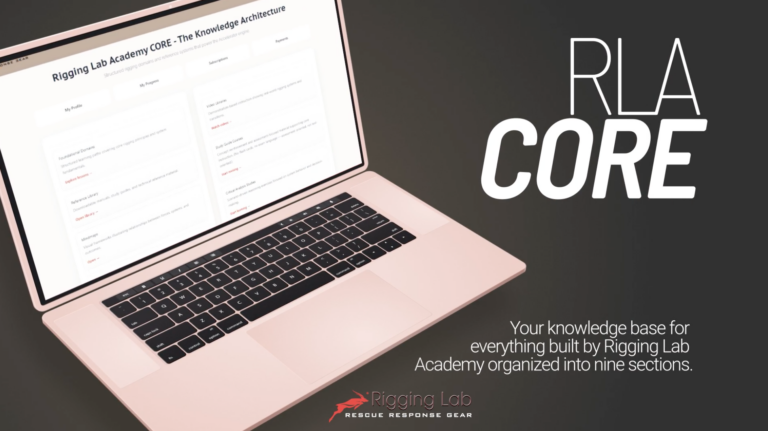
CORE was built to solve that problem.
Instead of treating courses, videos, illustrations, reports, podcasts, and study tools as separate products, CORE organizes them as different ways into the same knowledge base. The subject may be anchors, mechanical advantage, mainline systems, horizontal rigging, high directionals, litter operations, or program leadership. What changes is not the technical foundation. What changes is how the learner enters it.
That distinction matters because rescue professionals do not all learn in the same way, and they do not always need the same kind of resource at the same moment. A technician preparing for training may need a structured course. A team working through a system problem may need a technical illustration. A training officer evaluating a program may need a report. An experienced rescuer may already understand the theory and only need to see the system built and transitioned.
Inside CORE
One Knowledge Base Built for Different Ways of Learning
Technical rescue education rarely fails because information is unavailable. It fails because the information is scattered, disconnected, or delivered in only one format.
CORE brings those needs into one connected environment.
Foundations
The Foundations provide the structured curriculum inside CORE.
These are the full learning pathways built around the major disciplines of technical rescue and operational rigging. Anchors, mechanical advantage, mainline systems, horizontal systems, high directionals, patient movement, specialized environments, technical rigging, and program leadership are developed as connected areas of knowledge rather than isolated techniques.
Each domain provides a deliberate progression through lessons and units. This is where students can build understanding systematically, beginning with the underlying principles and moving into application.
The domains are not simply collections of information. They establish the technical language, force relationships, equipment roles, and decision-making framework that support the rest of CORE.
Video Libraries
The Video Libraries approach the same technical domains through demonstration.
Instead of beginning with written theory, the learner sees systems assembled, loaded, adjusted, transitioned, and operated. This makes the video libraries especially valuable for visual learners, experienced practitioners, and anyone who needs to connect a concept to its physical behavior.
The videos are not meant to replace the technical foundation. They give that foundation movement.
A frame under load, a changing resultant, a litter transition, or a mechanical advantage system often becomes clearer once the student can see what moves, what remains fixed, and how the system responds as conditions change.
For many students, the video is the point where an abstract idea becomes operationally recognizable.
Mind Maps
Mind Maps give learners a wider view.
Technical rescue systems are rarely understood well when every component is studied in isolation. Anchors influence mainlines. Mainlines influence edge management. Edge management influences patient movement. High directionals change force paths, footprint requirements, and anchor demands.
Mind Maps show those relationships visually.
They help students see how components, forces, system roles, and operational decisions connect across a larger structure. They are useful for review, preplanning, instruction, and for anyone trying to understand where one subject sits inside the broader discipline.
When a learner knows the individual parts but has not yet connected them, the Mind Maps provide that connection.
Technical Illustrations
Technical Illustrations move deeper into geometry, force paths, frame orientation, system configuration, and component interaction.
These are not decorative images. They are reference-grade drawings intended to make complex systems easier to inspect and discuss.
A well-built illustration can isolate the critical details that are difficult to see in live footage: the location of a resultant, the relationship between guy planes and frame planes, the movement of a load through an offset, or the way forces change through a directional system.
Technical Illustrations are particularly useful when teams need a common visual reference. They support briefings, instruction, system analysis, and field preparation without requiring the entire operation to be rebuilt simply to discuss one relationship.
Podcasts
The Podcasts create room for longer technical conversations.
They are not compressed course summaries. They explore the reasoning behind systems, the assumptions that shape decisions, and the practical realities that are often lost when technical content is reduced to a checklist.
Applied rigging and predictive engineering require more than memorized procedures. They require technicians to think through uncertainty, competing options, system behavior, and operational consequence.
Long-form conversation allows those ideas to develop.
The podcasts are useful when the learner has time to listen but may not be positioned to work through a formal lesson. They also extend beyond the boundaries of the courses by exploring ideas that benefit from discussion rather than instruction alone.
Reports
Reports are where structured analysis lives.
The Technical Systems Report framework moves through the major rescue and rigging domains in a way designed for people who are building, reviewing, or evaluating programs.
This section is especially useful for training officers, team leaders, instructors, and technical specialists who need more than an explanation of how a system works. They need a framework for evaluating readiness, identifying gaps, comparing options, and connecting technical capability to program-level decisions.
Reports turn knowledge into assessment.
They help organizations move from possessing equipment and individual skills toward understanding whether those elements form a reliable operational system.
Reference Library
The Reference Library houses the materials that support continued study and field preparation.
Manuals, downloadable guides, technical documents, primers, and other working references are kept together so the learner can return to them as needed.
Not every resource needs to be completed like a course. Some materials are meant to be consulted at the moment a question appears.
The Reference Library provides that function. It gives the student or team a place to verify information, revisit technical material, and maintain access to the documents that support ongoing training and operational planning.
Study Guide Courses
Study Guide Courses reinforce knowledge after it has been introduced.
They are assessment-focused without being built around exam preparation. The goal is not to teach students how to pass a test. The goal is to determine whether they can recognize the important relationships inside the material.
These courses help students revisit core principles, identify weak areas, and strengthen recall before moving into more complex application.
For teams, they also create a common reinforcement tool. Members may enter CORE through different formats, but Study Guide Courses help verify that the essential understanding remains aligned.
Critical Analysis Studies
Critical Analysis Studies move beyond review and into reasoning.
These are scenario-driven exercises built around system behavior, changing conditions, and operational decisions. Students are not simply asked to identify a component or repeat a rule. They are asked to evaluate what is happening, predict what may change, and explain why one decision may be stronger than another.
This is where knowledge becomes judgment.
Technical rescue environments are not perfectly controlled. Terrain changes. Loads move. Anchors are limited. Equipment interacts in unexpected ways. A system that appears acceptable in one condition may behave differently after a small shift.
Critical Analysis Studies help students practice seeing those shifts before they become operational problems.
One System, Multiple Entry Points
CORE is organized into nine sections, but those sections are not nine separate destinations.
There are nine ways into the same technical environment.
A learner may begin with a Foundational Domain and move into videos for application. Another may begin with a technical illustration, then use a report to explore the larger system. An experienced technician may enter through Critical Analysis Studies and return to the Reference Library when a specific technical question appears.
There is no requirement to consume every format in the same order.
Summary
CORE is not a single course, and it is not a conventional content library.
It is a technical learning environment built around the reality that knowledge must be accessed in different ways. Courses establish the foundation. Videos show behavior. Mind Maps connect the larger system. Technical Illustrations isolate critical details. Podcasts extend the discussion. Reports support evaluation. The Reference Library provides working material. Study Guide Courses reinforce understanding. Critical Analysis Studies develop judgment.
The learner does not have to begin at the beginning.
They can choose the domain they are working in, select the format that fits the moment, and move through the system from there.
That is the purpose of CORE: one connected knowledge base, organized so technical rescue professionals can learn, reference, evaluate, and reason through the work from more than one direction.
Peace on your Days
Lance