Introduction
Artificial High Directionals (AHDs) represent a decisive shift from basic anchor-based rigging into controlled, engineered system behavior. Teams that are competent in raise and lower operations often reach a point where efficiency, safety, and control begin to degrade—not because of poor technique, but because of environmental limitations. Edges, terrain transitions, and structural barriers introduce friction, force distortion, and unpredictable load paths.
This is where AHDs become operationally necessary—not optional.
They are not advanced tools for the sake of complexity. They are precision tools used when the environment no longer supports clean system mechanics.
The Operational Problem AHDs Solve
Basic systems assume a relatively clean path of travel. In reality, most rescue environments do not provide that.
When a rope system runs over an edge or obstruction:
- Friction increases dramatically
- Rope abrasion risk rises
- Load movement becomes inconsistent
- Mechanical advantage systems lose efficiency
- Patient packaging may be compromised during transitions
An AHD addresses these issues by changing the geometry of the system itself.
Instead of forcing the rope to conform to the terrain, the terrain is effectively removed from the equation.
What an Artificial High Directional Actually Does
At its core, an AHD elevates the working line above the problem space.
This creates three immediate effects:
- Improved Line of Action
The rope now follows a cleaner, more direct path between the load and the system. - Friction Reduction
By lifting the rope off the edge, the system eliminates drag points that degrade performance. - Edge Transition Control
The most unstable part of most rescue operations—the edge—is now managed rather than endured.
This is not a minor improvement. It is a structural correction to the system.
When an AHD Is Truly Needed
AHD deployment should not be based on habit or preference. It should be triggered by identifiable system constraints.
You need an AHD when:
- The rope must pass over a sharp or abrasive edge
- The load must transition from horizontal to vertical (or vice versa)
- Friction is reducing hauling efficiency beyond acceptable limits
- The load is contacting terrain during movement
- A clean vertical or offset lift is required
- Anchor placement alone cannot produce a safe or efficient line of pull
In these cases, continuing without an AHD is not “simpler”—it is less controlled and often less safe.
Common AHD Configurations and Their Roles
AHDs are not a single device or setup. They are a class of systems built to solve specific directional problems.
Monopod
- Single high point
- Fast deployment
- Effective for vertical lifts and confined spaces
- Limited lateral stability
Bipod
- Two legs with a shared apex
- Greater stability than a monopod
- Useful for offset loads and moderate edge management
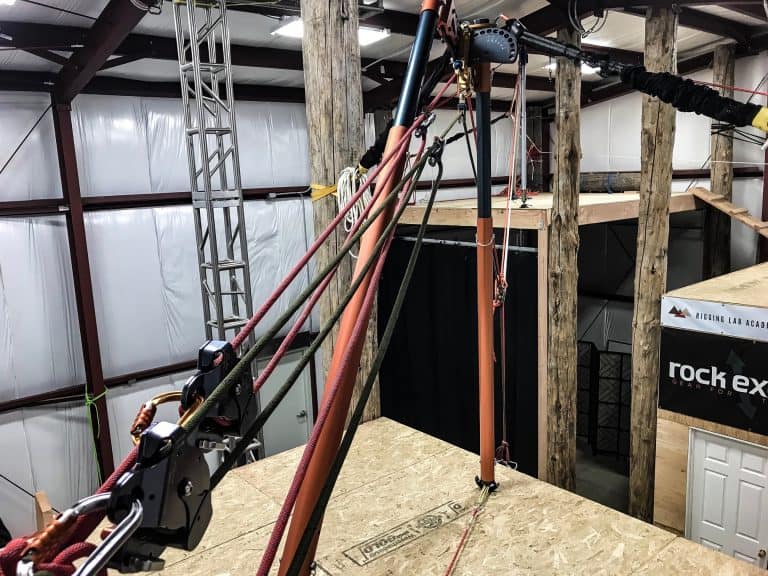
Tripod
- Three-leg system with full stability
- Ideal for confined space entry and vertical access
- Handles complex load vectors more effectively
Each configuration is selected based on terrain, load behavior, and required control—not convenience.
How AHDs Improve System Efficiency
A team that is “solid” on raise and lower systems often encounters a plateau in performance. Systems feel heavier, slower, and harder to manage.
This is not a personnel issue—it is a system geometry issue.
By introducing an AHD:
- Mechanical advantage systems regain efficiency
- Haul teams experience smoother input/output response
- Belay systems track more predictably
- Load movement becomes consistent and controlled
In effect, the AHD restores the intended performance of the system.
Minimum Team Considerations
The current knowledge base does not define a fixed minimum team size for AHD deployment or raise/lower operations. However, operational reality imposes functional requirements.
A team must be able to cover:
- System setup and anchor management
- Edge or AHD control
- Haul or lower operations
- Belay oversight
- Load or patient management
When an AHD is introduced, additional coordination is required:
- Monitoring compression and stability of the AHD
- Managing directional changes in the system
- Ensuring proper alignment under load
This typically increases the need for experienced personnel rather than simply increasing headcount.
NFPA Context and Standardization
The use of AHDs aligns with the expectations of modern rope rescue operations under NFPA 1670, where teams are required to manage complex environments safely and effectively.
AHDs are not explicitly mandated in every scenario, but their function directly supports:
- Edge protection requirements
- Load control and movement
- System safety and redundancy
In practice, teams operating at a technician level are expected to understand when elevated anchor systems are required to meet operational standards.
Artificial High Directionals are not advanced because they are complicated. They are advanced because they change how a system behaves.
Teams that rely only on anchors and mechanical advantage will eventually encounter environments where those tools are not enough. The introduction of an AHD is the moment where rigging shifts from adapting to terrain… to controlling it.
That shift defines the difference between functional systems and engineered systems.
Peace on your Days
Lance