
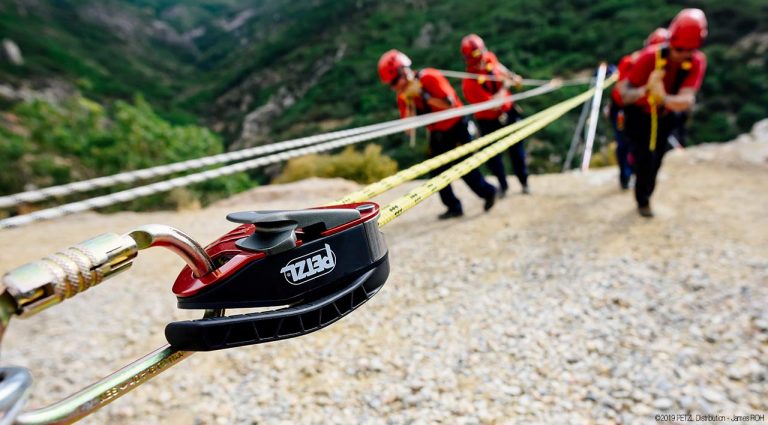
Team Rescue Techniques Petzl Maestro for Hauling and Lowering with Petzl Maestro
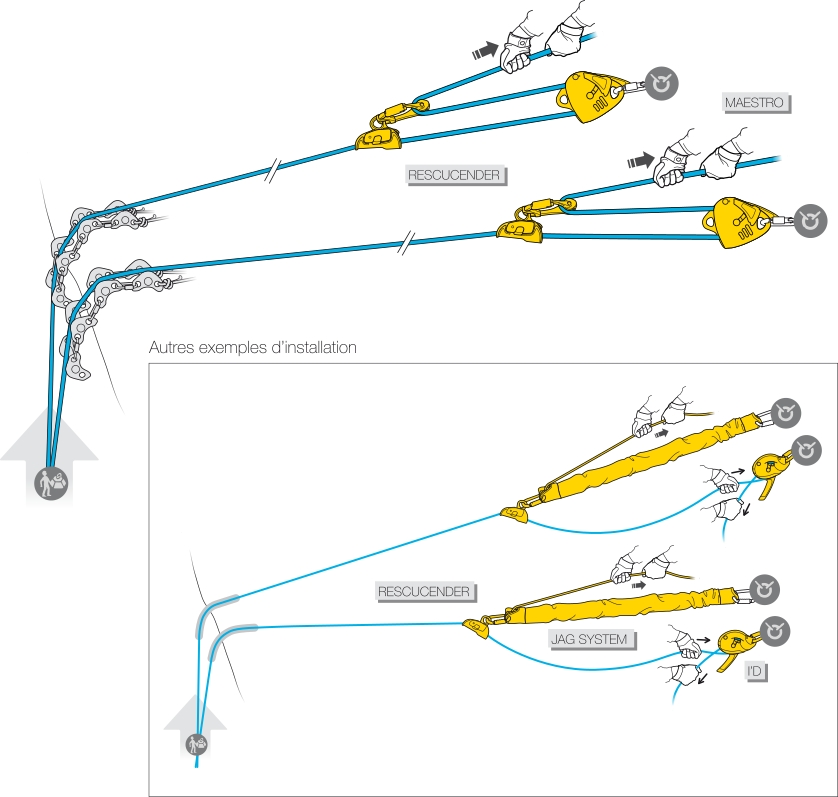
The Petzl Maestro is a highly versatile device for technical rescue operations, streamlining hauling and lowering techniques with precision and safety. Successful team rescue systems require the use of two independent rope systems, which can either work in parallel (twin tensioned haul lines) or separately (a work rope and a belay rope). Each configuration has its specific advantages and challenges, depending on the scenario and team requirements.
In this article, we delve into the details of these configurations, exploring their practical applications, limitations, and key considerations.
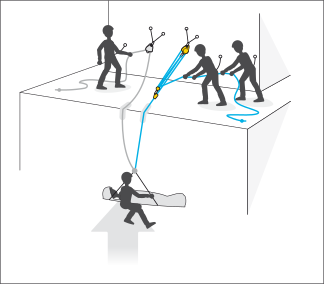
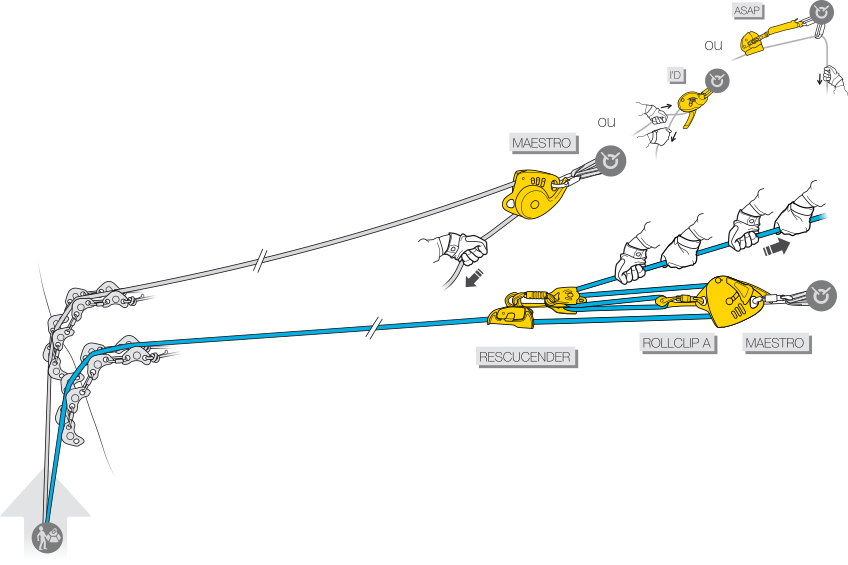
Hauling with Work Rope and Belay Rope
This configuration separates the roles of the two rope systems. The work rope carries the full load during operations, while the belay rope serves as a safety backup. If the work rope or its anchor fails, the belay rope must arrest the load immediately.
Advantages
The primary advantage of this system is its simplicity. By focusing all hauling and positioning forces on the work rope, teams can reduce complexity and streamline the operation. This setup typically requires only one mechanical advantage (MA) system, such as a pulley or winch, to handle the load. The belay rope remains in place as a safety net, taut enough to take over seamlessly if the work rope fails.
This configuration is especially beneficial in tight spaces or environments where space for additional systems is limited. The ability to mix and match different types of hauling mechanisms (e.g., manual and mechanical systems) further enhances its flexibility.
Disadvantages
However, this method is not without its challenges. A significant disadvantage arises if the work rope fails. The belay rope must then bear the full load, often requiring substantial clearance to safely arrest the falling load. If the belay rope setup is neglected or poorly maintained, this transition can fail, leading to catastrophic outcomes.
Another concern is slack management. Teams may unintentionally focus too heavily on the work rope, allowing slack to develop in the belay system. This slack increases the fall distance and forces on the system if it activates. Finally, unforeseen abrasion or shifting of the rope path can occur as the belay rope comes under load, posing additional risks.
To mitigate these challenges, teams must pay close attention to the quality and tautness of the belay system and ensure the rope paths are well-protected.
Hauling with Twin Tensioned Haul Lines
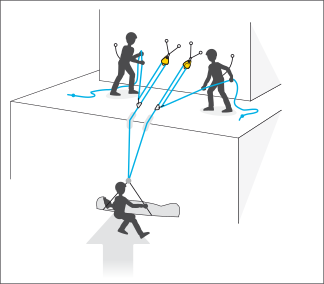
In the twin tensioned haul line configuration, the two ropes function equally, working in parallel to share the load. This setup ensures that each rope supports half the total load, offering enhanced redundancy and stability.
Advantages
The most significant benefit of twin tensioned systems is their ability to distribute the load evenly across both ropes. This reduces the strain on each rope and minimizes the risk of failure. Because the ropes share the load equally, the clearance required for arresting a fall is much smaller compared to a single work rope setup. If one rope fails, the other continues to support the load, ensuring the system remains operational.
This configuration also enhances safety by reducing the likelihood of catastrophic failure. The redundancy provided by twin tensioned lines ensures that even if one system is compromised, the other can take over with minimal disruption.
Disadvantages
Despite its advantages, the twin tensioned system is more complex to set up and requires precise calibration. Ensuring equal tension on both ropes is critical, as uneven distribution can compromise the system’s effectiveness. This often necessitates the use of specialized equipment, such as load cells, to monitor and adjust tension.
Additionally, this configuration requires more workspace to accommodate the dual systems, making it less suitable for confined environments. Teams must also allocate additional time for setup and verification, which may not be feasible in time-sensitive situations.
Choosing the Right Configuration
The decision to use a work rope and belay rope or twin tensioned haul lines depends on the specific requirements of the operation. Factors to consider include:
- Environmental Conditions: In confined spaces, the simplicity of the work rope and belay rope system may be advantageous.
- Load Requirements: For heavier or more complex loads, twin tensioned systems provide better safety and load distribution.
- Redundancy Needs: If maximum safety and redundancy are priorities, twin tensioned haul lines are the superior choice.
- Available Workspace: The physical environment and available space for setup play a critical role in determining the appropriate configuration.
Conclusion
Hauling and lowering operations in technical rescue demand careful planning, precision, and an unwavering focus on safety. By understanding the strengths and limitations of work and belay rope configurations versus twin tensioned haul lines, teams can select the best system for their specific needs. The Petzl Maestro enhances both setups, providing reliable performance and flexibility for critical operations.
For additional training and insights, explore Rigging Lab Academy’s extensive resources:
Peace on your Days…
Lance


Comments are closed.