
A fallen worker may remain conscious, uninjured, and capable of assisting with their own recovery, yet still be unable to climb back to the working level. The fall-arrest system has done its job, but the incident is not resolved until the worker is removed from suspension and transferred to a secure location.
A Fast Fours mechanical advantage system provides a compact option for this type of controlled recovery. Its distinguishing feature is a double-ended rope configuration that allows the system to function either as a conventional 4:1 haul system or as a shared hauling system operated from both ends. Instead of terminating one end of the rope at the pulley becket, that end passes through a second progress-capture pulley. This creates two usable haul ends and gives rescuers greater flexibility in how the available effort is applied.
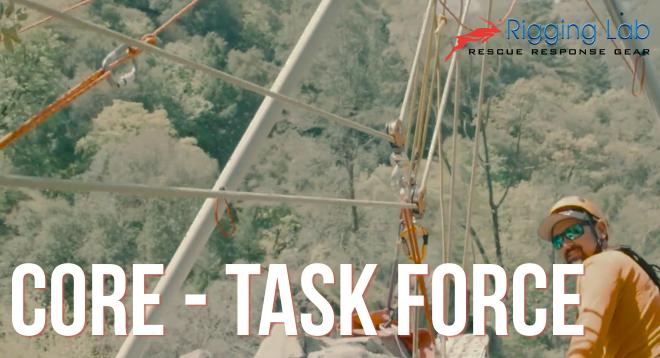
The demonstration shown here focuses on one specific application: returning a responsive worker to the level of a co-worker positioned above.
The Recovery Scenario
In this evolution, the fallen worker is suspended below the working level but remains responsive and capable of participating. The situation is controlled, communication is possible, and there is no immediate need to package or independently haul an incapacitated patient.
The Fast Fours system is positioned at the upper working level. To begin deployment, the operator disengages the progress capture on the upper pulley. This allows the system to extend so the lower pulley assembly can be sent down to the suspended worker.
Once the lower assembly reaches the worker, the upper operator:
- Reengages the progress-capture mechanism.
- Confirms the lower connection has been properly established.
- Sends the long operating end of the Fast Fours down to the worker.
- Coordinates a simultaneous haul from both ends.
The upper operator pulls one end while the suspended worker pulls the other. Both participants contribute to the same recovery movement, reducing the individual effort required from either person.
This is the central strength of the Fast Fours configuration. It is not limited to a single hauling method. The system can be operated from one end as a 4:1 or from both ends as a faster, shared-effort arrangement.
Why the Double-Ended Configuration Matters
A traditional set of fours is commonly configured as a 4:1 mechanical advantage system. The rope is terminated within the pulley system, leaving one primary haul end for the operator.
The Fast Fours changes that arrangement by passing the normally terminated end through an additional progress-capture pulley. Both rope ends remain operational.
That modification provides two distinct operating modes.
Single-End Hauling
One operator pulls a single haul end while the other end remains captured. The system functions as a 4:1 mechanical advantage system, subject to the usual efficiency losses created by pulley friction, rope interaction, alignment, and equipment condition.
This mode may be appropriate when:
- The suspended worker cannot assist.
- Only one haul operator is available.
- Greater mechanical advantage is more important than retrieval speed.
- The system is being used for another controlled hauling or tensioning task.
Manufactured 4:1 haul kits are commonly used for rescue pickoffs, system tensioning, and other operations where compact mechanical advantage is needed.
Two-End Hauling
When two people pull the opposing rope ends, each person contributes effort to the movement. In the demonstrated fallen-worker application, the upper operator and the suspended worker haul together.
This arrangement can increase take-up speed and distribute the physical work between two people. It is especially useful when the worker is conscious, coordinated, properly connected, and able to follow commands.
The practical value is not simply that two people are pulling. The configuration allows those two people to work from different positions while contributing to the same recovery system.
Progress Capture and System Control
Progress capture is essential to the way the Fast Fours is deployed and operated.
During extension, the upper progress capture must be intentionally disengaged so the pulley assembly can be lowered. Once the system reaches the worker, that progress capture is reengaged before hauling begins.
When engaged, the device permits movement in the hauling direction while limiting unwanted reverse travel. This allows operators to retain progress between pulls rather than continuously holding the entire suspended load.
Progress-capture pulleys are specifically designed for hauling and rescue systems. Depending on the product, the cam may also be locked open so the device can function as a standard pulley when unrestricted rope movement is required.
The sequence matters:
Open to deploy. Connect and verify. Reengage before hauling.
A missed or incomplete reengagement can eliminate the intended progress capture. That is why the operator should physically and visually confirm device orientation, rope installation, cam position, connector security, and system function before relying on the haul.
Mechanical Advantage Is Not the Entire Rescue
The Fast Fours provides a method of moving the worker, but mechanical advantage alone does not create a complete fallen-worker rescue plan.
Before the system is deployed, the team must determine:
- What is supporting the worker now?
- Has the worker suffered an impact or other injury?
- Is the worker conscious and able to assist?
- Can the rescue connection be made without disconnecting existing protection?
- Is the upper anchor suitable for the anticipated load and direction?
- Will the worker contact an edge, obstruction, structure, or equipment during movement?
- Can the worker be received safely at the upper level?
- What happens if the worker becomes unable to participate?
The demonstration represents a cooperative recovery. It should not be interpreted as the universal answer for every suspended worker. An unconscious, injured, entangled, inaccessible, or medically deteriorating worker may require an independent rescue system, attendant intervention, controlled lowering, pickoff, packaging, or a more developed rope-rescue operation.
Prompt Rescue Still Applies
A worker who appears stable should not remain suspended longer than necessary. OSHA requires employers to provide for the prompt rescue of an employee following a fall or ensure that the employee can perform self-rescue. This requirement appears in both general-industry and construction fall-protection standards.
Suspension in a harness can also contribute to orthostatic intolerance, particularly when the worker remains motionless. OSHA notes that prolonged immobility may lead to unconsciousness and, in severe circumstances, fatal consequences.
The fact that a worker can communicate and assist does not remove the need for an efficient recovery. It simply expands the operational options available to the team.
The Fast Fours can support prompt recovery when it has already been selected, rigged, inspected, and practiced as part of the work-at-height rescue plan. It should not be introduced for the first time after a worker is already suspended.
Connecting the Fallen Worker
The recovery system must connect to an appropriate attachment point without compromising the worker’s existing fall protection. The exact method depends on the harness, fall-arrest configuration, rescue equipment, work environment, and organizational procedures.
Several principles remain consistent:
- Maintain the worker’s existing protection until the rescue system is confirmed.
- Use compatible connectors and designated attachment points.
- Avoid cross-loading or unintended connector orientation.
- Keep the system clear of sharp edges, abrasion, heat, and moving machinery.
- Confirm that the worker understands which component to connect and how.
- Verify the connection before applying the worker’s full load to the recovery system.
OSHA requires compatibility between personal fall-protection components and requires ropes, harnesses, lanyards, and related equipment to be protected from cutting, abrasion, melting, and other damage.
A conscious worker may be able to install the connection independently, but verbal confirmation is not enough. The upper operator should obtain the clearest available visual or physical verification before hauling begins.
Coordinating the Shared Haul
The shared-haul mode depends on coordinated movement.
The upper operator controls the operation and establishes the commands. The suspended worker should understand:
- Which rope end to pull.
- When to begin.
- When to stop.
- What to do if the rope becomes difficult to move.
- What to do when approaching the working level.
- Where hands and equipment must remain during the final transition.
Both people should pull smoothly rather than using abrupt, uncoordinated movements. The upper operator must watch the entire rope path, the lower pulley assembly, the worker’s connection, and the receiving edge.
As the worker reaches the upper level, the operation may change from hauling to edge management. The system may have lifted the worker to the correct elevation, but the team must still control the worker through the final transition to a secure standing, sitting, or supported position.
The rescue is not complete merely because the worker reaches the edge.
Preplanning the Fast Fours
The value of a compact haul system comes from readiness, not simply ownership.
Before beginning work at height, the team should know:
- Where the Fast Fours will be stored.
- Who is authorized and trained to deploy it.
- Which anchors may be used.
- How the system will reach a fallen worker.
- Which worker attachment points are compatible.
- Whether the worker can realistically assist.
- How communication will be maintained.
- How the worker will be moved through the edge.
- What backup method will be used if the cooperative recovery fails.
Pre-rigged systems can reduce deployment time, but only when their configuration is protected from tangling, contamination, incorrect reassembly, and unauthorized modification. The system should be inspected according to manufacturer requirements and incorporated into scenario-based training.
Training should include more than pulling a weight across the floor. Teams need to practice lowering the pulley assembly, making the rescue connection, reengaging progress capture, coordinating two-ended hauling, receiving the worker at the edge, and changing plans when the worker cannot assist.
Where the Fast Fours Fits
The Fast Fours is not a complete fall-rescue program and should not be treated as a replacement for broader rescue capability.
It is a flexible mechanical advantage tool that can be especially effective when:
- The fallen worker remains responsive.
- The worker can assist with the haul.
- The vertical distance is manageable.
- The rope path is clear.
- A suitable upper anchor is available.
- The receiving area can safely accept the worker.
- The system has been incorporated into the preplanned rescue procedure.
Its strength lies in adaptation. One compact system can provide a conventional 4:1 haul or a double-ended shared haul, allowing the team to select the operating method that best fits the worker, available personnel, and recovery objective.
In the demonstrated application, the worker below and the operator above each pull an operating end. The effort is shared, progress is captured, and the worker is returned to the original level through a controlled, coordinated recovery.
That is the practical purpose of the Fast Fours: not simply to multiply force, but to give the team more ways to apply the people, equipment, and movement options already available.