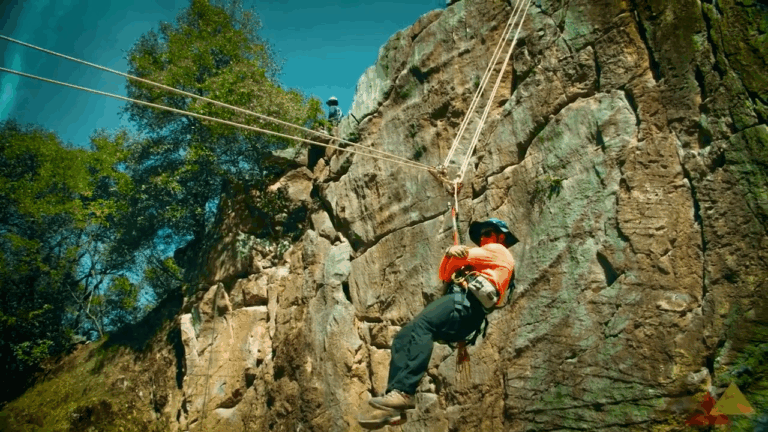
Skate Block Systems provide a streamlined, efficient rigging solution for small teams performing rescues or load movements in specialized environments. These systems are particularly effective when personnel and time are limited—such as during tower maintenance, communications rigging, crane work, or industrial access operations.
Unlike full highline or two-rope offset systems, the skate block uses the load itself as part of the system’s mechanical behavior. By harnessing gravity as a self-tensioning mechanism, the skate block minimizes equipment requirements and reduces operational complexity. The result is a controlled, low-tension horizontal movement that can be managed by a minimal crew while preserving redundancy and safety.
Principles & Mechanics
The skate block functions on the principle of controlled tension through load weight. Rather than pre-tensioning the line to full rigidity—as in a highline—the skate block allows the main rope to remain semi-tensioned, using the load’s mass to achieve balance.
The Core Concept
At its simplest, a skate block is a movable directional that travels along a tensioned rope, guiding the suspended load laterally. The load’s position adjusts through a combination of rope release and movement of the block across the span.
This approach enables precise positioning and smooth transitions without requiring high-tension control systems. Because the rope sag is deliberate, the system maintains low anchor forces, making it safer and more practical for limited manpower operations.
Force Distribution
Force in a skate block is dynamically shared among three points:
-
Anchor Station A – Serves as the fixed control or haul side.
-
Anchor Station B – Receives tension and controls the return rope.
-
Load Connection Point – Acts as both the moving directional and tension moderator.
In a balanced skate block, tension in both rope legs should be nearly equal. If tension becomes uneven, the load may drift toward one anchor, creating lateral imbalance. This is corrected by adjusting either the control line or adding friction at the haul device.
System Behavior
Because the skate block is designed for low-tension, the rope exhibits significant sag—typically allowing 30°–45° between rope legs under load. This deep-angle geometry is what distinguishes it from a highline or offset system, keeping anchor loads within manageable limits and allowing easy corrections mid-operation.
Load Management and Operational Efficiency
The efficiency of the skate block lies in its ability to manage load travel smoothly while simplifying system control. The design requires no heavy pre-tensioning, meaning the rig can be built quickly and adjusted dynamically in the field.
In industrial or tower environments, the skate block can be rigged using existing structural anchor points (e.g., beams, railings, tower rungs). This adaptability allows rescuers to deploy a horizontal transport system without the need for full-span tensioned systems that demand multiple operators or complex synchronization.
When integrated with a tension track line, a single skate block provides guided movement for a suspended load through restricted spaces such as catwalks, structural frames, or pipe corridors. The system’s flexibility enables small teams to maintain control even in highly constrained layouts.
Self-Tensioning Benefit
A defining feature of the skate block is its self-tensioning mechanism. As the load is applied, gravity naturally tensions the line, preventing over-tensioning and allowing smooth lateral travel. This built-in feedback loop simplifies the lowering process, making it particularly effective for single-rescuer operations or planned worker retrievals.
Redundancy and Safety in Mirrored Configurations
The mirrored skate block refines this concept by introducing redundancy without sacrificing simplicity. It employs two identical skate block setups—one functioning as the primary load-bearing system and the other as a mirrored backup operating in parallel.
Mirrored Configuration Advantages
-
Full Redundancy: Each side can independently support the load, eliminating single-point failure risk.
-
Synchronized Control: A single operator can manage both lowering devices simultaneously with matched friction devices (e.g., MPDs, I’Ds, or Clutches).
-
Balanced Geometry: Equal line length, tension, and pulley placement ensure consistent behavior during lowering or raising.
-
Simplified Personnel Requirements: Because both systems are mechanically identical, one technician can oversee both descent controls while an assistant monitors anchors and slack.
In many industrial and tower rescues, mirrored skate blocks are used for non-urgent evacuations—such as retrieving an incapacitated worker from height. The system’s redundancy allows methodical control with a minimal team size, enhancing safety without sacrificing efficiency.
Setup & Stability
Step 1: Anchor Preparation
Each anchor must be positioned to allow clear line-of-sight travel for the load. Whenever possible, top anchors should be elevated to reduce edge friction and improve clearance. Techniques such as “wrap three, pull two” are frequently employed to secure anchor slings around beams or tower members, maximizing anchor height and strength.
Step 2: Pulley and Block Installation
Attach a high-efficiency pulley (≥36 kN rating) at the load connection point. This pulley becomes the traveling directional or “skate block.” Both main lines run through the pulley—one to each anchor station. The pulley must travel freely, without friction points or rope interference.
Step 3: Friction Device Configuration
Each anchor station uses a controlled friction device such as a Petzl ID, CMC MPD, or Harken Winch to manage rope movement. For mirrored setups, both devices must be operated simultaneously, maintaining equal speed and tension to prevent rotation or twisting of the load.
Step 4: Edge Management
If operating over sharp edges or structures, AHDs (such as the Arizona Vortex in monopod or A-frame mode) can be deployed at the anchors to elevate the rope path. This prevents edge trauma and stabilizes resultant forces through proper alignment.
Step 5: Load Attachment and System Test
Before introducing the live load, perform a function check using a weighted test package. Confirm synchronized movement, equal tension in both lines, and consistent friction control during haul/lower operations.
Edge Mitigation and System Optimization
Edge clearance is a critical factor in skate block efficiency. AHDs are often used as edge management tools, not only to protect the rope but also to optimize angle and clearance.
By elevating the anchor points through devices like the Arizona Vortex, TerrAdaptor, or SMC Vector, rescuers can create a clean rope path over handrails, parapets, or lattice beams. The elevated pulley heads keep resultants in compression while maintaining low-friction movement along the line.
When headroom is restricted—such as in a crane boom or industrial plant structure—riggers can achieve additional clearance by stacking directional pulleys or integrating tripod-based AHDs that offset the rope path just enough to clear obstacles.
System Integrity and Balance
Maintaining system symmetry is the cornerstone of skate block stability. The mirrored setup ensures equal tension across both sides of the load, eliminating unwanted sway or spin.
During operation, friction and elasticity must remain balanced. Operators continually monitor rope tone (audible pitch and vibration) as an informal tension gauge. Subtle differences in sound or feel indicate imbalance, prompting immediate correction through small adjustments to one device.
Additional Integration:
-
Worker’s positioning lanyards can be incorporated into the load connection as secondary stabilizers.
-
Quick-release connectors allow for smooth transitions from horizontal travel to vertical lowering once the load reaches the edge.
-
Taglines may be attached to prevent rotation of suspended loads, particularly in windy or confined environments.
Operational Awareness
During live operation, the skate block behaves differently than a rigid highline—it flexes. This elasticity requires the operator to anticipate movement rather than react to it. The load will naturally sag toward mid-span, and small adjustments to lowering or hauling devices can have significant effects on lateral motion.
Technicians must maintain constant communication between both anchors. Commands like “lower slow,” “hold,” and “check left” should be synchronized. If a mirrored system is used, the lead operator should stand at a midpoint position with visual access to both devices for optimal coordination.
Case Example
During a tower maintenance exercise, a two-person team employed a mirrored skate block for the controlled descent of a simulated casualty. Both ropes ran through independent MPDs anchored with “wrap three, pull two” slings at 15-foot elevation points. As descent began, the operator managed both MPDs simultaneously, maintaining consistent rope feed. When one rope lagged slightly, the load began rotating; a minor correction through synchronized handle adjustment immediately restored stability. This exercise demonstrated the skate block’s efficiency for single-operator, small-team rescue scenarios.
Operational Checklist — Skate Block Systems
-
Verify secure, elevated anchors using proper sling methods.
-
Install a high-efficiency pulley rated ≥36 kN for the traveling direction.
-
Use mirrored lines for redundancy; confirm equal rope length and path.
-
Attach dual friction devices (MPD, ID, Clutch) for synchronized lowering.
-
Maintain balanced tension and monitor rope tone continuously.
-
Employ AHDs or elevated anchors to prevent edge friction.
-
Perform full test load before committing to live operation.
-
Keep communication clear and consistent between both anchors.
-
Utilize taglines or lanyards to prevent load rotation.
-
Record tension observations and corrections for after-action review.
Summary
Skate Block Systems epitomize efficiency through simplicity. They harness gravity, symmetry, and redundancy to achieve controlled horizontal movement with minimal manpower. When configured in mirrored form, they offer dual-system safety and precision control suitable for industrial, tower, and confined-space operations.
These systems fill the gap between traditional lowering setups and fully tensioned highlines—providing a fast, reliable means of lateral load movement without complex rigging or extensive personnel. Proper integration of elevated anchors, mechanical friction devices, and balanced geometry ensures that even a single operator can conduct a safe, redundant rescue.
Ultimately, the skate block embodies a principle central to technical rigging: let physics work for you. By allowing the load to tension the system naturally, technicians maintain control without unnecessary mechanical strain—an elegant solution where efficiency and safety converge.