
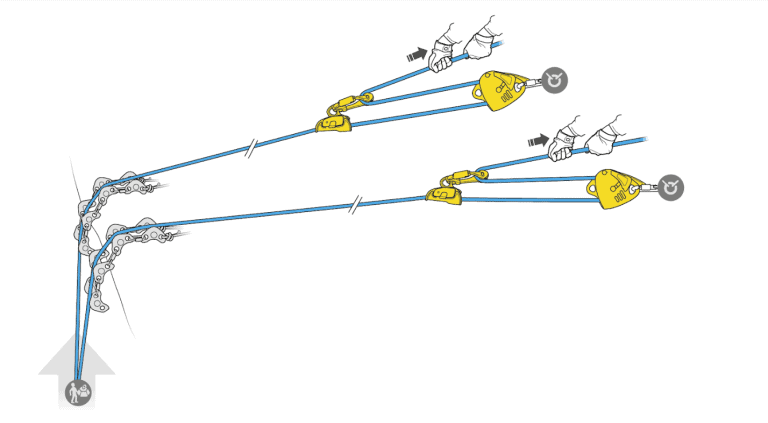
Recommended Rope Systems: Two-Tension Rope System (TTRS) for Raise and Lower Operations
In the world of technical rope rescue, the Two-Tension Rope System (TTRS) has emerged as a preferred setup for raising and lowering operations. By sharing the load equally between two ropes, TTRS enhances stability, redundancy, and overall system efficiency, making it an invaluable tool for rescue teams and technical operations.

| System Benefits | Maestro |
| • load is distributed between two systems, reducing force concentration on any one component • in the event of a line failure, the amount of load transferred to the remaining line is approximately half of the total load, thus minimizing the drop distance and arresting force • rigging is the same for both sides of the system, reducing the complexity of training and operations |
• AUTO-LOCK function automatically locks the rope when the handle is not in use • integrated progress-capture pulley for increased hauling efficiency • audible clicking sound during haul mode indicates that rope is in motion |
Two-Tensioned Rope System – Lower
A Two-Tensioned Rope System shares the load between two ropes, both under tension.
Each system is capable of functioning as both mainline or back-up to the other line.
System

| System Benefits | Maestro |
| • load is distributed between two systems, reducing force concentration on any one component • in the event of a line failure, the amount of load transferred to the remaining line is approximately half of the total load, thus minimizing the drop distance and arresting force • rigging is the same for both sides of the system, reducing the complexity of training and operations |
• AUTO-LOCK function automatically locks the rope when the handle is not in use • one-directional faceted sheave and auxiliary brake provide optimal friction control • ergonomic handle and integrated brake allow for comfortably controlled descents |
Understanding the Two-Tension Rope System (TTRS)
The TTRS configuration involves two ropes under equal tension, working in tandem to manage the load. Unlike traditional main-and-belay systems, TTRS ensures that both ropes bear the load simultaneously, reducing the strain on individual components and minimizing the risk of catastrophic failure.
Key Benefits of TTRS for Raise and Lower Operations
- Increased Redundancy: With both ropes sharing the load, TTRS provides a built-in safety net. If one rope fails, the other continues to support the load.
- Enhanced Load Stability: Equal tension across both ropes minimizes movement and sway, ensuring smoother and safer operations.
- Reduced Force on Anchors: By distributing the load, TTRS reduces the overall stress on anchor points, preserving their integrity during critical operations.
- Simplified Transitions: The system seamlessly switches between raising and lowering, making it ideal for dynamic rescue scenarios.
TTRS Setup: Raise and Lower
Components Needed:
- Two Independent Rope Systems: Both ropes must meet safety standards for load-bearing and durability.
- Tensioning Devices: Examples include the CMC MPD, Petzl I’D, or Clutch to ensure smooth and controlled operations.
- Anchors: Secure, redundant anchor points to support the system.
- Load Monitoring: Devices like load cells to measure and adjust tension on each rope.
Step-by-Step Guide:
- Anchor Setup: Establish two independent anchor points, ensuring they can handle the combined forces from the ropes.
- Attach Devices: Secure tensioning devices to both ropes and anchors. Confirm they are correctly aligned for raising and lowering.
- Equalize Tension: Use manual or mechanical tensioning systems to balance the load evenly across both ropes.
- Test the System: Before applying the load, test the system under controlled conditions to verify stability and functionality.
- Operate the System: Coordinate team members to raise or lower the load while monitoring tension and load distribution.
Real-World Applications of TTRS
Confined Space Rescue
TTRS excels in confined spaces where precise control and minimal sway are critical for lowering and raising individuals or equipment.
High-Angle Rescues
In steep or vertical environments, TTRS provides the stability needed to manage heavy loads and secure edge transitions.
Industrial Rope Access
The redundancy and load-sharing capabilities of TTRS make it an excellent choice for industrial settings requiring heavy lifting and lowering.
Best Practices for TTRS Operations
- Pre-Operation Checks: Ensure all components are inspected and free of wear or damage.
- Load Monitoring: Continuously monitor tension and load distribution to prevent imbalances.
- Team Coordination: Communicate clearly among team members to ensure synchronized operations.
- Regular Training: Familiarize the team with TTRS setup and operation through regular drills and practice sessions.
Recommended Gear for TTRS
Conclusion
The Two-Tension Rope System (TTRS) offers unmatched versatility and safety for raising and lowering operations. By distributing the load and providing built-in redundancy, TTRS enhances the efficiency and reliability of technical rope rescue and industrial applications. Equip your team with the knowledge and tools to master TTRS and take your operations to the next level.
Peace on your Days
Lance






Comments are closed.