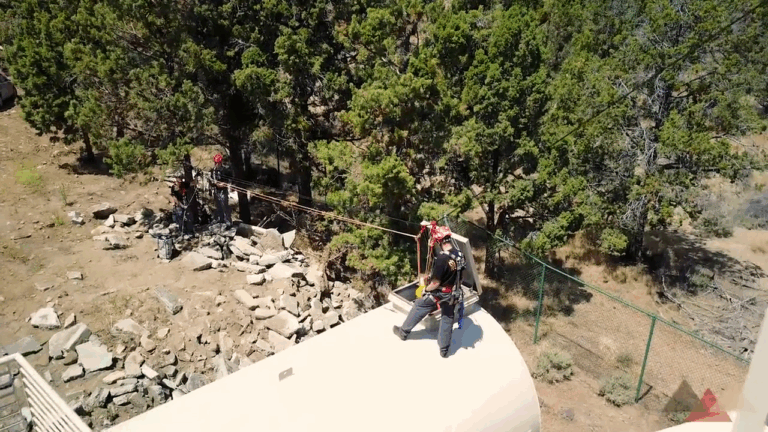
Norwegian Reeving in Highline Rescue Systems are essential in technical rope rescue when terrain, distance, or obstacles prevent direct access. Among the reeving methods used to move a load across a span, Norwegian reeving is one of the least understood. While Rigging Lab Academy has touched on it in gear overviews, the practical details deserve more attention.
This article explains what Norwegian reeving is, how it differs from other systems, and how to safely build and operate one.
What Is Norwegian Reeving?
Norwegian reeving is a way of routing the control line in a highline system so that it connects between the carriage and the suspended load. Unlike an English reeve, where the haul line passes directly through the carriage, the Norwegian version creates a link between the carriage and the load.
This design allows rescuers to adjust the load’s vertical position while it is mid-span. The tradeoff is added complexity and rope usage.
Why Choose Norwegian Reeving?
Every reeving system solves a specific problem. Norwegian reeving is valuable when:
-
Fine vertical adjustment is needed while the load is crossing.
-
Obstacles (trees, rock outcrops, structures) require height changes during travel.
-
Force distribution must be shifted away from a single carriage point.
-
Redundancy is desirable: more than one line shares control of the load.
In short, Norwegian reeving gives a rescue team flexibility that a simple highline cannot.
Step-by-Step Rigging Guide
Here’s a straightforward outline for building a Norwegian reeving system.
-
Anchors
-
Build two redundant, load-sharing anchors.
-
Ensure they are rated for highline vector forces.
-
-
Track Line
-
Rig and tension your main highline track line(s).
-
Install high directionals if needed to clear edges.
-
-
Carriage
-
Use a carriage pulley set (e.g., REEVE, SPIN L2).
-
Attach backup connections.
-
-
Reeve Line Routing
-
Run the reeve line from one anchor through the carriage.
-
Terminate it at or near the load connection point.
-
This creates the “Norwegian” link between carriage and load.
-
-
Load Attachment
-
Secure the patient litter or load to the reeve line.
-
Use swivels or rigging plates to reduce twist.
-
-
Control Stations
-
Assign rope operators at both ends.
-
One manages the track line tension, the other manages reeve line travel.
-
Required Equipment
-
Track line(s): static or semi-static rope, rated for highline forces.
-
Carriage: REEVE carriage or pulley set.
-
Reeve line: rope long enough for span plus vertical adjustments.
-
Progress capture: prusiks, cams, or pulleys with built-in PCDs.
-
Rigging hardware: carabiners, swivels, rigging plates.
-
Belay system: twin-tension or independent backup.
Advantages of Norwegian Reeving
-
Vertical adjustment mid-span.
-
Better obstacle management across rugged terrain.
-
Shared loading between carriage and reeve line.
-
Adds a layer of redundancy for critical operations.
Limitations
-
Requires more rope and more complex rigging.
-
Demands extra personnel for coordination.
-
Risk of miscommunication between haul teams.
-
Training-intensive — not ideal for first-time setups in the field.
Safety Considerations
-
Force Monitoring: Place load cells or dynamometers on anchors.
-
Edge Management: Protect rope where it contacts terrain.
-
Clear Communication: Use standard commands and confirm before line adjustments.
-
Training: Teams should rehearse Norwegian reeving in controlled environments.
When to Use It
Norwegian reeving is best applied in specialized rescues where terrain and obstacles make traditional reeving inefficient or unsafe. For most highlines, English or Spanish reeves will suffice. But when mid-span control and flexibility are required, Norwegian reeving becomes the smarter choice.
Conclusion
Norwegian reeving may not be the most common highline technique, but it is an important option for trained rope rescue teams. It adds flexibility, redundancy, and control in situations where standard reeves fall short. With the right anchors, equipment, and training, Norwegian reeving turns a complex problem into a safe and efficient operation.
Peace on your Days
Lance