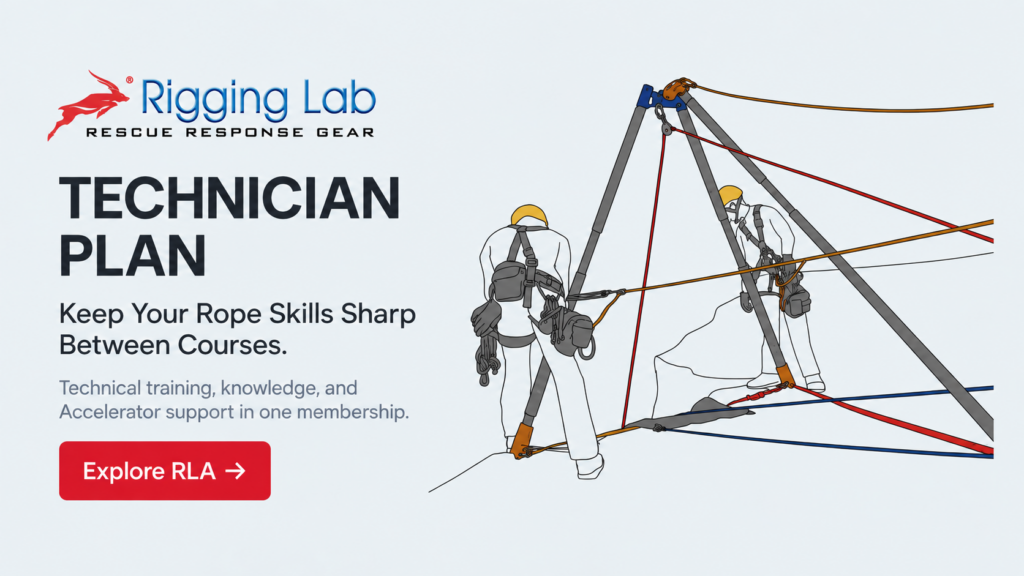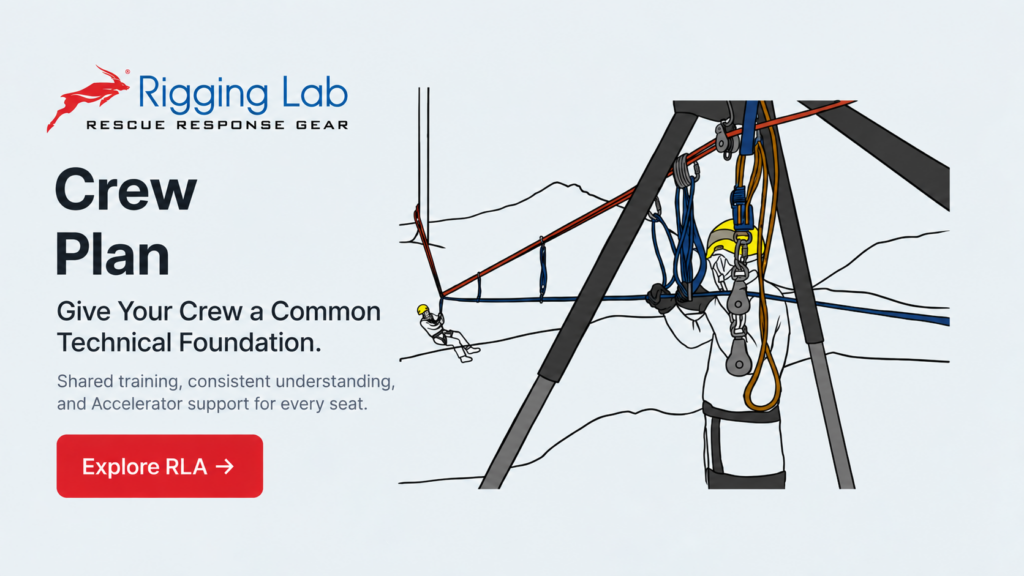
Integrating Artificial High Directionals (AHDs) within Skate Block Systems transforms a simple, low-tension rescue technique into a controlled, highly adaptable rigging platform. This integration enables teams to overcome edge trauma, improve resultant alignment, and achieve greater system precision—all without sacrificing the lightweight, small-team functionality that defines the skate block.
In essence, an AHD turns a skate block from a rope suspended between two anchors into a structural interface—a deliberate elevation and alignment mechanism that manages how forces are introduced to anchors, edges, and the load path. Whether configured with a CMC Arizona Vortex, PMI-SMC TerrAdaptor, or SMC Vector, AHDs extend the operational envelope of the skate block system from tower tops and catwalks to wilderness ridgelines and confined industrial spaces.
Core Relationship Between AHDs and Skate Blocks
At its heart, the skate block is a mobile directional—a pulley that travels along a rope to reposition a load. The AHD provides the elevated anchor geometry that makes this motion both efficient and safe.
Without an AHD, the rope path often contacts the edge directly, increasing friction and decreasing mechanical efficiency. By elevating the point of deflection, AHDs prevent rope abrasion, reduce edge trauma, and align forces in line with the system’s compression members.
Key Advantages of AHD Integration
-
Edge Management: AHDs elevate the working rope path over sharp edges, minimizing friction and protecting rope integrity.
-
Resultant Control: Proper AHD setup ensures that the resultant vector falls through the device’s footprint, maintaining compression and preventing frame failure.
-
Mechanical Efficiency: Elevated pulleys maintain smoother rope travel and reduce drag, improving load movement control.
-
Force Reduction: Increased rope angle from elevation reduces the horizontal component of load force, decreasing anchor tension.
-
Operational Precision: Elevated pulleys allow more accurate lateral control and consistent load behavior through the full range of movement.
Integration Principles and Geometry
1. Resultant Alignment and Compression Management
When integrating AHDs into a skate block, the resultant vector becomes the most important design parameter. It must remain within the device’s footprint to ensure structural compression rather than bending.
-
A-Frame Configuration: Common in skate block integration for its broad stance and forward-leaning geometry. The apex pulley sits above the edge, directing the rope cleanly over the lip.
-
Sideways A-Frame: Used when anchors are horizontally offset. This setup allows rope travel across a span while maintaining stable compression, often supported by additional guying.
-
Monopod (Gin Pole): Applied in lightweight or mobile operations. The monopod is positioned with a forward lean (“erring into the resultant”) to ensure that the compression member aligns with the load vector.
Maintaining a forward lean of 5–15° in monopod configurations ensures that as rope tension increases, the resultant remains inside the footprint rather than pulling backward through the device.
2. Anchor and Pulley Placement
The AHD serves as the apex directional—the first or last redirection point in the system, depending on whether it’s placed at the start or end of the span.
-
For rescue load travel, the apex pulley is positioned to minimize the vertical drop between the rope and load, ensuring controlled horizontal translation.
-
For industrial evacuation, the AHD may act as both an edge protector and primary high anchor, enabling clean rope deployment from elevated platforms.
The Role of AHDs in Mirrored Skate Block Systems
A mirrored skate block system—two identical, redundant setups—benefits greatly from AHD integration. Each mirrored side can incorporate an AHD to manage the rope path and resultant alignment independently.
Benefits of Dual-AHD Integration
-
Symmetry and Redundancy: Each mirrored side maintains identical elevation and force geometry, ensuring balanced load sharing.
-
Reduced Friction and Twist: Elevated pulleys maintain parallel rope paths, preventing rope crossovers or rotation in the traveling pulley.
-
Simplified Edge Transition: AHDs create smooth entry and exit points for the rope, facilitating better control when lowering the load past edge obstructions.
-
Operational Control for Single Operators: Dual AHD integration keeps the rope system geometrically stable, allowing a single operator to manage both lowering devices safely.
When both AHDs are configured correctly, the mirrored skate block behaves as a synchronized unit—each side providing equal tension and friction control, maintaining constant geometry through the entire lowering or traverse sequence.
Equipment Selection and Integration
1. Arizona Vortex (AZV)
The Arizona Vortex 2 Multipod remains the gold standard for AHD integration in skate block systems due to its configurational versatility.
-
Tripod or A-Frame Mode: Ideal for primary edge management where resultant vectors must stay vertical.
-
Sideways A-Frame: Used in horizontal applications where rope lines deviate from the main anchor direction.
-
Attachment Points: Multiple apex holes and mid-tube tie-ins allow riggers to attach main and mirrored lines separately while maintaining symmetry.
2. TerrAdaptor (PMI-SMC)
The TerrAdaptor offers greater modular height adjustment and load path customization. Its lash ring head assembly is designed for multi-directional force management, accommodating complex horizontal rigging scenarios. The telescoping legs allow technicians to fine-tune elevation when one side must clear obstructions.
3. SMC Vector Gin Pole
For lightweight or single-line skate blocks, the SMC Vector serves as a portable monopod AHD. Its fixed apex pulley is ideal for limited access environments where a full Vortex frame is impractical. This configuration demands meticulous guying but provides rapid deployment for one-person rescues or maintenance tasks.
Mechanical Advantage and Control Integration
Incorporating AHDs enhances the system’s ability to employ mechanical advantage (MA) subsystems without adding complexity.
-
Petzl JAG System: Functions as a prebuilt 4:1 for adjusting guy tension or fine-tuning rope sag.
-
CMC AZTEK ProSeries System: Offers adjustable 4:1 or 5:1 MA for controlling AHD guy lines, edge direction, or minor haul adjustments.
-
CMC MPD or Petzl ID: Provide integrated friction and progress capture for lowering or raising under control.
These devices collectively enable rapid re-tensioning, correction of resultant drift, and fine-tuned synchronization in mirrored setups.
Force and Stability Considerations
Managing Resultant Forces
The stability of an AHD-integrated skate block system hinges on maintaining the resultant within the compression footprint. Factors influencing resultant behavior include:
-
Anchor Height: Increasing height shifts the resultant backward; lowering it shifts forward.
-
Rope Angle: The deeper the rope sag, the lower the anchor load.
-
Pulley Placement: A higher pulley reduces friction but steepens the resultant, affecting compression balance.
Guying Strategy
AHDs require three-way guying at a minimum—forward, backward, and lateral. For offset or mirrored systems, a quad guy configuration provides greater resilience under asymmetric loading.
-
Tensioned Guying with AZTEK Systems: Allows precise resultant control as the load moves through mid-span.
-
Dynamic Guying with Rope Grabs: Enables real-time adjustments if the AHD shifts during load transfer.
Stability Monitoring
Operators should constantly assess:
-
Rope vibration (tone) for even tension.
-
Guy line deflection for drift.
-
Frame flexion or “walking” at the base indicates over-tension or misalignment.
Edge and Terrain Applications
Tower and Industrial Environments
In tower rescues, AHDs elevate the system above railings, crossmembers, or truss elements, ensuring rope clearance and smoother horizontal transitions. The monopod or A-frame mode provides clean load paths for non-urgent evacuations using mirrored skate blocks.
Wilderness or Canyon Scenarios
In wilderness rescues, AHDs like the Vortex create high points above ledges or cliffs where natural anchors would otherwise generate severe edge friction. A forward-leaning A-frame prevents the rope from sawing over rock lips, preserving both rope integrity and system efficiency.
Confined or Limited-Access Sites
Where ground clearance or headroom is minimal—such as in structural maintenance bays or elevator shafts—AHDs allow rope redirection above obstructions, enabling single-anchor skate blocks with controlled rope trajectories.
Operational Example
During a training exercise on a 40-meter radio tower, a two-rescuer team established a mirrored skate block system using dual Arizona Vortex A-frames at the top platform. Each Vortex was leaned forward 10° and guyed with AZTEK systems. Two MPDs controlled the lowering operations.
As the suspended load approached the mid-span, both AHDs experienced resultant drift due to uneven lowering. The lead operator adjusted the left AZTEK guying by 3 inches, realigning the resultant over the footprint and restoring compression. The operation continued smoothly with perfect symmetry.
This exercise highlighted the advantages of AHD integration in maintaining geometry, reducing friction, and stabilizing the system under load transitions.
Operational Checklist — AHD Integration for Skate Blocks
-
Confirm AHD placement ensures resultants fall within the footprint.
-
Lean AHDs 5–15° forward toward the load direction.
-
Employ 3-way (minimum) or 4-way guying for offset operations.
-
Use AZTEK or JAG systems for precise tension adjustments.
-
Maintain equal anchor heights and rope lengths for mirrored setups.
-
Inspect pulleys and connectors (rated ≥36 kN) for clean, aligned travel.
-
Monitor the guy tension and frame alignment throughout load movement.
-
Communicate continuously between anchor operators to ensure synchronization.
-
Test with a preloaded dummy or equipment bag before introducing personnel.
-
Document anchor forces and resultant corrections post-operation for review.
Summary
Integrating Artificial High Directionals within Skate Block Systems elevates their functional capability from a simple low-tension method to a precise, engineered rescue system. AHDs enhance edge management, stabilize geometry, and allow small teams to execute controlled traverses, evacuations, and load transitions in complex environments.
When used with modular structures like the Arizona Vortex, TerrAdaptor, or SMC Vector, AHDs create an elevated working envelope that allows the rope to move efficiently and safely above terrain obstacles. The mirrored skate block, reinforced by dual AHDs, epitomizes this synergy—offering redundancy, predictability, and compact control suited for both industrial and wilderness operations.
Mastery of this integration lies not only in technical setup but in active vector awareness—the ability to see, feel, and adjust how force behaves through each component. That awareness, combined with deliberate rigging technique, transforms the skate block from a convenience into a cornerstone of modern small-team rope rescue.