Highline systems are not built from a single template. The configuration selected must match the terrain, the objective, and the level of control required.
The mistake is not choosing the wrong gear—it is choosing the wrong system structure.
Each configuration changes how force moves, how the load behaves, and how the team must operate. Understanding when to use each system is what separates a functional setup from an efficient one.
Tagline-Only Systems — Minimal Structure, Maximum Simplicity
The simplest configuration removes the trackline entirely and relies on taglines to control the load.
This system is appropriate when:
- The span is short
- The terrain allows for natural clearance
- The load is light and manageable
- Precision is not critical
In this setup, the load is suspended from a primary rope system and guided across the span using opposing taglines.
The advantage is speed and simplicity. Fewer components mean faster setup and fewer failure points.
The limitation is control. Without a defined trackline, the load can drift, rotate, or lose clearance. The system relies heavily on operator coordination and terrain forgiveness.
This is not a true highline—it is a guided movement system.
Basic Trackline Systems — Defined Path and Improved Control
Adding a trackline introduces structure. The load now travels along a defined path, reducing drift and improving predictability.
This configuration is appropriate when:
- The span is moderate to long
- Clearance must be maintained
- The load requires consistent positioning
- Environmental factors (wind, obstacles) affect stability
The trackline carries the load while taglines control movement across the span.
This is the most common highline configuration because it balances control and complexity.
However, the system still lacks vertical adjustment. Once the trackline is set, the load follows that path. If the terrain changes, the system cannot adapt without resetting.
Trackline with Reeving System — Full Control Configuration
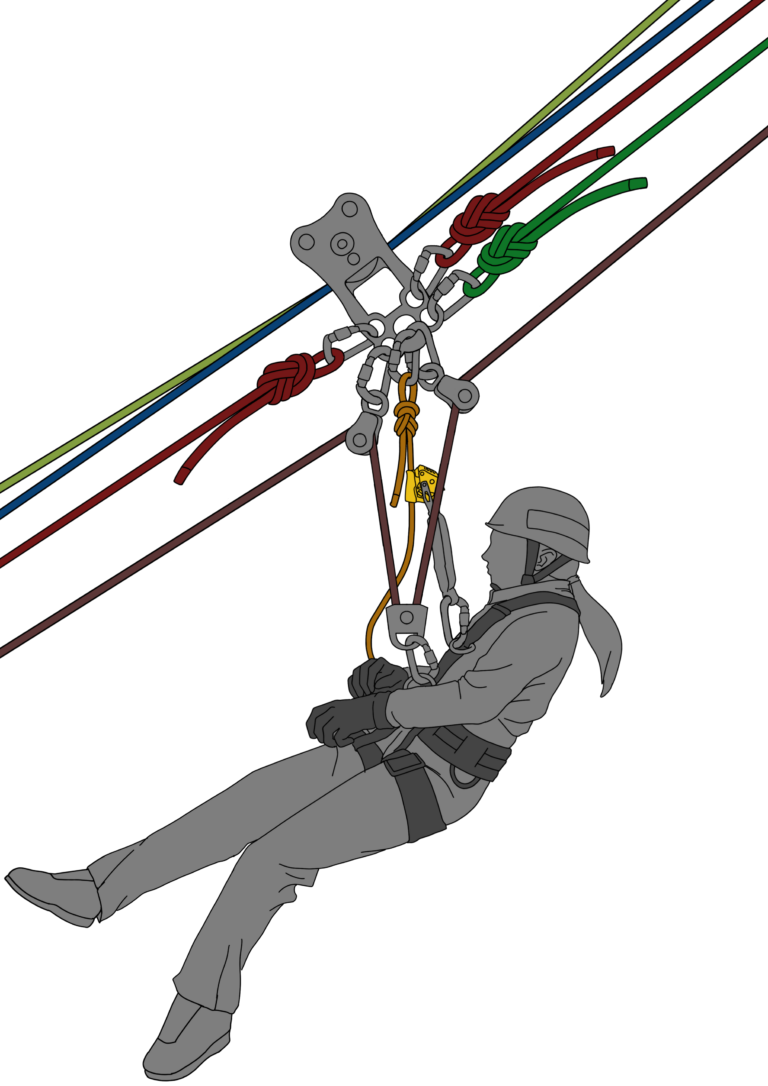
Adding a reeve system introduces vertical control, creating a fully adjustable highline system.
This configuration is used when:
- Terrain varies significantly across the span
- Obstacles require elevation changes
- Precision placement is required
- The load must be raised or lowered during movement
The trackline provides the horizontal path, while the reeve system allows the load to move vertically at any point along that path.
This creates a highly controllable system, but also increases complexity. Operators must manage:
- Horizontal movement (taglines)
- Vertical movement (reeve system)
- System tension (trackline)
This configuration requires clear communication and defined roles. Without structure, the system becomes difficult to control.
Twin Trackline Systems — Stability and Redundancy
In more advanced setups, two tracklines are used instead of one. This increases both stability and redundancy.
This configuration is appropriate when:
- The load is heavy or critical
- Redundancy is required
- Load rotation must be minimized
- System stability is a priority
The dual lines create a more stable platform, reducing sway and improving control.
However, this system introduces additional complexity:
- Increased anchor loading
- More difficult tension management
- Greater setup time
This configuration is not always necessary. It should be used when the operational benefit outweighs the added complexity.
Offset Highlines — Directional Load Movement
Offset highlines are used when the load must be moved both horizontally and laterally, not just straight across.
This is common when:
- The landing zone is not directly opposite the start point
- Obstacles require the load to move around structures
- The system must avoid hazards
This configuration changes the force direction within the system. The trackline is no longer a straight span, and forces must be carefully managed to avoid uneven loading.
Offsets increase system complexity and require careful planning. Poorly managed offsets can introduce significant side loading and instability.
System Selection — Matching Configuration to Environment
Choosing the correct configuration depends on three primary factors:
Terrain
- Is the span clear or obstructed?
- Does elevation change across the span?
- Are there natural anchors available?
Load Requirements
- Weight of the load
- Need for precision placement
- Sensitivity of the load (patient, equipment, etc.)
Operational Capacity
- Number of available personnel
- Skill level of the team
- Available equipment
The system should match the environment—not the other way around.
Overbuilding a system introduces unnecessary complexity. Underbuilding a system reduces control and increases risk.
Control vs Complexity
Every configuration decision is a tradeoff between control and complexity.
- More control requires more systems
- More systems require more management
- More management requires more coordination
The goal is not maximum control—it is appropriate control.
A simple system that is well-managed is more effective than a complex system that is poorly controlled.
Common Failure Points in Configuration Selection
Most failures in highline systems occur before the system is even built—during the selection phase.
Common issues include:
- Adding reeve systems when they are not needed
- Over-tensioning tracklines to eliminate sag
- Sharing anchors between independent systems
- Failing to account for terrain changes
- Underestimating coordination requirements
These errors introduce unnecessary risk and reduce system efficiency.
Closing Perspective
Highline configurations are not interchangeable. Each one changes how the system behaves, how forces are distributed, and how the team must operate.
The correct configuration is the one that:
- Matches the terrain
- Meets the load requirements
- Can be managed by the available team
When those three elements align, the system performs as intended.
Peace on your Days
Lance