Force Angle Verification and System Readiness in Gin Pole Rigging. Before committing any load—especially a human subject—to a directional or monopod system, the rig must pass a structural readiness check. This means more than simply tightening ropes or locking pins. It’s about confirming that every mechanical and geometric component is functioning within allowable thresholds.
Failure to do so isn’t a nuisance—it’s a collapse hazard.
Applied Force Angles Must Be Matched by Opposing Guy Angles
Referencing the first image, the applied force angle from the rope path must be countered by a greater opposing guy angle. This is a foundational requirement in directional rigging. If the applied force vector is sharper (closer to vertical) than the resisting guy line, the frame is susceptible to forward tipping or deformation under load.
This is particularly important in monopole setups, where no secondary leg provides lateral resistance. The guying strategy becomes the only stabilizing structure resisting moment forces and dynamic inputs.
Load Sharing Across Guy Angles
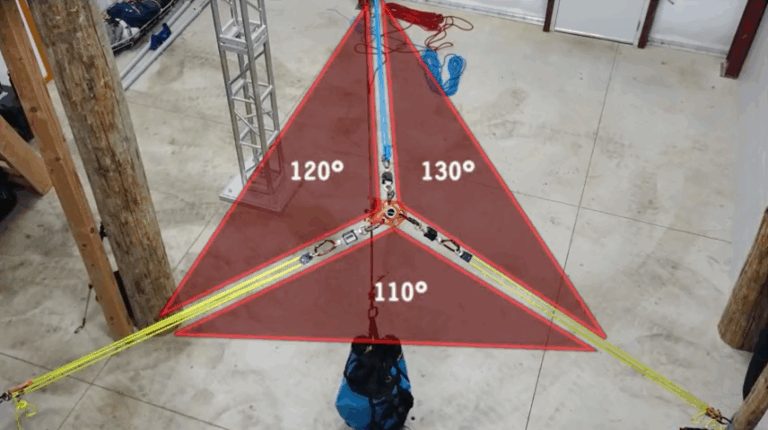
In the second image, guying angles are distributed at 120°, 130°, and 110°. This triangular configuration balances the load across the guy plane, ensuring no single line becomes a critical failure point.
Angles in excess of 120° risk increasing system friction and load spreading too thin. Angles under 90° sharply increase line tension. Triangular symmetry, combined with proper anchor placement and terrain-aware layout, is essential for predictable system behavior.
Pre-Load Verification Checklist
Before placing any load into the system, perform a complete verification cycle:
-
✅ Pins: Fully inserted, locked, and checked for retention
-
✅ Footing: Stable, seated, and reinforced where needed
-
✅ Head Placement: On correct spigot or leg segment per load spec
-
✅ Guy Angles: Measured and confirmed against applied force angle
-
✅ Anchors: Evaluated for strength and integrity under full expected load
-
✅ Test Load: Applied with careful observation of system movement
-
✅ Guy Lines: Secured and tensioned, no visible creep or slack
-
✅ Frame Movement: No observable shift, torque, or unintended load path deviation
A test load—usually bodyweight in a low-risk context—is used to confirm that all tension lines hold and that system components behave predictably under static conditions.
Engineering the Gin Pole for Strength and Predictability
In tall monopole applications, structural risk increases with height. The longer the outer leg, the greater the bending moment and the smaller the margin for error.
Best practices include:
-
Keep monopole height within manufacturer specs (e.g., ≤ 22 kN capacity at standard length)
-
Mount the vortex head on the outer leg spigot to maximize load transfer
-
Avoid exposing inner legs with multiple holes unless required (e.g., for winch mounting)
-
Limit unsupported length and eliminate unnecessary connectors in high-tension zones
Material configuration directly impacts strength. Adhering to official specifications for leg length, head placement, and allowable pin exposure ensures the frame performs as expected.
Anticipating Force Shift Under Load
During lift or lower operations, the applied force vector often shifts. In a sideways A-frame or monopole configuration:
-
The downward vector pulls the head toward the load
-
The load path moves laterally as the rope adjusts around the frame
-
The back guy absorbs this shift and must be properly tensioned to counteract forward drift
-
If done correctly, the back guy may begin lifting the front foot—reducing ground resistance and allowing the frame to float in tension
This intentional counteraction stabilizes the directional, even during unplanned user input like someone grabbing the frame or leaning on it under tension.
Summary
Force angle validation is not optional—it is central to safe monopole and directional rigging. By designing for correct opposing guy angles, distributing forces evenly across the guy plane, and executing full pre-load checks, rescuers can ensure the system is ready to perform without compromise.
When in doubt: measure, verify, and test before committing live load.
Peace on your Days
Lance