Cross hauling is a controlled horizontal movement technique used to transport loads—such as a patient litter, heavy gear, or suspended equipment—between two points using independent hauling and lowering systems. The method relies on coordination between two rescuers or teams operating from opposite anchors, each managing their side’s tension to maintain balance and stability. When executed properly, a cross haul allows for smooth traversal over gaps, obstacles, or irregular terrain where vertical movement is not possible. This lesson focuses on the mechanics, rigging structure, and load management principles that define cross-hauling in professional rescue environments.
System Overview and Core Mechanics
In a cross haul, the load is suspended between two anchors via separate rope systems—each controlled independently to allow precise positioning along the horizontal axis. By applying tension on one line while easing the other, rescuers can translate the suspended load laterally across the space between anchors.
Mechanical principle:
Each rope supports a component of the total load, and the vector sum of their tensions equals the total gravitational force. The resulting vector triangle shows that when both ropes are tensioned equally, the load remains centered; increasing tension on one side shifts the load toward that anchor.
∑F=0⇒TL+TR=W\sum F = 0 \Rightarrow T_L + T_R = W∑F=0⇒TL+TR=W
Where:
-
T_L and T_R are tensions in the left and right lines, respectively.
-
W is the weight of the suspended load.
Key mechanical outcomes:
-
Load translation depends on the differential tension between lines.
-
Both anchors experience inward vector forces that must be contained through robust rigging.
-
System efficiency relies on friction control and synchronized operator communication.
Anchor Configuration and System Independence
Each side of the cross haul requires an independent anchor system—typically a load-sharing or fixed anchor capable of sustaining both dynamic and static tension. Using independent anchors minimizes shared stress and allows one system to remain fully operational if the other requires adjustment or reset.
Anchor setup guidelines:
-
Use two-point or three-point load-sharing anchors when possible.
-
Maintain clear separation between anchor legs to prevent crossover or entanglement.
-
Keep angles at the master point below 120° to limit resultant force multiplication.
-
Ensure both anchors are in direct line with the hauling direction to reduce side loading.
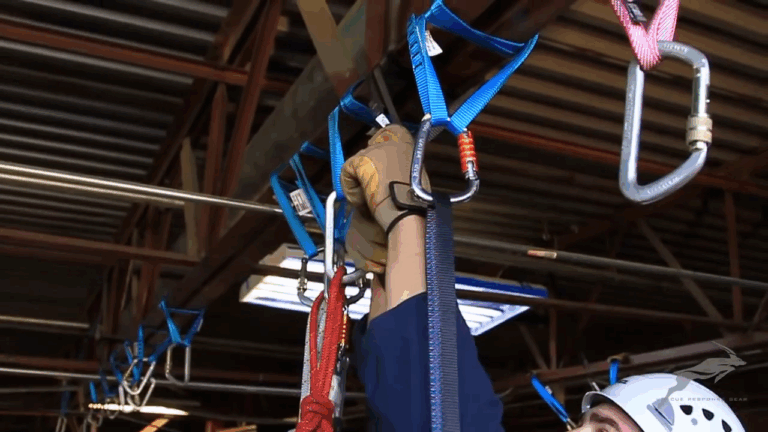
A rigging plate (such as a Petzl PAW or equivalent) is often used to organize connections, including pulleys, descenders, and directional changes. This plate centralizes all load-bearing points, keeping the system symmetrical and visually clean for operational oversight.
Hauling and Lowering Coordination
In a cross haul, one team operates in haul mode while the opposite team acts in lower mode, alternating roles as the load moves laterally. Communication and rhythm are critical—any asynchronous tensioning can introduce shock loading or lateral sway.
Operational sequence:
-
Initial Lift: Both sides tension simultaneously until the load clears the obstacle or ground.
-
Translation Phase:
-
Hauling the side increases tension gradually.
-
Lowering the side release rope in a controlled, friction-managed manner.
-
-
Stopping and Reset:
-
Both sides apply friction devices (e.g., Petzl IDs, MPDs, or Clutches) to secure the load.
-
Verify equal tension before resuming movement.
-
Each movement phase involves continuous tension monitoring—too much differential can overload one anchor or shift the load off-center.
Preferred friction devices:
-
Petzl ID or CMC MPD: Allows seamless transition between hauling and lowering.
-
Brake rack or friction hitch: Provides controlled payout on the lowering side.
-
Progress capture pulley (PCP): Prevents backslip on the hauling side.
Managing Forces and Load Angles
The geometry of a cross haul system introduces vector forces that increase as the rope angle between anchors widens. As the line approaches horizontal, the resultant force on each anchor can exceed the suspended weight several times over.
Force amplification equation:
Fanchor=W2cos(θ/2)F_{\text{anchor}} = \frac{W}{2 \cos(\theta / 2)}Fanchor=2cos(θ/2)W
Where θ is the included angle between the two anchor lines.
At 120°, each anchor bears a force equal to the load; at 150°, that force doubles. Thus, maintaining shallow anchor angles—ideally 90° or less—is essential to prevent excessive anchor stress.
Best practices for managing vector forces:
-
Keep anchors as high and in line as possible.
-
Use tensioning systems to adjust sag dynamically.
-
Regularly communicate between teams to manage incremental movement.
-
Employ load cells or in-line tension meters during training or industrial operations for monitoring.
Preventing Shock Loading
Shock loading can occur if one line suddenly goes slack or if the lowering side releases too quickly. The resulting kinetic force spike can exceed system ratings or cause abrupt pendulum movement.
Methods to prevent shock loading:
-
Maintain light pre-tension on both lines at all times.
-
Use progress capture devices to prevent sudden backslip.
-
Communicate commands clearly: “Haul,” “Hold,” and “Lower” should be unambiguous and consistent.
-
Gradually increase or decrease tension to transition smoothly through the load path.
-
Use friction control devices capable of dissipating energy rather than locking abruptly.
In systems moving patients or fragile equipment, this control ensures comfort, safety, and stability during the transfer.
Obstacle Navigation and Team Coordination
Cross-hauling is often used to bypass terrain voids, cliff edges, towers, or confined industrial structures where lateral travel is necessary before lowering or raising. The ability to manage three-dimensional positioning—forward/backward, up/down, and side-to-side—is achieved by adjusting the tension ratio and rope geometry on each side.
Team coordination techniques:
-
Assign a lead communicator responsible for all movement calls.
-
Ensure both systems operate under mirrored friction control setups to maintain symmetrical performance.
-
Conduct pre-load testing to confirm alignment before the actual transfer.
-
Rehearse directional transitions slowly to calibrate the friction device sensitivity.
Equipment Considerations
Rigging hardware must be selected for strength, compatibility, and operational fluidity.
-
Pulleys: Use high-efficiency sheaves with sealed bearings for hauling lines; bushings may be preferred on lowering sides for better friction modulation.
-
Carabiners or shackles: Rated for multidirectional loading when used at anchors.
-
Rigging plates: Provide organizational clarity and reduce cluster stress at focal points.
-
Anchors and slings: Use rated materials (steel or webbing) with sufficient Working Load Limit (WLL) for expected resultant forces.
For complex rescues involving litters or heavy equipment, additional taglines or guide lines can stabilize swing and control lateral drift, ensuring smoother passage through irregular spaces.
Practical Application Scenario
Two rescuers establish independent anchors on opposing sides of a narrow ravine. The patient litter is attached via a central rigging point, suspended between the two systems. The left rescuer hauls using a 3:1 MA with progress capture, while the right rescuer manages controlled descent using a friction device. As communication cues alternate, the litter moves horizontally, clearing obstacles below. Minor tension adjustments keep the litter level and prevent pendulum swing until it reaches the far anchor zone, where both sides lower simultaneously for final placement.
This setup illustrates the practical efficiency and control achievable through proper tension management and disciplined communication.
Summary
Cross haul systems allow rescuers to move loads laterally with precision and balance, combining the principles of vector alignment, friction management, and team coordination. By operating independent hauling and lowering systems in harmony, rescuers can safely navigate obstacles and voids while maintaining constant control of the suspended load. Proper anchor geometry, low-angle tensioning, and continuous communication minimize the risk of overloading or shock forces. Understanding the mechanics of horizontal force transfer ensures each cross haul operates within predictable, efficient, and safe parameters—whether for patient transport, equipment relocation, or industrial rigging tasks.