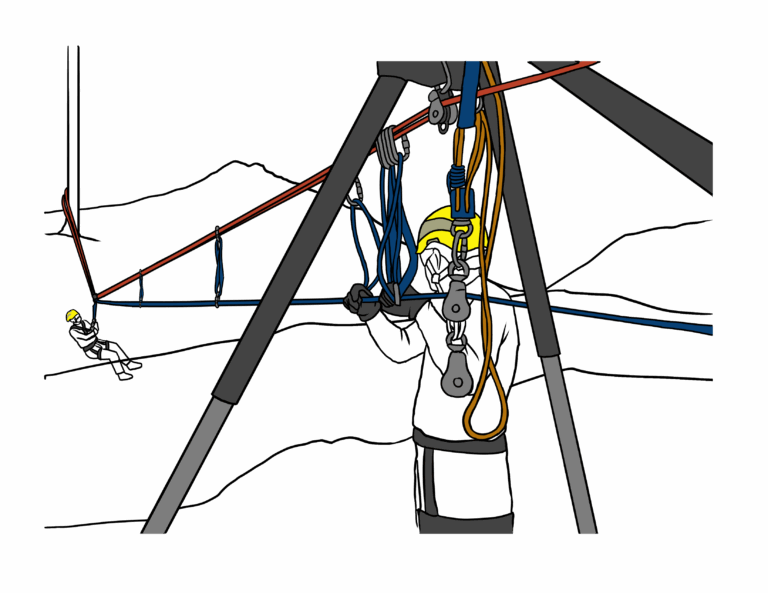
5 Counter-Intuitive Truths of High-Angle Rescue Rigging
When you need to move something heavy, your first instinct is probably to pull a rope as tight as you can. It’s a common-sense principle we learn as kids: a taut line is a strong line. This intuition serves us well for everyday tasks, but in the world of technical rope rescue, it can be dangerously wrong. The physics of rigging a rope across a horizontal gap operates under a different set of rules, where our everyday understanding can lead to catastrophic failure.
This article will explore five surprising principles from the world of horizontal rigging that challenge our common-sense approach to physics and safety. These truths reveal that in high-angle rescue, the most effective solutions are often the most counter-intuitive, relying on a deep understanding of forces, discipline, and choosing the right tool for the job.
1. The Flatter the Rope, the Higher the Force
The most critical—and most counter-intuitive—principle in horizontal rigging is that pulling harder can actually make the system weaker by overloading its components. This phenomenon is known as vector force multiplication. When you rig a rope horizontally between two anchor points, the angle of the rope has an enormous effect on the tension placed on those anchors.
As the angle of the rope widens and the line becomes flatter, the stress on the anchors increases exponentially. The forces at play quickly become much greater than the actual weight of the load you are moving. For example, at a 120-degree angle, each anchor is already supporting 100% of the load’s weight.
At extreme angles, the numbers become staggering. As a highline approaches 175 degrees—appearing nearly flat to the naked eye—the force on each anchor can skyrocket to eleven times the weight of the load. This is why a perfectly flat rope isn’t a sign of strength; it’s a sign of a system under immense, almost unimaginable tension that is close to failure.
2. A Little Sag Makes a System Safer
Given the dangers of a flat, over-tensioned line, how do professionals manage these forces? They deliberately engineer sag into the system. This directly contradicts the instinct to pull a rope as tight as possible to eliminate any slack. In professional rigging, perfect tightness is a recipe for disaster.
To keep anchor forces within safe limits, technicians use the “10% Sag Rule” as a guideline for pre-tensioning highlines. This rule ensures that enough slack is intentionally left in the rope to reduce the angle and, consequently, the immense stress on the anchors. Deliberate sag is a primary safety control, not an imperfection.
For situations that truly demand minimal sag, like a swiftwater rescue where a litter must stay clear of the water, the solution isn’t to crank on a single rope. Instead, professionals build a Twin Highline System. By using two tracklines, the load is distributed, which reduces sag without dangerously over-tensioning any single component.
3. The Highline is a Last Resort, Not a First Choice
When faced with a large gap like a canyon or river, many assume that building a highline is the default solution. However, in the discipline of technical rescue, a highline is considered a “last resort.” This is precisely because of the immense forces they generate and the complexity required to build them safely.
Professionals are taught to match the system to the actual need, and often, a simpler, lower-tension system is not only safer but more efficient. These alternatives are broadly known as “Offset Systems,” which include Guiding Lines and Tracking Lines. They are designed to alter a load’s path without requiring the full tension and “bombproof” anchoring of a highline.
For instance, in a scenario requiring a team to move a litter across a sloping canyon where it can stay close to the ground, a full highline would be overkill. A much better choice would be a Two-Rope Offset. This system uses independent lowering and hauling lines, often connected to the litter via a yoke to facilitate a smooth, pendulum-style movement across the gap. This approach significantly reduces anchor stress and setup time compared to a full high-tension rig.
4. Nuance is Everything: 3D vs. Single-Plane Movement
Not all horizontal ropes are created equal. To an untrained eye, a Guiding Line and a Tracking Line might look similar, but their operational differences are critical and demonstrate the incredible precision required in rescue rigging. The choice between them isn’t about semantics; it’s about controlling movement in fundamentally different ways.
A Guiding Line is a low-tension system that allows for three-dimensional movement. Think of it as the perfect tool for lowering a patient down a cluttered industrial shaft, allowing rescuers to steer the litter around pipes and beams with precision. A pulley on the rescue package travels along this fixed rope, giving the team the ability to move the load up, down, left, and right to navigate obstacles.
A Tracking Line, in contrast, is a moderate-tension system that restricts movement to a single plane. It is tensioned just enough to “float” a litter over uneven ground or across a small gap. This is the perfect tool for moving a package smoothly over rough terrain without needing the full suspension of a highline. This distinction is critical because while offsets operate at lower overall tension than a highline, a rope deflected 90° at a directional pulley can still exert 141% of the load on that single anchor point—a hidden force that demands professional respect.
5. “Rope Housekeeping” is as Important as Knot Tying
In high-stakes environments, safety isn’t just about strong knots and reliable hardware; it’s also about process and discipline. “Rope Housekeeping” is a core operational discipline that is as critical to the success of an operation as any physical rigging component. It’s not about being tidy for the sake of it—it’s an active process of organization that prevents rope entanglement, which can halt progress or compromise an entire rescue.
Disciplined practices include building “self-contained units” where any excess rope is neatly stored in a rope bag attached to the system, preventing it from snagging on debris or getting tangled. In highline systems, this extends to structural organization, like using festoons to manage control lines and prevent them from ballooning or fouling in the wind. Teams also incorporate deliberate “housekeeping pauses” during an operation—brief, 30-second stops to check rope alignment and clear any potential tangles before they become a problem.
This focus on organization underscores a final truth: in complex rescue scenarios, operational discipline is a safety system in itself. The ability to maintain control over the environment through rigorous organization is just as vital as the strength of the ropes and anchors.
Conclusion: Rethinking the Forces at Play
Professional rigging is not a simple matter of strength and equipment. It is a science of managing invisible forces and maintaining unwavering discipline. The most important lessons are often counter-intuitive, reminding us that a deeper understanding of physics, combined with a commitment to process, is what truly ensures safety when lives are on the line.
The next time you see a rope stretched across a gap, what unseen forces will you think about?
Peace on your Days
Lance