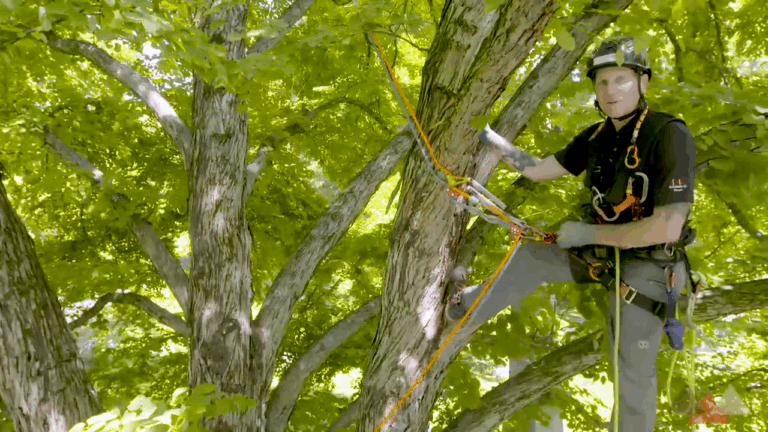
In the ever-evolving world of arborist climbing, techniques are constantly refined to improve safety and efficiency. We’ve seen how the single rope or stationary rope system made a significant leap forward by allowing us to use natural redirects without adding any extra friction to the hitch. That’s a huge benefit on its own, making it easy and smooth to maneuver through the tree. But what if there was an even safer, more streamlined way to perform these redirects? That’s the core of understanding natural redirects in mirrored systems.
For a single rope system, a climber must use a secondary attachment point, like a lanyard, to ensure they are never in a fall situation when repositioning their main line. This works, but it adds a step to the process—you have to rig up a temporary safety system before you can unweight your primary one. This is where a mirrored system completely changes the game. By having twin primary systems anchored independently, you can work a natural redirect with a speed and security that a single system can’t match. It’s a fundamental shift in workflow that keeps you safe and focused on the job.
The Mirrored System Advantage
A mirrored system is built on a simple yet powerful concept: redundancy. It means having two fully functional, independent primary climbing systems on your harness at all times. These systems are anchored to separate, non-compromised sections of the tree. The beauty of this setup is that you can keep one primary system completely weighted and secure while you work on the other. This eliminates the vulnerability that comes with a single-line system.
Think about it this way: when you’re on a single rope system and need to disconnect, you must first create a temporary anchor. This requires extra gear, extra time, and a conscious shift in your rigging. With a mirrored system, that entire process is gone. You are never exposed to a moment where you aren’t on a primary, fully functional, life-sustaining system. The safety isn’t an add-on; it’s built into the very design of your climb. The work positioning lanyard you use is just that—a tool for positioning, not a critical backup against a fall. This fundamental change in approach makes every move more secure and more confident.
A Streamlined Workflow in Action
The real benefit of a mirrored system becomes obvious when you perform a natural redirect. The process is simple, fast, and incredibly secure. While one of your primary systems remains fully weighted, you can use your work positioning lanyard for minor adjustments to your body position. With your weight fully on one system, you can easily unweight and disconnect your second primary system.
This is a critical moment. You are now working on your second system, moving it around the redirect, and reattaching it to your harness, all while your other primary system holds you safely in place. There is never a moment of exposure. Once you’ve reconnected the second line, you’ll want to perform a quick, functional test. Just as you would with any other climbing system, you’ll apply your weight to the newly redirected line to confirm it’s holding you. When you’re sure it’s secure, you can unweight your original primary system and continue your work. This streamlined process saves you a huge amount of time and effort in the tree. It’s a seamless transition from one position to the next.
Safety Beyond the Redirect
The safety advantages of a mirrored system extend far beyond simple redirects. By having two independent lines, you completely eliminate the single point of failure that is always a concern with traditional single rope systems. In a tree, you are working on anchors with an unknown load rating. If one branch were to fail, your second line, anchored to a different limb, would remain secure and save you from a fall.
This kind of redundancy is standard in nearly every other work-at-height discipline, from rope access technicians to high-rise window washers. Arborists are unique in their ability to work on a single line on an unrated anchor. The mirrored system provides a clear pathway to a safer, more professional standard. It gives you, the climber, a profound sense of security, allowing you to focus on your work with greater confidence. This peace of mind is invaluable and makes you a safer, more effective arborist.
The Intersection of Safety and Efficiency
Some might think that using two ropes would make a climb more cumbersome or slower. In practice, the opposite is true. The mirrored system’s safety benefits directly translate into a more efficient workflow. Because you don’t have to rig and de-rig secondary backup systems for every small repositioning, you save precious time and energy. The process is so much faster that the initial time investment of setting up a second line is easily made up for throughout the day.
This enhanced efficiency is a byproduct of a system that works in perfect harmony with the climber. The twin primary systems give you unparalleled freedom to move, adjust, and perform complex maneuvers. It’s not about adding complexity; it’s about building a smarter, safer, and more streamlined way to work in the canopy. The ease with which you can use natural redirects with a mirrored system is the perfect example of how an investment in safety can lead to a massive increase in productivity.
Peace on your Days
Lance