In the world of professional arboriculture, understanding your climbing system is the foundation of safety and efficiency. A core part of this knowledge is the doubled rope system in tree work. It’s a foundational technique that has long provided climbers with a high degree of control and precision. This system allows a technician to position themselves with great detail, even on tricky angles. While it offers many benefits, it also presents a key challenge that every arborist must learn to manage: friction.
The mechanics of a doubled rope system are straightforward. The rope runs through an anchor at the top of the tree, and the climber controls their movement with a hitch and a brake hand. This setup provides an incredible element of control, allowing a climber to descend or move with purpose. It is a powerful tool for navigating the intricate architecture of a tree. However, it’s also a system where every bit of resistance matters.
The Art of Controlled Descent
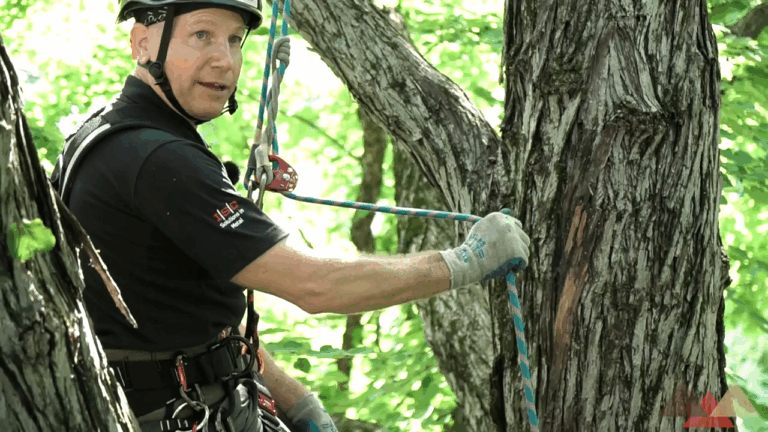
One of the greatest strengths of a doubled rope system is the immediate control it gives the climber. When you descend, you use a two-handed technique. One hand works as your brake hand, positioned underneath the hitch on the trailing rope. Your other hand is placed directly on the hitch itself, sliding it down the line. This gives you an amazing ability to manage your speed. At any point, you can stop your descent by simply letting go of the hitch. The friction created by the hitch immediately stops you, holding you right where you are. This precision is invaluable for fine-tuning your position, whether you’re getting ready to make a cut or inspecting a specific part of the tree.
This type of direct, physical connection to your system creates a high level of confidence. The hitch’s predictable behavior on a straight line allows you to trust its stopping power. You can rely on this feedback to make minute adjustments, moving just a few inches at a time if needed. The ability to work on angles is also a major benefit. A climber can lean out from a main limb, or move laterally, and still maintain excellent control over their position. This makes the doubled rope system a versatile and reliable choice for a wide range of tasks.
The Silent Enemy: The Impact of Friction
While the doubled rope system offers excellent control, it comes with a major drawback. As the rope runs through the anchor point at the top of the tree, it’s constantly moving and creating friction. This is an unavoidable part of the system. But the problem is not just at the main anchor. As a climber maneuvers around the canopy, the rope will often come into contact with other limbs. This creates secondary friction.
Imagine your rope rubbing against a branch as you move past it. This friction happens in both directions—as you descend and as the rope moves up through the anchor. This constant rubbing on the limbs can significantly change the system’s dynamics. What was once a smooth, consistent descent now becomes less predictable. This added friction can make it significantly less efficient to move through the tree. Every movement requires more effort, and the system loses its fluid feel.
How Friction Compromises Your Hitch
The most important effect of this secondary friction is that it changes the characteristics of your hitch. A hitch is a knot that works by gripping the rope. On a straight, clean line to your anchor, the hitch operates exactly as it was designed to. You know exactly how it will respond, and you can trust it to hold you securely. You can feel a consistent level of resistance as you descend.
However, once you have gone around a number of limbs and secondary friction starts to build up, your hitch is no longer operating in the same predictable way. The added friction from the limbs below the anchor point can affect the tension on the hitch. It might become stickier, harder to release, or less responsive. This inconsistency can be a significant safety concern. When the behavior of your hitch changes, you lose that sense of absolute control. The hitch may no longer be as reliable as it was when it was on a straight line. This is a critical factor that every arborist must be aware of.
Balancing Control and Efficiency
The challenge of the doubled rope system is finding the right balance between the excellent control it provides and the inefficiency created by friction. It is a tool that requires an arborist to be constantly aware of their rope’s position and its interaction with the tree. The more limbs a rope is wrapped around, the more the system’s performance will change. Experienced climbers know to manage these redirects and to be mindful of the added friction.
While newer, more modern systems have emerged to address this very issue, the doubled rope system remains a core skill for many arborists. It is a system that teaches fundamental lessons about rope dynamics and the importance of understanding every element of your gear. Knowing how friction can compromise a hitch is a lesson that stays with a climber throughout their career, no matter what system they use. It’s a powerful reminder that in tree work, nothing can be taken for granted. The best arborists are not just strong climbers; they are also experts in the physics of their ropes and the forces at play.
Peace on your Days
Lance