A Canyon Rescue Demands More Than a Vertical Drop
Not every rescue moves straight down. In desert canyon environments, terrain often calls for lateral movement, precise force balance, and shared system control. When a patient must be transported from one rim to another, a two-rope offset canyon rescue setup using twin tension systems becomes essential.
Instead of relying on complex hardware, this system succeeds through clarity, role definition, and vector management.
What Is a Two-Rope Offset in Canyon Rescue?
A two-rope offset is a diagonally-oriented rigging system that uses two independently tensioned ropes to move a load—often a patient in a litter—across a horizontal gap with vertical variation. This method offers balance, control, and full redundancy.
In canyon rescues, teams deploy this setup to cross chasms where vertical descent or climbing carry-outs are impractical or dangerous.
Core Elements of the System
To function under pressure, the system must be simple in structure and sound in logic.
🔹 Twin Tensioned Lines
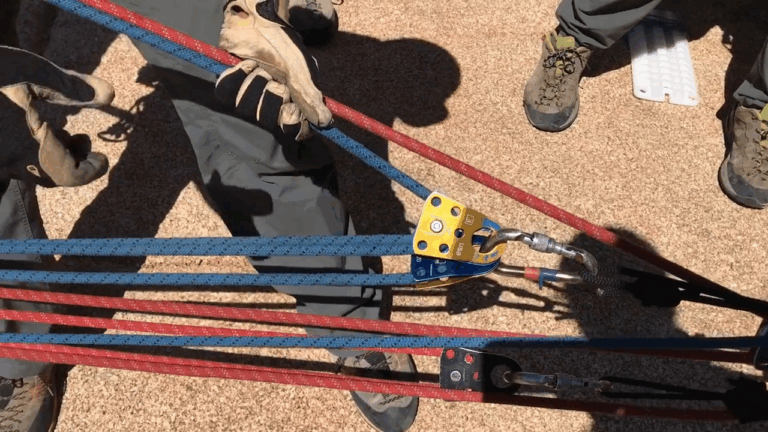
Each line carries a live load. These are not main-and-belays—they are equals. With mirrored devices, operators keep the litter suspended and balanced throughout the offset.
🔹 Artificial High Directionals (AHDs)
Tools like the Arizona Vortex elevate rope paths above edge hazards. They preserve rope angles, reduce drag, and allow vector force to remain predictable as the litter travels.
🔹 Anchors on Both Sides
Each canyon rim supports primary and backup anchors. These anchors must align with anticipated force paths, not just be convenient attachment points.
🔹 Communication Protocols
Success relies on timing. Each side must coordinate raises, lowers, stops, and mid-span resets. Teams typically use radios or visual cues to maintain sync.
System Behavior While in Motion
As the litter enters mid-span, tension shifts. Wind may cause sway. Vectors begin pulling in two directions simultaneously. Without coordination, load drift or instability becomes likely.
Here’s how experienced teams manage it:
-
Adjust tension from both ends in measured increments.
-
Use prusiks or managed descenders for fine control.
-
Pre-load directionals to prevent movement lag or swing.
Common Mistakes and How to Avoid Them
Even well-rigged systems can underperform if logic breaks down. Watch for:
-
Uneven tensioning that shifts weight to one side.
-
Directionals that aren’t guyed or secured properly.
-
Anchor vectors that pull inward rather than outward.
-
Teams rushing transitions without coordinated calls.
Prevention starts in the planning phase:
-
Map out vector diagrams.
-
Assign roles with redundancy.
-
Rehearse transitions before committing a load.
Why This System Works So Well
This configuration excels in three ways:
-
It’s load-sharing by design, not as a backup.
-
It creates active redundancy—every rope is capable of catching and lowering.
-
It scales to different terrain, whether you’re crossing a gulch, ravine, or sinkhole.
Moreover, it models the kind of thinking every rope rescue tech should develop: system awareness, geometric thinking, and adaptive control under stress.
Final Thought: Transfer, Don’t Just Lower
A two-rope offset canyon rescue is not just a rigging exercise—it’s a study in how systems respond to movement, terrain, and communication. When every role is defined and every component behaves as expected, the system fades into the background. The rescue becomes fluid.
That’s what clarity looks like in high-angle operations.
And that’s what we teach—every rope, every anchor, every transition.
Peace on your Days
Lance