
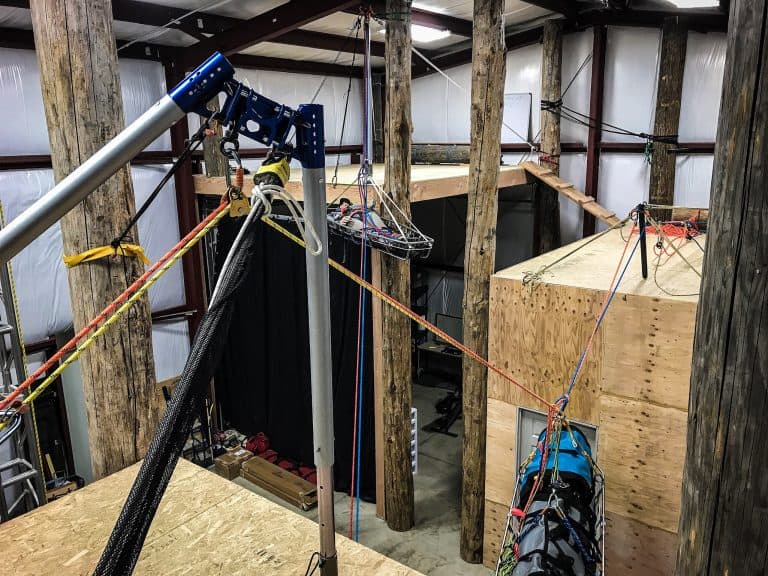
In technical rope rescue, Twin Tension Rope Systems (TTRS), also referred to as dual-capacity systems, are critical for ensuring safety, efficiency, and precision during litter hauling operations. This article explores the importance of anchor systems, artificial high directionals (AHDs), and the configurations that make TTRS a preferred solution in complex rescue scenarios.
The Foundation: Anchor Systems in TTRS
Anchors form the backbone of any rope rescue system. In TTRS, they must be carefully selected and configured to handle dynamic loads and maintain system stability.
Anchor Selection
- Natural Anchors: Use strong and reliable natural elements such as trees or boulders.
- Artificial Anchors: Incorporate bolts, rigging plates, or anchor straps when natural options are unavailable.
- Load Capacity: Each anchor must handle the load’s full weight plus a safety factor, ensuring system integrity.
Anchor Configuration
- Multi-Point Anchors: A Delta (3) guy system connects three anchor points to stabilize high directional components like a gin pole or Arizona Vortex.
- Back-Ties: Essential for counteracting forward resultant forces, back-ties provide additional stability and distribute loads evenly.
Leveraging Artificial High Directionals
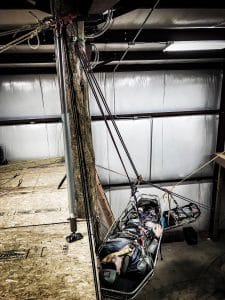
AHDs like the gin pole or Arizona Vortex enhance the TTRS by providing elevated anchor points. These structures simplify edge transitions and reduce friction along the rope path.
Gin Pole
- Alignment: Ensure the pole aligns with the compression force for stability.
- Back-Tying: Use multiple stabilizing lines to counteract forces and maintain vertical alignment.
Arizona Vortex
- Versatility: Configure it as a tripod, bipod, or monopod based on operational needs.
- Anchor Integration: Combine the Vortex with multi-point anchors for optimal support and redundancy.
For a step-by-step demonstration, refer to the Arizona Vortex configurations.
Practical Applications in TTRS
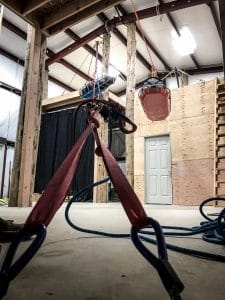
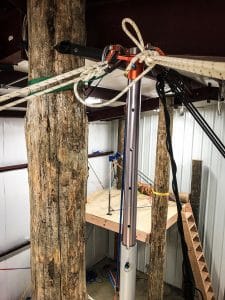
At the Rigging Lab Academy’s training grounds, innovative applications of TTRS were tested:
Case Study: Litter Hauling
- Gin Pole Setup: Used in a skate-block configuration for edge transitions and haul systems.
- Two-Rope Offset: The SMC Vector and Arizona Vortex demonstrated the adaptability of TTRS for raising and lowering operations.
- Dynamic Load Management: Load sharing across two tensioned ropes reduced stress on individual components and ensured smooth operation.
These real-world tests emphasize the versatility of TTRS in various rescue environments.
Advantages of Twin Tension Rope Systems
- Load Distribution: Evenly splits the load between two ropes, enhancing redundancy and safety.
- Efficiency: Simplifies transitions between raising and lowering without requiring significant reconfiguration.
- Flexibility: Adapts to diverse scenarios, from confined spaces to high-angle rescues.
Conclusion
Twin Tension Rope Systems are a cornerstone of modern rope rescue, offering unparalleled safety and adaptability. By mastering anchor configurations, utilizing AHDs effectively, and practicing versatile setups, rescue teams can optimize their operations for success in challenging environments.
For further training and resources on TTRS and advanced rigging techniques, visit Rigging Lab Academy.
Peace on your days…
Lance


Comments are closed.