Rigging Guidance When You Don’t Know Where to Start
You’re somewhere between what you know and what you need to know. Maybe it’s a system configuration you haven’t built before. Maybe it’s a scenario that sits just outside your training. Maybe you’re a student who has absorbed the theory but hasn’t yet found the bridge to the field. The gap is real. And for a moment — sometimes longer — it can feel like there’s no obvious way across.
The hardest part of learning something technical isn’t the content. It’s the moment before you start — when you don’t yet know the right question to ask.
There is a particular kind of friction that lives between knowing you need to know something and actually taking the step to find it. It isn’t laziness. It isn’t lack of interest. It’s the weight of not knowing where to begin — which door to open, which term to search, whether the thing you’re looking for even has a name yet.
Students feel it. Field technicians feel it. Even experienced practitioners feel it when a system shifts or a scenario lands outside familiar ground. The knowledge exists. The guidance exists. But standing at the edge of what you know, it can feel like there’s no clear way in.
“The information was always there.
The question was always valid.
The step was the only thing missing.”
Consider the moment a technician — or a student mid-course, or someone preparing for a scenario they haven’t faced before — opens a tool and sees a simple prompt: Select one of the Quick Start options below, or enter your system configuration and constraints to begin analysis.
Five options. No prerequisites. No assumed vocabulary.
The moment of entry
The screen offers a choice without demanding credentials first.
Rigging Guidance
Technical Rescue Questions
Scenario Analysis
Systems Check
One tap. Rigging Guidance. The system orients immediately.
What follows isn’t a search result. It isn’t a syllabus. It’s structured reasoning — a system that has absorbed the depth of the curriculum and can meet you at the exact point of your question, wherever that happens to be.
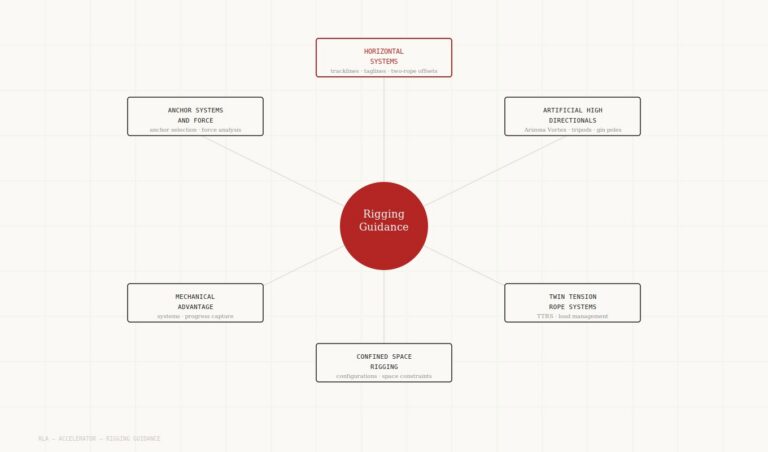
Horizontal rigging systems. Artificial High Directionals. Twin Tension Rope Systems. Anchor analysis. Mechanical advantage. Confined space configurations. The breadth is there — but so is the precision. The system doesn’t overwhelm. It asks three clarifying questions in return: what system, what environment, what goal. Then it works.
What opens up
Key Rigging Areas
Explore further
Notice what the system does at the end. It doesn’t close. It opens three more doors — specific, operational, grounded in real decisions that technicians actually face. This is the shape of how learning moves when the infrastructure is right. One step leads somewhere. That somewhere leads further.
The verified sources behind each response trace back to the curriculum itself — the courses, the lessons, the applied knowledge that the guidance is built from. The reasoning and the academic content are the same body of knowledge, expressed two different ways. One for study. One for the field.
The dissonance most people feel — the sense that the answers are somewhere out there, that the right course or the right framework or the right guidance exists but remains just out of reach — that dissonance is real. But it isn’t permanent.
Sometimes the step is just choosing Rigging Guidance. And finding out that the system was ready for your question before you knew how to ask it.
That’s what it feels like when the gap closes. Not a revelation. Not a transformation. Just the quiet recognition that the thing you needed was already there — and that asking was enough to reach it.
Peace on your Days
Lance