Technical Rescue Questions Answered from the RLA Knowledge Base
You have a technical rescue question. Not a general one — a specific one. The kind that comes from being inside the discipline, from having studied the system or worked the scenario and landed on something you need answered precisely. You know enough to know the question exists. What you need is a technically accurate answer, grounded in the knowledge base, with a source you can verify.
The difference between a good question and a great answer is the depth of the knowledge base behind it.
Technical rescue is a discipline where precision matters absolutely. The difference between a TTRS raise and a TTRS lower isn’t academic — it changes how the system is built, how the load behaves, and what the failure modes look like. Mechanical advantage isn’t a concept to approximate — it’s a calculation with consequences. Anchor system requirements aren’t guidelines — they’re the margin between operational and unsafe.
Students encounter these questions in coursework and can’t always find a direct answer in the material. Field technicians encounter them on site and need clarity fast. Both groups deserve more than a search result or a forum thread. They deserve an answer grounded in the curriculum — technically accurate, practically framed, with a verified source to back it up.
“The question is already formed. What it needs is an answer that meets it at that level.”
Consider the moment a technician or student opens a tool and sees a simple prompt: Select one of the Quick Start options below, or enter your system configuration and constraints to begin analysis.
Five options. One of them is built for exactly this.
The moment of entry
The screen offers a choice without demanding credentials first.
Rigging Guidance
Technical Rescue Questions
Scenario Analysis
Systems Check
One tap. Technical Rescue Questions. The mode activates and orients immediately.
What follows isn’t a search engine. It’s direct access to the knowledge base — grounded answers from the RLA curriculum, focused on the technical rescue and rope system questions that practitioners actually face. Practically framed. Technically accurate. Verified source links included.
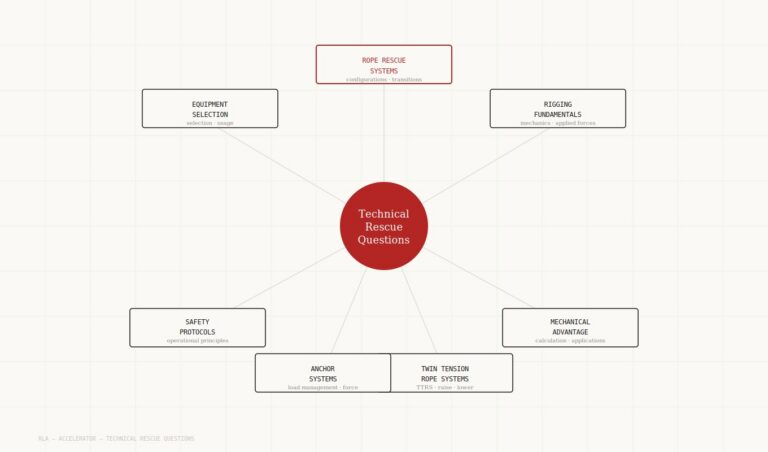
What the mode covers
Common questions to get started
Those three questions are not casual. They are the kind of questions that come from someone who is deep enough in the material to know what they need to understand. The system meets them there — not with a general overview, but with a direct answer grounded in the same curriculum that the courses, the lessons, and the applied content are built from.
That connection matters. The answer isn’t sourced from the internet at large — it draws from the RLA knowledge base, the same body of knowledge that underpins everything built here. One source. Two access points. One for structured learning. One for the specific question you need answered right now.
Technical rescue questions deserve technical rescue answers. Not approximations. Not forum opinions. Not search results that may or may not reflect the discipline accurately.
Sometimes the step is just choosing Technical Rescue Questions. And finding out that the answer you needed was already within reach — grounded, verified, and waiting for the question.
That’s what it feels like when the knowledge base is actually accessible. Not buried in a course module somewhere. Right there, at the moment the question forms.
Peace on your Days
Lance