Sling Redirects Techniques for Arborists and Rope Rescue are one of the most useful tools in rope work. Whether you are climbing, rigging, or performing rescue operations, a redirect changes the rope’s path to improve efficiency, positioning, and comfort. Climbers often rely on natural redirects — running the rope around a branch, beam, or rock edge. But natural features are not always available, and they can add unnecessary friction or damage to the rope.
That’s where sling-based redirects come into play. By installing a redirect with a webbing sling and carabiner, climbers can set smooth, efficient rope paths that reduce drag and improve control. Even better, a sling redirect can be configured either as a dynamic redirect (allowing rope to move through it freely) or as a static redirect (locking the suspension point into place).
This blog explains how to install a redirect with a sling, demonstrates the difference between dynamic and static redirects, and explores the advantages of each approach.
What Is a Redirect?
A redirect is any point in a rope system that changes the rope’s direction between the anchor and the load or climber.
Purposes of Redirects
-
Change Rope Angle: Improve rope alignment with the climber or load.
-
Reduce Edge Compression: Move the rope away from bark, rock, or sharp edges.
-
Improve Ergonomics: Make climbing smoother and less fatiguing by repositioning rope path.
-
Increase Efficiency: Direct forces in a way that makes progress easier and safer.
Redirects can be natural (using the environment) or artificial (using equipment like pulleys, slings, and connectors). The sling-based redirect discussed here is an artificial option that provides greater control and smoother operation.
Installing a Sling-Based Redirect
Step 1: Selecting Equipment
You’ll need:
-
A webbing sling (nylon or Dyneema rated for life safety).
-
A locking carabiner to act as the redirect point.
-
Your climbing system (rope wrench, hitch, foot ascenders, tether, etc.).
Step 2: Installing the Sling Redirect
-
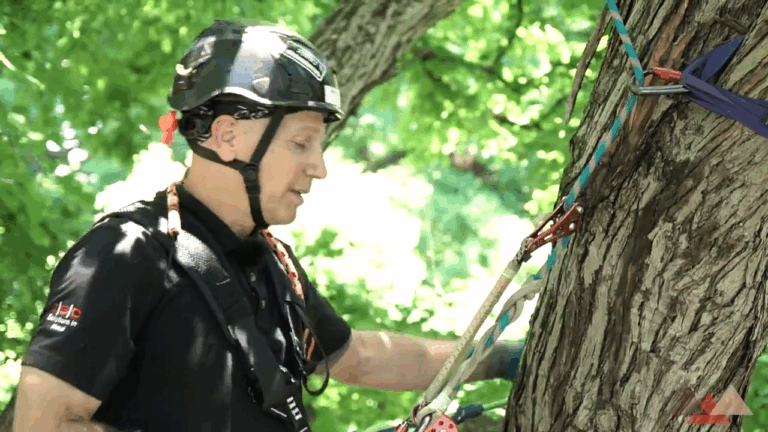
Place the sling over a solid branch or structural feature.
-
Clip the carabiner through both ends of the sling to create the redirect point.
-
Take slack from above your rope wrench and clip it into the carabiner.
-
Test your hitch to ensure it is holding properly before fully weighting the system.
Step 3: Checking Safety
-
Keep your lanyard connected while adjusting the system.
-
Always test the hitch before transferring full body weight.
-
Maintain a primary suspension point until the redirect is fully secured.
Dynamic Redirect with a Sling
When used in its simplest form, the sling and carabiner create a dynamic redirect.
How It Works
-
The rope is able to run freely through the carabiner.
-
As the climber moves, the redirect shifts rope angles dynamically.
-
Forces compress the branch or structure where the sling is placed.
Benefits
-
Easy to install and remove.
-
Keeps rope path smooth, especially compared to doubled rope friction.
-
Requires minimal gear.
Limitations
-
Because the rope moves through the carabiner, there is still compression on the tree.
-
Not as efficient for extended work positioning because the suspension point is not fixed.
Static Redirect with an Alpine Butterfly
One of the key benefits of working with a stationary rope system is the ability to convert a redirect into a static redirect. This is accomplished by creating a midline anchor above the rope wrench.
How to Create a Static Redirect
-
Tie an alpine butterfly knot above your hitch.
-
Clip the loop of the alpine butterfly into the sling and carabiner redirect.
-
Tension the knot to shift your primary suspension point to the redirect.
-
Optionally, use a Munter mule to tighten and lock the system for partial load sharing.
What Changes
-
The rope is no longer moving through the redirect point.
-
The climber’s suspension point is effectively transferred to the carabiner location.
-
The original anchor point becomes a backup, no longer bearing compression.
Benefits
-
No rope-on-bark compression at the redirect limb.
-
Zero added friction on the hitch — movement remains smooth.
-
Creates a cleaner, more stable suspension point.
Limitations
-
Requires additional steps and knots.
-
Must be tensioned properly for balanced load sharing.
-
Less flexible than a dynamic redirect if frequent repositioning is required.
Comparing Dynamic vs Static Redirects
| Feature | Dynamic Redirect | Static Redirect |
|---|---|---|
| Rope Movement | Rope runs freely through carabiner | Rope is fixed at redirect |
| Compression on Limb | Yes | Minimal to none |
| Hitch Friction | Some reduction vs doubled rope | Significantly reduced |
| Setup Speed | Quick | Slightly longer |
| Best Use | Short-term repositioning | Extended work positioning / stability |
Both methods are valuable. The choice depends on whether the climber needs flexibility and speed (dynamic) or stability and efficiency (static).
Applications of Sling-Based Redirects
Arbor Work
-
Maneuvering through trees where natural redirects create too much drag.
-
Creating a secondary suspension point for stable canopy work.
Rope Rescue
-
Improving rope paths around edges where natural features risk cutting or compressing the rope.
-
Providing clean directional changes in confined environments.
Rope Access
-
Adjusting suspension points for better work positioning on structures.
-
Reducing fatigue during long-duration climbs or positioning tasks.
Safety Considerations
-
Always maintain two points of attachment while setting or adjusting redirects.
-
Test the hitch after any system change.
-
Use rated equipment and inspect slings and connectors regularly.
-
Be mindful of load angles — redirecting ropes can multiply forces on anchors.
Conclusion
Installing a redirect with a sling and carabiner offers climbers and rescuers a simple, effective way to improve rope path, reduce friction, and increase efficiency. The dynamic redirect provides speed and flexibility, while the static redirect — created with an alpine butterfly midline anchor — offers stability and reduced compression.
By understanding both methods, you can adapt your climbing or rescue system to the demands of the environment. Whether navigating tree canopies, managing rope rescue edge transitions, or refining rope access techniques, sling-based redirects provide a smooth, safe, and versatile solution.
Next Step: Practice both redirect types in controlled environments. Learn how each affects your hitch, body positioning, and rope path. With training, these skills will become second nature, giving you smoother climbs and safer operations in the field.
Peace on your Days
Lance