Technical rescue training does not happen in one format. A rescuer may need a structured lesson one day, a video demonstration the next, and a technical illustration or downloadable reference during a later review. A training officer may need something different altogether: a way to organize concepts, reinforce instruction, support team development, and connect field operations back to a larger technical framework.
That is the purpose behind the structure of CORE.
CORE is not simply a content library. It is a connected learning environment organized around the different ways rescue professionals study, train, review, and apply knowledge. Instead of forcing every user into a single path, CORE gives members multiple ways into the same body of material.
The subject may be anchors, mechanical advantage, mainline systems, high directionals, litter operations, horizontal rigging, force management, or program leadership. What changes is not the technical foundation. What changes is how the learner enters it.
Foundations
Foundations provides structured learning paths covering core rigging principles and system fundamentals. This is where users can build the technical base that supports everything else in the platform.
For newer rescuers, Foundations offers sequence and structure. For experienced technicians, it provides a way to revisit the language, principles, and baseline assumptions that influence more advanced rescue decisions.
Foundations is not just introductory material. It is the framework that helps make the rest of the system more useful.
Video Libraries
The Video Libraries provide demonstration-based instruction showing real-world rigging systems, transitions, and applied rescue operations.
This section is built for users who need to see systems in motion. Rope systems, high directionals, litter movement, edge transitions, track lines, offsets, and other rescue applications often become clearer when the movement, sequencing, and system behavior can be observed directly.
Video gives context that static instruction cannot always provide. It shows timing, positioning, communication, and the relationship between the system and the terrain.
Reference Library
The Reference Library houses downloadable manuals, study guides, and technical reference material.
This section supports deeper review and offline study. It gives individuals and teams access to material that can be revisited, shared, printed, or used as part of a training plan.
For training officers, the Reference Library can support lesson planning and program development. For individual members, it provides a place to return when a concept needs more detail or clarification.
Study Guides
Study Guides are designed for concept reinforcement and assessment-focused review.
The goal is not to reduce training into memorized answers. Instead, this section supports the process of checking understanding, reviewing essential ideas, and preparing for more confident application.
Study Guides help users revisit important concepts without replacing the need for hands-on practice, instructor evaluation, or operational experience.
Mindmaps
Mindmaps provide visual frameworks that illustrate relationships between forces, systems, equipment, decisions, and outcomes.
Technical rescue depends heavily on relationships. A change in one part of the system often affects another part of the system. Anchor selection influences force management. A directional frame changes the rope path. Patient movement affects edge control. Mechanical advantage changes effort, but also affects system complexity and communication.
Mindmaps help make those relationships visible.
They are especially useful for users who need to see how concepts connect rather than study them as isolated topics.
Critical Analysis Studies
Critical Analysis Studies are scenario-driven reasoning exercises focused on system behavior and decision-making.
This section is where users move beyond naming equipment or describing procedures and begin examining why a system behaves the way it does. The focus is on judgment, consequence, transition points, and failure potential.
Critical Analysis Studies are especially valuable for experienced rescuers, team leaders, instructors, and training officers who want to sharpen decision-making rather than simply repeat known procedures.
Technical Illustrations
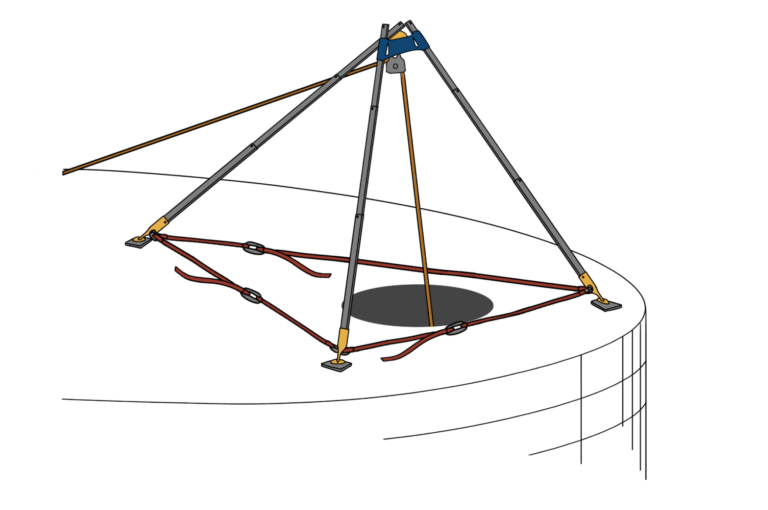
Technical Illustrations provide visual representations of rigging systems, force paths, geometry, and rescue concepts.
In technical rescue, visual clarity matters. A well-built illustration can show the relationship between anchors, directionals, rope paths, load movement, and system geometry in a way that supports faster understanding.
These illustrations are useful for instruction, review, team discussion, and concept development.
Podcasts
Podcasts provide long-form discussions exploring applied rigging concepts, training issues, rescue leadership, and field experience.
Not all learning happens through formal lessons. Some of the most useful insights come through conversation, reflection, and discussion. Podcasts create space for that kind of learning.
They allow users to hear how experienced rescuers think through problems, interpret systems, and connect technical details to real operational concerns.
Reports
Reports are structured analytical outputs derived from rigging systems, rescue scenarios, and technical operations.
This section supports a more formal look at system behavior, training observations, and operational themes. Reports help turn field activity and technical analysis into organized material that can be reviewed, shared, and applied.
For teams and program leaders, reports can support better discussion, better planning, and better training decisions.
Classic Courses
Classic Courses are an in-progress archive of structured courses covering core rigging, rescue, and technical operations knowledge.
This section preserves course-based learning while CORE continues to expand into a broader learning system. It gives members another way to access organized instruction and supports users who prefer a more traditional course structure.
Why This Structure Matters
Rescue professionals do not all learn the same way, and they do not always need the same type of material at the same moment.
A new member may need Foundations.
A field technician may need a video demonstration.
A training officer may need a study guide, illustration, or report.
A team leader may need critical analysis.
An experienced rescuer may need a quick reference before teaching or training.
CORE is built to support all of those needs inside one connected system.
The value is not only in the amount of content. The value is in the organization of the content. Each section gives the user a different way to enter, understand, review, and apply the material.
Summary
CORE brings together structured lessons, video demonstrations, downloadable references, study guides, mindmaps, critical analysis studies, technical illustrations, podcasts, reports, and classic courses into one connected learning environment.
The purpose is not to overwhelm users with more content. The purpose is to make technical rescue knowledge easier to access, easier to connect, and easier to apply.
Whether you are building a foundation, preparing for training, reviewing a system, supporting a team, or developing a rescue program, CORE gives you multiple ways into the material and multiple ways to keep learning.
Peace on your Days
Lance