Rappelling with the CLUTCH Device for Technical Rescue
The CLUTCH, co-engineered by CMC and Harken Industrial, has rapidly become a trusted standard in rope rescue and tactical descent systems. Designed for precise control and operational versatility, the CLUTCH serves as a multi-role mechanical device capable of rappelling, belaying, lowering, and hauling—all in one compact form.
For technical rescue professionals and tactical teams, rappelling with the CLUTCH offers a controlled, reliable alternative to traditional descenders. Its integrated locking mechanism, ergonomic handling, and rope-preserving internals provide a blend of safety and efficiency that’s difficult to match.
What Sets the CLUTCH Apart
Unlike figure 8s or even some modern brake racks, the CLUTCH automatically locks when the handle is released. This feature alone reduces the likelihood of runaway descents and elevates operational safety—especially in high-stakes or fatigue-prone environments.
More than just a descender, the CLUTCH operates as a system component. Its compatibility with static and low-stretch ropes (in 11 mm and 13 mm variants) makes it adaptable to diverse scenarios, from confined space rescue to vertical access in urban environments. Whether you’re lowering a load, rappelling solo, or rigging a two-rope system, the CLUTCH maintains consistent performance.
Rigging the CLUTCH for Rappel
Before starting, all gear must be inspected. The CLUTCH body should be checked for wear, deformation, and debris. Rope must fall within manufacturer specs, and carabiners should be free of gate failure or mechanical issues.
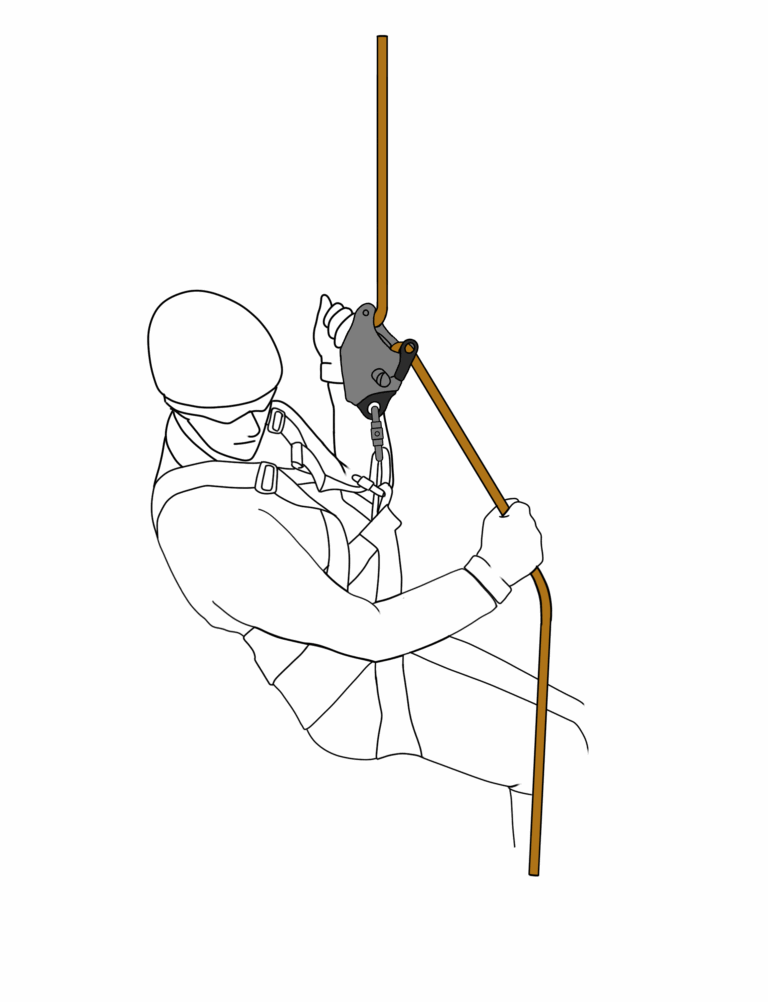
Rigging begins by opening the side plate and routing the rope through the device’s internal track, following the etched diagram. Once closed and locked, the CLUTCH is clipped into the harness via a locking carabiner. The rope path should allow the brake strand to feed freely through the device, with the brake hand always positioned below.
A complete system check follows—confirming that the rope is correctly loaded, the device is locked, and the anchor is secure. Communication between team members should be clear before initiating descent.
Executing a Controlled Rappel
To begin descending, the operator grips the CLUTCH handle and gently applies pressure to modulate speed. The handle’s range of motion allows for finely tuned adjustment, while the auto-lock feature engages when the handle is released—instantly stopping descent.
Throughout the rappel, the brake hand must remain on the rope. This is non-negotiable. While the device’s mechanical lock offers a safety net, proper hand control is still the first line of protection.
As the operator descends, they can use the device to stop mid-rope—whether to clear an edge, navigate an obstacle, or assess the environment. The CLUTCH holds firm under load and releases smoothly when motion resumes.
Approaching the landing zone, speed should taper gradually. Upon contact with the ground or station, the operator locks the device and disconnects only after ensuring system stability.
Best Practices for CLUTCH Rappels
Rappelling with the CLUTCH isn’t just about following setup steps—it’s about disciplined habits. Operators must maintain consistent brake-hand control, never assuming the device will correct every mistake. Familiarity builds confidence, so training in low-risk environments is essential before deployment in live rescue scenarios.
Team communication must be clear, especially in complex systems involving multiple ropes or confined spaces. Regular gear inspection is another must—checking for wear on both the CLUTCH and the rope at key friction points.
Above all, treat the CLUTCH as a technical system, not just a tool. It rewards preparation, punishes assumption, and delivers precision when used correctly.
Common Pitfalls and How to Avoid Them
The most frequent errors stem from complacency: improperly routed ropes, unlocked carabiners, or neglecting a final system check. Others include removing the brake hand mid-rappel or attempting to rush the descent without control.
Each mistake magnifies under pressure. That’s why process and mindset matter. When rappelling with the CLUTCH, deliberate action replaces speed as the goal—because a safe descent is always a successful one.
Conclusion
The CLUTCH isn’t just another descent device—it’s a modern rope technician’s advantage. From its self-locking mechanism to its ability to serve as part of complex hauling or lowering systems, it brings unmatched capability to vertical operations.
When used with the respect and discipline it deserves, the CLUTCH transforms technical descent into a controlled, repeatable process. And in rescue or tactical work, control is everything.
Peace on your Days
Lance