For professional arborists and dedicated tree care enthusiasts, the ability to work safely and efficiently within the tree’s canopy is the very foundation of the craft. It’s a dance between human and nature, a complex ballet of technique, precision, and trust in your equipment. One of the most elegant and effective techniques for navigating a tree’s architecture is the strategic use of natural redirects. This method allows a climber to fluidly change their line of descent and traverse a limb without introducing any additional friction to their climbing hitch, a crucial factor that makes for a smoother and far more controlled experience. This guide will delve into the essential principles of this advanced technique, covering everything from its underlying mechanics to the critical safety measures that must be in place before you ever begin. Let’s jump into – Frictionless Tree Work with Natural Redirects.
The Pursuit of a Frictionless System
When you’re suspended high above the ground, every ounce of friction becomes a significant factor. Traditional redirect methods often involve hardware like carabiners or pulleys, which, while useful, inevitably introduce a degree of drag on your climbing system. This drag can make it harder to adjust your position, complicates your ascent and descent, and, perhaps most importantly, can negatively affect the performance and longevity of your climbing hitch. The constant rubbing and wear can degrade your rope and gear over time, creating a need for more frequent replacements and raising safety concerns.
The true genius of a stationary work system, also commonly referred to as a single rope system, lies in its ability to virtually eliminate this friction. By navigating the rope around the natural curves of the branch, you bypass the need for fixed hardware that would create a constant, grinding resistance. This simple yet profound change in approach unlocks an entirely new realm of possibilities. It allows you to achieve the perfect, precise position for a cut or a trim without the exhausting and often frustrating battle against your own equipment. The rope glides effortlessly, freeing you to focus on the task at hand rather than wrestling with your climbing system.
The benefits of a truly frictionless system are numerous and immediately apparent to anyone who has spent time in the canopy. First and foremost is the enhanced control it provides. With minimal drag, your movements become fluid and intuitive. You can make subtle, precise adjustments with ease, which is absolutely critical when you’re operating heavy tools at height. This level of control translates directly to increased safety and efficiency. A smoothly operating system is also a more reliable one. When you can trust your gear to function flawlessly, your mental energy can remain focused on your work, not on a sticky rope or a hitch that isn’t biting correctly. Lastly, using natural redirects significantly reduces wear on your gear. By avoiding constant friction, you extend the life of your rope and hitch, a considerable long-term saving and a sound investment in your own safety.
The Non-Negotiable Foundation of Safety
The beauty and efficiency of this technique are undeniable, but it’s vital to recognize that it involves a critical moment of vulnerability. To properly execute a natural redirect, you must, for a brief time, disconnect from your primary suspension point. This is a moment of immense trust in your preparation and your backup systems. Before you even consider un-clipping, you must have two fundamental safety components securely in place.
The first is your lanyard. This is your immediate, first line of defense. A lanyard, properly attached to your harness and the tree, provides a continuous connection that will prevent a fall should you accidentally lose your primary attachment. It’s a simple tool that provides an indispensable layer of protection. However, a lanyard alone, while a life-saver, might not be enough to provide the stability and comfort needed to reposition yourself effectively.
This is where the second component comes in: a secondary tie-in point. While the lanyard offers a safety net, the secondary tie-in point gives you perfect positioning and stability. For maximum benefit, this secondary point should be attached to the center of your harness. A well-placed webbing sling is a great way to achieve this. With this secondary point supporting your weight, you can be completely comfortable and perfectly positioned, knowing that even if your primary suspension point were to suddenly release, you would not be going anywhere. The combination of a lanyard and a secondary tie-in point is not a matter of being overly cautious; it’s a non-negotiable step in responsible tree work. It grants you the confidence to perform a complex maneuver without the constant, gnawing fear of a fall.
The Art of the Redirect: A Cohesive Process
Once your safety systems are meticulously in place—both your lanyard and your secondary tie-in point are connected and secure—you are ready to begin the process. The technique of using a natural redirect is not a series of isolated actions but rather a fluid and intentional process.
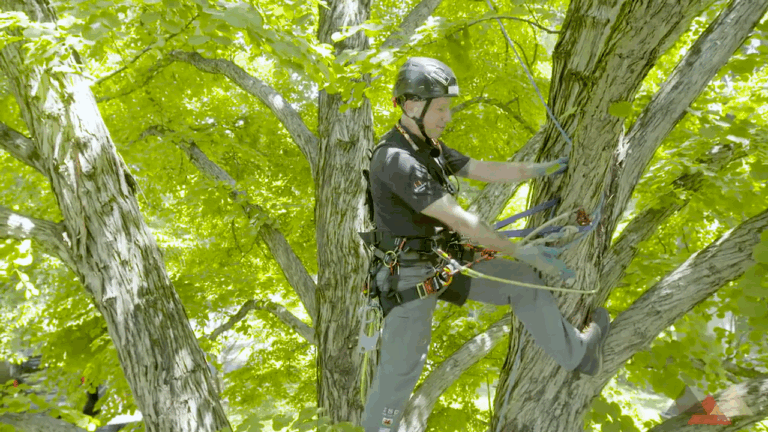
The first step, once you are fully supported by your secondary systems, is to release your primary suspension point. You are now free to take slack from your rope. Carefully and deliberately, you will then run this slack over the limb you wish to travel along. This is the heart of the redirect. You are quite literally creating a new, frictionless path for your rope to follow, using the tree’s own structure as your guide. It’s an organic pulley, a natural anchor that works with your gear, not against it.
With your rope now correctly positioned, you can reconnect your primary line to your harness. At this point, the process enters its most critical phase. Before you even think about disconnecting your backup systems, you must test your new hitch. Gently lower your body, slowly shifting all of your weight onto this new connection. You must feel the full, reassuring pull of your weight being held by this single point. This test is non-negotiable and provides the absolute confirmation that your setup is secure and trustworthy. It is a moment of total commitment to the new configuration.
Only after you have completely tested the hitch and are fully confident that it will hold you securely can you safely disconnect your lanyard and secondary tie-in point. This leaves you fully supported by your new primary system. From here, you can continue your descent, or “drill down,” through the natural redirect, enjoying the smooth, frictionless movement that this technique provides. It’s a seamless transition that demonstrates the pinnacle of climbing efficiency.
Final Thoughts on Mastery and Respect
Mastering this technique goes far beyond simply memorizing a sequence of actions; it’s about developing an intuitive understanding of the tree and your equipment. The core principle is elegant in its simplicity: use the tree itself as your most powerful tool. The natural curvature and strength of a healthy limb can serve as a perfect, low-friction anchor point, a silent partner in your work. This method is especially valuable for long lateral traverses across a branch or when you need to move from one section of the tree to another. Rather than performing a complete descent and re-climbing, you can simply adjust your position along the branch, saving precious time and conserving your energy.
As with any form of advanced climbing, it is paramount to recognize that this technique should only be performed with the proper training and a profound respect for both the tree and the inherent risks of working at height. Always meticulously inspect any limb you intend to use as a redirect point. Look for any signs of decay, insect damage, or structural weakness. Your trust is placed in the tree, so it must be a trust earned through careful observation.
By integrating the use of natural redirects into your skillset, you are not merely learning a new trick; you are embracing a fundamental principle of efficient and safe tree climbing. You will find yourself working smarter, not harder, and you’ll do so with the quiet confidence that comes from a system that works in complete harmony with your environment.
Peace on your Days
Lance