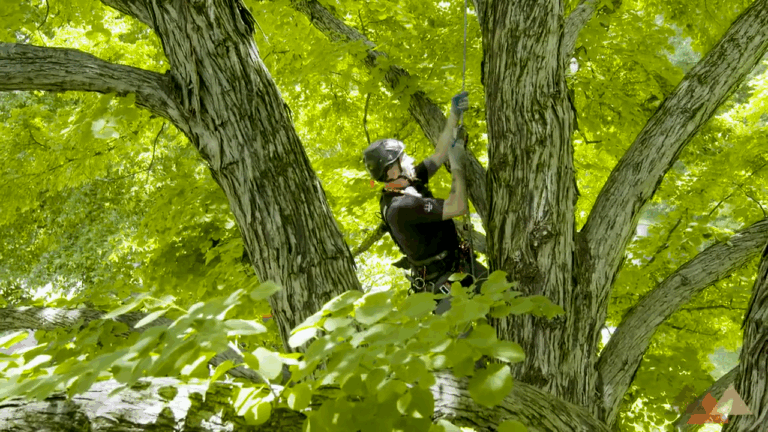
Learn how to build Efficient Walking System for Ascent in the Trees using a handled ascender, foot loop, and rope wrench — with the unique advantage of quick descent.
Ascending a single rope efficiently is one of the most important skills in modern rope work, whether you are an arborist, rope access technician, or rescuer. Energy spent fighting your system is energy you cannot put into the job at hand — whether that’s canopy work, industrial maintenance, or patient evacuation.
Among the many ascent techniques available, the walking system stands out as one of the most body-efficient. These systems are designed to use the legs as the primary source of power, minimizing arm fatigue and spreading the workload evenly. While many rope-walking systems can be complex and gear-heavy, there is a streamlined version using a handled ascender, a rope wrench, and simple foot attachments.
This blog explores the mechanics of this efficient walking system, how to set it up, its advantages, and why it may be the best option for climbers who want both efficiency and flexibility in their ascent method.
What Is a Rope Walking System?
A rope-walking system is an ascent technique where the climber effectively “walks” up a single rope using alternating steps, much like climbing a set of invisible stairs.
Core Principles
-
Leg Power First: Legs are stronger than arms and can handle repetitive upward motion without fatigue.
-
Auto Advancement: Each step advances the system automatically, without manual hitch adjustment.
-
Balance and Rhythm: Efficient systems create smooth, repeatable motion that feels natural over long climbs.
Walking systems are popular in arboriculture and caving, where climbers must ascend long vertical lines while conserving energy. They are also increasingly adopted in rescue and rope access work.
Equipment Needed for the Walking System
-
Handled Ascender with Hook
-
Installed above the rope wrench.
-
Hook at the base connects into the tether eye to create upward drag.
-
-
Rope Wrench and Hitch System
-
Provides friction control and descent capability.
-
Remains engaged during ascent as a backup.
-
-
Foot Loop (Left Foot)
-
Connected to the handled ascender.
-
Acts as the anchor point for the left leg.
-
-
Foot Ascender (Right Foot)
-
Installed on the rope for the right foot.
-
Provides stable, alternating step motion.
-
With these components, the climber creates a simple, balanced walking motion — right foot on the rope ascender, left foot in the loop, with the handled ascender dragging the system upward.
Step-by-Step Setup
Step 1: Install the Handled Ascender
-
Place the handled ascender above the rope wrench on the line.
-
Ensure the cam is properly engaged on the rope.
-
Clip the small hook from the base of the ascender into the tether eye.
-
This connection provides drag, pulling the hitch upward as the system advances.
Step 2: Add the Foot Loop
-
Clip a webbing foot loop into the top of the handled ascender.
-
Place your left foot into the loop — this will serve as the primary driving leg for ascent.
Step 3: Install the Foot Ascender
-
Attach a foot ascender to your right foot and place it on the rope.
-
This creates the second leg of your walking motion.
Step 4: Position Yourself
-
Sit back into the system to engage both ascenders.
-
Place hands lightly above the system for balance.
Step 5: Begin the Ascent
-
Alternate steps:
-
Left foot pushes through the loop on the handled ascender.
-
Right foot advances on the rope ascender.
-
-
The rope wrench remains engaged, keeping your hitch ready as backup.
-
The hook and tether connection advance the hitch automatically with each step.
Why This System Works
Leg Efficiency
-
Both legs are engaged, creating a stair-like walking rhythm.
-
Hands are free for balance rather than labor-intensive rope management.
Auto Hitch Advancement
-
The hook and tether connection drag the hitch upward with each step.
-
Eliminates the need for manual hitch movement.
Upright Posture
-
Climbers remain upright in a natural body position.
-
Reduces lower back strain common in sit-stand ascents.
The Big Advantage: Quick Descent
Most rope-walking systems are extremely efficient but suffer from a major drawback: they are not designed for rapid transition to descent. Removing foot attachments, disengaging knee ascenders, and resetting mechanical devices can take precious time.
This system, however, has a built-in advantage:
-
At any point, the climber can stop, reengage the rope wrench, slide the hook off the tether eye, and disconnect the foot loop.
-
With a few quick moves, the climber is back in descent mode on the rope wrench.
This flexibility is critical in environments where quick retreat may be necessary — such as encountering bees, unstable branches, or sudden hazards.
Comparison with Other Walking Systems
| Feature | Standard Walking Systems | Handled Ascender Walking System |
|---|---|---|
| Gear Requirements | Knee ascenders, extra tethers, pulleys | Handled ascender, hook, foot loop |
| Efficiency | Very high, leg-only | Moderate-high, requires some hand balance |
| Setup Time | Longer | Faster |
| Descent Transition | Slow, requires removing gear | Very fast, slide off and descend |
| Best Use | Long clean ascents | Technical climbs, mixed needs |
While cave-style walking systems may achieve higher efficiency, this method provides a balance of efficiency and flexibility that is hard to beat in real-world environments.
Field Applications
Arboriculture
-
Ascending past limbs and obstacles where rapid reconfiguration is needed.
-
Switching from ascent to descent when tree conditions change.
Rope Rescue
-
Quick patient access where rapid descent may be required.
-
Environments with unknown hazards that demand flexibility.
Rope Access
-
Work-at-height where frequent repositioning is necessary.
-
Industrial climbs where balance of efficiency and safety matters more than absolute speed.
Safety Considerations
-
Always test the hitch before disengaging backup points.
-
Keep a lanyard attached during adjustments.
-
Inspect handled ascenders for wear — hooks and cams must remain reliable.
-
Maintain smooth rhythm to avoid shock loading either foot ascender.
Training Tips
-
Practice alternating steps until the walking rhythm feels natural.
-
Train both efficient ascent and quick transition into descent.
-
Drill with obstacles to refine efficiency when rope path is not perfectly vertical.
Conclusion
The efficient walking system using a handled ascender and rope wrench offers climbers and rescuers a powerful balance of efficiency and flexibility. While it may not be as purely efficient as complex cave-style rope walkers, it has one major advantage: the ability to transition instantly from ascent to descent.
For arborists, rope access professionals, and rescuers, this adaptability can make the difference between a smooth climb and a hazardous situation. With minimal gear and easy setup, this walking system is an excellent addition to your climbing toolkit.
Next Step: Train the method until transitions are second nature. Efficiency is valuable — but the ability to change course quickly is what makes this system indispensable in the field.
Peace on your Days
Lance